Apple and Pear crisp, great way to use up a glut of fruit

7 Feb

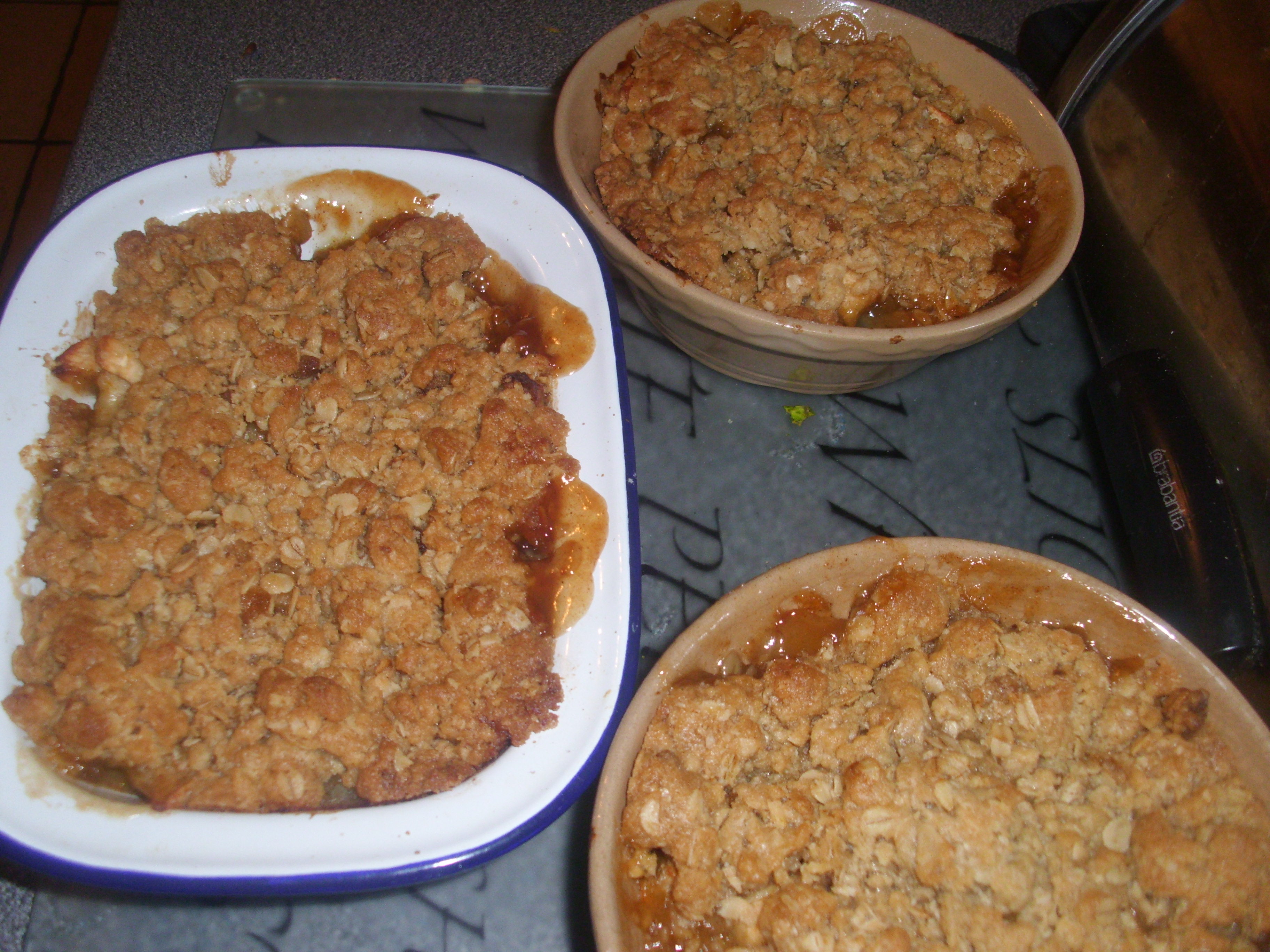
DSCI0484I recently found a bag of eating apples on my doorstep from my good friend Erica.  She admitted that they had a few blemishes and to be careful in case there were any beasties inside.  I was a bit wary, so I decided to make them into a recipe that I could freeze and use another day.  I just happened to have the last eight pears in my fridge that I picked off our tree and stored until needed.  The skin was starting to wrinkle so I decided to combine the two fruits and make an apple and pear pudding.  The term ‘Crisp’ is, I think, a variation on the English ‘crumble’ except that it is much denser and turns into a lovely crisp topping when baked.  I was really pleased with the outcome and I will definitely be making this again whenever I get a glut of fruit. I am sure it would be lovely using other fruits as well, maybe blackberry and apple, plums, apple and rhubarb, peaches, berries…… Oh my, the list could go on and on.

Here is the recipe.

Apple and pear crisp                        Makes 1 large for 6 – 8 people or 3 smaller for 2 people

For the topping

  • 1 cup / 4 ounces plain flour
  • 1 cup / 8 ounces light brown sugar
  • 1 cup / 4 ounces oats
  • 6 ounces butter

For the base

  • 1/4 tsp grated nutmeg
  • 1 tsp ground cinnamon
  • 6 oz granulated sugar
  • 3 tbsp plain flour
  • 2 tbsp juice from an orange + 1 tsp zest
  • 2 tbsp fresh lemon juice + 1 tsp lemon zest
  • 1.5 pounds of apples, peeled, cored and cut into 1 inch pieces
  • 2 pounds pears, peeled, cored and cut into 1 inch pieces
  1. Preheat the oven to 190C / 170C fan / gas 5.
  2. Combine the flour, sugar and oats in a food processor. Add the butter, cut into small chunks, and process until like large breadcrumbs. Alternatively rub the butter in by hand as if making pastry.
  3. Place the fruit into a large bowl and add the orange and lemon juices. Mix to coat the fruit.
  4. Add the remaining ingredients and mix well.  Transfer to either one large shallow, ovenproof dish or smaller ones of your choice.
  5. cover with the topping, it doesn’t matter if there are little gaps.
  6. Bake for 40 to 45 minutes or until the topping is brown and the fruit is bubbling.
  7. Serve warm or cold.  if you want to freeze, cool completely, cover with cling film and foil and freeze. Defrost before serving cold or warming through in the oven.


This slideshow requires JavaScript.


Courgette and lemon pasta

30 Jan

DSCI0405My husband is not very keen on vegetarian meals so when I said I was making this to use up some courgettes my friend Erica had given me his face looked like he had sucked a lemon.  In spite of this he tucked in with relish, cleared his plate completely and grudgingly declared ‘it wasn’t bad’. I thought it was absolutely lovely. It was light and refreshing and the pine nuts gave it a lovely nutty flavour and added crunch. I will definitely be making this again no matter how much he protests and begs for meat!

Pine nuts are very good for you. Here are a few nutritional facts.

  • They are rich in mono-unsaturated fatty acids like oleic acid (18:1 undifferentiated fat) that helps to lower LDL or “bad cholesterol” and increases HDL or “good-cholesterol” in the blood. Research studies suggest that Mediterranean diet, which contain good amounts of monounsaturated fatty acids, vitamins and antioxidants, helps to prevent coronary artery disease and strokes by favoring healthy blood lipid profile.
  • Pine or cedar nuts contain essential fatty acid (ω-6 fat), pinolenic acid. Recent research has shown its potential use in weight loss by curbing the appetite.
  • They are an excellent source of vitamin E; contain about 9.33 mg per 100 g (about 62% of RDA). Vitamin E is a powerful lipid soluble antioxidant, required for maintaining the integrity of cell membrane of mucus membranes and skin by protecting it from harmful oxygen-free radicals.
  • Furthermore, pines are one of gluten-free tree nuts, and therefore, are a popular ingredient in the preparation of gluten-free food formulas. Such formula preparations can be a healthy alternative in people with wheat food allergy, and celiac disease.
  • They are an excellent source of B-complex group of vitamins.
  • Finally, pine nuts contain healthy amounts of essential minerals like manganese, potassium, calcium, iron, magnesium, zinc and selenium.  Consumption of pines helps the body develop resistance against infectious agents and scavenge harmful oxygen-free radicals.

I couldn’t find this recipe on the Woman and Home website so I have written it out below.

Courgette and lemon pasta                 Serves 4

  • 225g /8oz spaghetti
  • 450g / 1lb courgettes, grated
  • 50g /2 oz pine nuts, toasted
  • 2 lemons
  • 4 tbsp extra virgin olive oil
  • black pepper
  1. Cook the spaghetti as per packet instructions.
  2. Zest both the lemons and juice just one of them.
  3. Drain the pasta when cooked and return to the pan.  Add the olive oil, lemon juice and zest, courgettes and pine nuts.
  4. Toss together and serve immediately.

This slideshow requires JavaScript.

Prawn salad, nicoise style – delicious!

26 Jan

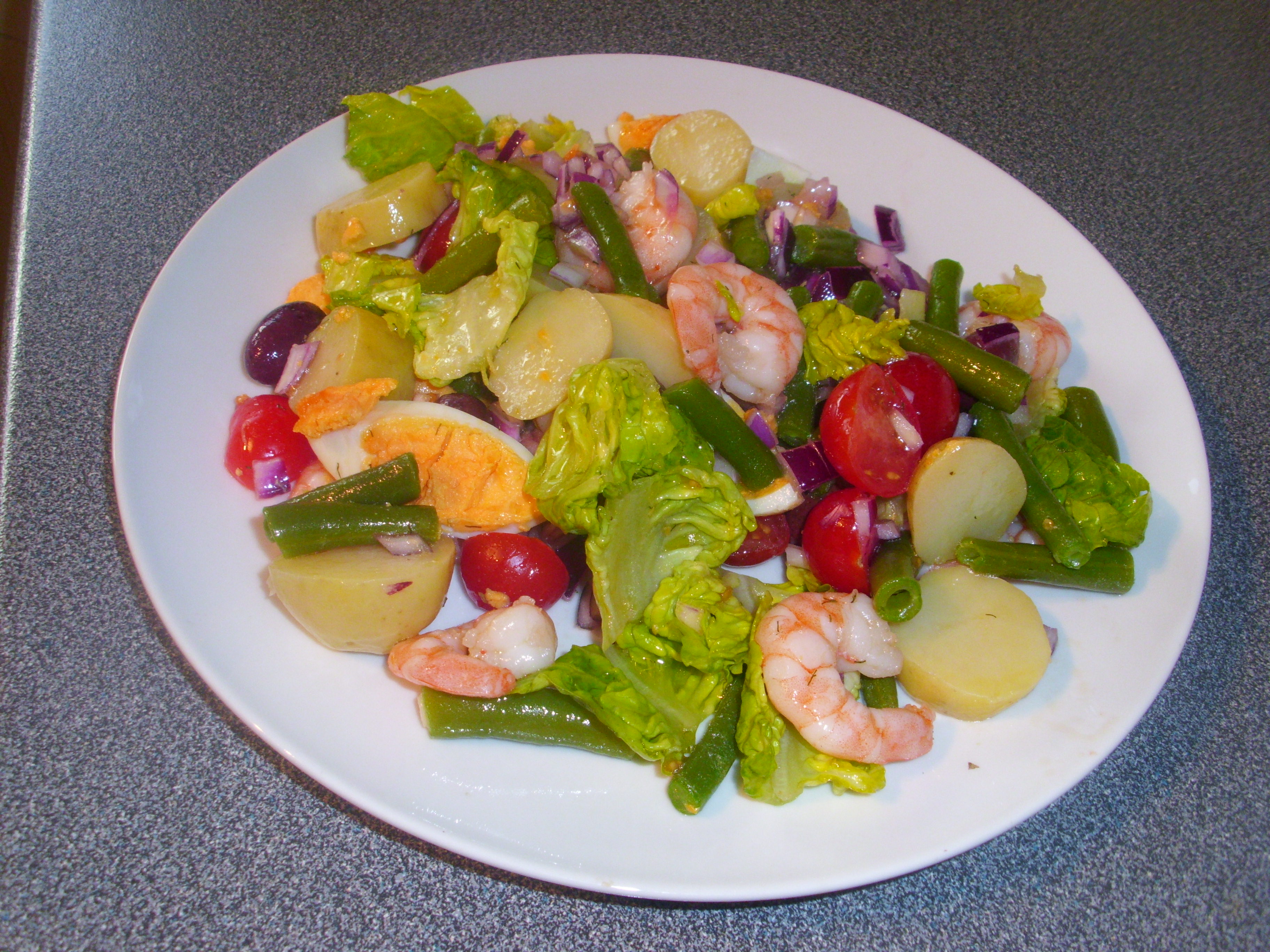
  It is so difficult to eat salads in winter even though I love them.  Not only are they healthy but they help me to lose weight, providing the dressing isn’t too high in calories.  The challenge for me is to find interesting salads that taste good even when it is wet and cold outside.   The other night I found myself in a position where my husband wanted curry and I wanted salad.  It was easy to divide the prawns for two separate dishes and I just happened to have a few cooked Jersey Royal potatoes left over and a handful of Dwarf beans in the fridge that I hadn’t used.  The latter two are essential components of a Salad Nicoise, one of my favourites, so it is no wonder I decided to do a variation on this theme.  The outcome was absolutely delicious and I will definitely be making this again!

Nicoise is the French word for “in the style of Nice.” So any dish that is labeled Nicoise would be in the cooking style of Nice in Provence, France. Usually these are recipes that have ripe olives, tomatoes and anchovies. The predominant flavoring is often garlic.

The prototypical dish is Salad Nicoise and includes olives, tomatoes, anchovies and vinaigrette, along with fava beans, tuna and hard-boiled eggs. (Even though potatoes are found in recipes outside of France, this is not typical of Nice.)

Compared to many, this is a relatively low-calorie recipe for this style of salad.  I hope you give it a try.

Prawn Salad Nicoise                                        Serves 2

  • 125g raw king prawns
  • 1 egg (free-range and organic if possible)
  • 1 little gem lettuce
  • 8 cherry tomatoes, halved
  • 8 Kalamata black olives
  • 1/2 red onion, finely chopped
  • 6-8 New Potatoes, peeled, cooked and sliced
  • 100g Dwarf beans, topped and tailed and cut into 1 inch pieces
  • Juice 1/2 lemon
  • 3 tbsp Olive oil
  • 1 tbsp chopped dill
  1. Bring a small pan of water to the boil and add the egg and prawns.  Boil for 4 minutes then remove the prawns with a slotted spoon and dry on kitchen paper.  Continue to cook the egg for a further 4 minutes, remove and run under cold water.  Peel off the shell and quarter.
  2. Using the same pan but with fresh boiling water, add the beans and blanche for 4 minutes until they are just tender.  Drain and reserve.
  3. Separate the leaves of the lettuce and tear into pieces.  Put into a large bowl.  Add the tomatoes, olives, onions, potatoes, cooled beans, prawns and egg.
  4. Mix together the lemon juice, olive oil and dill in a small bowl.  When combined pour over the salad and gently toss to coat all ingredients.  Season if you like (I didn’t think it was necessary).  Serve immediately.

    This slideshow requires JavaScript.

Spiced pork and potato pie

29 Dec

DSCI0433This spiced pork pie is delicious hot and cold.  I served it hot with gravy and vegetables when I first made it then had the leftover pie cold the next day with salad.  I once made one for my Grandson when he came home from school and he polished off the lot before he went home.  You can even make the pie in advance and freeze it, uncooked, to bake another day.

The spice mix includes Allspice. Here is a little bit of information about it.

  • Allspice is the dried fruit of the P. dioica plant. The fruit are picked when green and unripe and are traditionally dried in the sun. When dry, they are brown and resemble large brown peppercorns. The whole fruits have a longer shelf life than the powdered product and produce a more aromatic product when freshly ground before use.
  • Fresh leaves are used where available. They are similar in texture to bay leaves and are thus infused during cooking and then removed before serving. Unlike bay leaves, they lose much of their flavour when dried and stored, so do not figure in commerce. The leaves and wood are often used for smoking meats where allspice is a local crop. Allspice can also be found in essential oil form.
  • Allspice is one of the most important ingredients of Caribbean cuisine. It is used in Caribbean jerk seasoning (the wood is used to smoke jerk in Jamaica, although the spice is a good substitute) and in pickling; it is also an ingredient in commercial sausage preparations and curry powders.
  • Allspice is also indispensable in Middle Eastern cuisine, particularly in the Levant, where it is used to flavour a variety of stews and meat dishes. In Palestinian cuisine, for example, many main dishes call for allspice as the sole spice added for flavouring.
  •  Allspice is commonly used in Great Britain, and appears in many dishes, including cakes.
  • Even in many countries where allspice is not very popular in the household, as in Germany, it is used in large amounts by commercial sausage makers.

Here is the recipe.

Spiced Pork and Potato pie                                                 Serves 6

  • 1 md potato, cut into small chunks
  • 1 tsp sunflower oil
  • 500g lean minced pork
  • 1 onion, finely chopped
  • 1 clove garlic, finely chopped
  • 1/2 tsp each of ground cinnamon, allspice and nutmeg
  • 100 ml / 3.5 fl oz vegetable or chicken stock
  • 400g / 14 oz ready-made shortcrust pastry
  • 1 egg beaten to glaze.
  1. Heat oven to 200C/180C fan/gas 6.
  2. Boil the potatoes in salted water until tender then drain.
  3. Heat oil in a large frying pan and fry the mince and onion together over a high heat until browned.  Add the garlic, spices, stock, plenty of pepper and a little salt.  Mix well and remove from the heat.
  4. Add the potatoes, mash down and combine with the meat mix.  Leave to cool.
  5. Roll out half the pastry and line a pie dish with it.  Pile the pork mix on top and even out.  Brush edges of pastry base then cover with a pastry lid made from the remaining pastry. Press the edges together and crimp to seal.  Cut a cross in the centre to let the steam escape the brush the top with the beaten egg.
  6. Bake in the oven for 30 minutes and serve hot or cold.


This slideshow requires JavaScript.


Chicken in wine – quick, incredibly easy and sooooo tasty!

17 Dec

I love this dish.  You just throw everything into a shallow dish and pop it in the oven.  How easy is that!  The flavours are incredible and it went immediately into my Husband’s Top Twenty!  We had it for a quick evening meal one day and I served it to friends for a Sunday lunch after being out all morning.  Perfect!

You hear so much about illness linked to raw chicken etc.  I thought I would see what I could find out and hopefully provide some useful tips.

  • Packages of chicken should feel cold to the touch, and should be among the last items you select before checking out.
  • Packages of chicken should be wrapped in plastic bags to prevent leakage onto other items in your grocery cart.
  • Once you’re home, you should immediately place your chicken in a refrigerator that maintains a temperature of 4C or 40F or colder, and use it within 2 days. Otherwise, it should be frozen at -18C/0°F.
  • The correct way to thaw frozen poultry requires planning ahead for the time required to thaw it in the refrigerator. Whole chickens may take up to 2 days to fully thaw in this way, while boneless breasts should thaw overnight.
  • Once the product thaws, it should be kept in the refrigerator no more than a day before cooking it.
  • The only way to kill food-borne pathogens is by thoroughly cooking the food.  Always cook chicken well and never serve it ‘pink’.

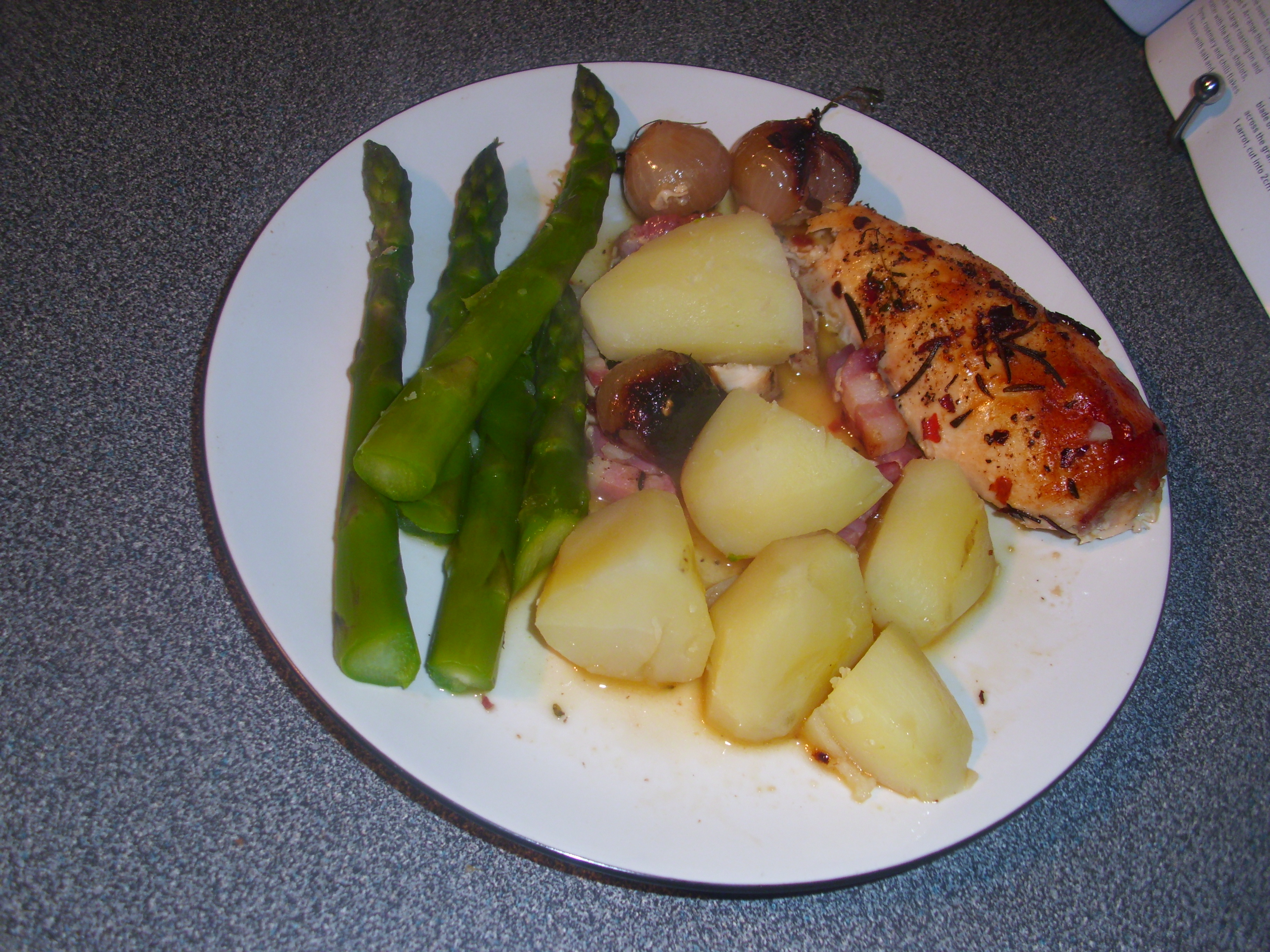
Here is the recipe.  I served it with New Potatoes and asparagus.

Chicken in wine                           Serves 4 (easily halved)

  • 4 chicken breasts, boned and skinned
  • 150g bacon lardons
  • 12 shallots, peeled
  • 1 tsp chilli flakes (optional, leave out if you don’t like the heat, although it is relatively mild)
  • 3 sprigs fresh thyme
  • 1 sprig rosemary
  • salt and pepper
  • olive oil
  • 250 ml dry white wine
  1. Preheat oven to 240C/220C fan/gas 9.
  2. Arrange chicken breasts in a shallow baking dish.  Scatter with the bacon lardons, shallots, thyme, rosemary and chilli flakes.  Season and drizzle with olive oil then bake in the oven for 20 minutes.
  3. Remove from oven and pour wine into dish.  Return to oven and continue cooking for another 20 minutes or until the chicken is cooked through and golden brown.

    This slideshow requires JavaScript.

Ginger shortbread – delicious

13 Dec

DSCI0437I have never made shortbread before and was a bit concerned by dough was not soft enough. I need not have worried. It was absolutely delicious. So delicious in fact that my husband would not leave it alone and ate five of the eight slices! A few days later he was telling someone he didn’t like cake. Mmmm! Selective memory I think.  Here are a few interesting facts about ginger.

  • Ginger was used in ancient times as a food preservative and to help treat digestive problems. To do this the Greeks would eat ginger wrapped in bread. Eventually ginger was added to the bread dough creating that wonderful treat many around the globe love today: gingerbread!
  • Ginger ale eventually stemmed from a ginger beer made by the English and Colonial America as a remedy for diarrhea, nausea and vomiting.
  • Ginger thrives in the tropics and warmer regions and is therefore currently grown in parts of West Africa, the West Indies, India and China with the best quality ginger coming from Jamaica where it is most abundant.
  • Root ginger is characterized by it’s strong sweet, yet woodsy smell. It is tan in color with white to creamy-yellow flesh that can be coarse yet stringy.
  • Ginger is available year-round. When selecting root ginger, choose robust firm roots with a spicy fragrance and smooth skin. It should not be cracked or withered. It can be stored tightly wrapped in a paper towel or plastic wrap (or put into a plastic bag) in the refrigerator for 2–3 weeks.
  • Ginger is popular in Asian cuisine where it is used both fresh and dried. Ginger can also be found crystallized, candied, preserved and pickled.  The powdered, dried form of ginger has a more spicy, intense flavor and is often used in baking (gingerbread, gingersnaps, ginger cookies).
  • After ginger was first introduced in Europe (approximately 800 AD) it ranked second to pepper as a spice for centuries.
  • Chinese cooks use ginger with beef successfully, whereas European chefs prefer to use it as an exotic flavouring for fresh fruit salads, or to give cream of carrot soup and extra kick.

The recipe was in a Good Food magazine and had been sent in by Jo Foster, a reader from Leigh-on-Sea.  The recipe wasn’t on their website when I looked so I have written it out below.

Ginger shortbread                                   Serves 8 – 12

  • 175g / 6 oz plain flour
  • 8 pieces crystallised ginger, finely chopped
  • Zest of 1 large lemon
  • 50g / 2oz caster sugar
  • 100g / 4 oz salted butter, softened
  1. Heat oven to 150C/130C fan/gas 2 and grease a 10 inch loose-bottomed fluted flan tin.
  2. Beat the butter until soft then beat in the sugar. Add the lemon zest and ginger and mix well.
  3. Stir in the flour and, using your hands, work it into a soft dough.  Tip it into the tin and press into an even flat layer with your fingers. Prick the surface with a fork then bake in the oven for 40 minutes until pale gold.
  4. Cut into wedges and cool completely in the tin.
  5. Remove from the tin and dust with a little caster sugar to serve.

This slideshow requires JavaScript.

Asian Fish Soup

5 Dec

DSCI0445I have become a lover of fish soup over the past year.  Before this I didn’t like the sound of it which just proves that we should try food out before we discount it as I have had some amazing fish soups since.  Most of the ones I have tried use tomato as a base but this one is completely different. It uses fish stock as the base but explodes with flavours from the ginger, garlic and chilli. Absolutely amazing and incredibly low in calories too.  The soup contains lemongrass which gives it a lovely lemony backdrop to the flavours. Here are a few interesting facts on Lemongrass.

  • Lemongrass is a tall perennial grass with a sweet tropical citrus aroma. The older the plant, the more fibrous and less flavorful.
  • Lemongrass has numerous health benefits. The primary chemical component in lemongrass is citral or lemonal, an aldehyde responsible for its unique lemon odor. Citral also has strong anti-microbial and anti-fungal properties.
  • In addition, its herb parts contain other compounds that are known to have insecticidal, anti-fungal and anti-septic properties.
  • The herb is very low in calories; contains 99 calories per 100 g but contains no cholesterol and are rich in folic acid.
  • Lemongrass is also rich in many essential vitamins such as vitamin B-5, vitamin B-6 and thiamin. It also contains vitamin-C and vitamin-A.
  • Lemongrass is also a rich source of minerals like potassium, zinc, calcium, iron, manganese, copper, and magnesium.

(http://sbsteas.wordpress.com/2011/09/09/fun-fact-friday-lemongrass/)

I found the recipe in a Woman & Home ‘Feel Good Food’ magazine but it is not on their website so I have copied it out below.

Asian Fish Soup                                       Serves 4

  • 1.5 pts (850ml) fish stock using 1.5 fish stock cubes
  • 3cm piece of root ginger, thinly sliced
  • 2 lemongrass stalks, bruised
  • 4 tbsp fish sauce
  • 1 birds eye red chilli, thinly sliced
  • 1 garlic clove, peeled and thinly sliced
  • 100g/4 oz rice vermicelli noodles
  • 200g / 7oz raw tiger prawns
  • 200g / 7oz cod loin, cut into small chunks
  • 200g / 7 oz mussel meat
  • small handful of coriander leaves
  • juice 2 limes
  1. Heat the stock in a pan and add the ginger, fish sauce, garlic and chillies. Bring to the boil then simmer for 5 minutes.
  2. Soak the noodles for 3 minutes or as per packet instructions.  Drain and set aside.
  3. Add the fish and shellfish to the stock and cook for 5 minutes. Remove the lemongrass stalks and add the noodles, herbs, and lime juice. Serve immediately.


This slideshow requires JavaScript.

Spring lamb and vegetables – one pot meal just as I like them!

1 Dec

Here is another one pot meal, great for when you are busy, just leave it in the oven to take care of itself!  I love lamb, especially when it is falling off the bones and is meltingly tender.  My husband, however, hates fat so I have to be really careful when I choose the cut of meat.  As this is cooked slowly in the oven I needed a tougher cut of meat so I finally chose lamb shanks.  I can remember when you could buy a lamb shank for about a pound.  That was before the TV Cooks made it popular.  Now they sell for about £4 each!

I thought it would be interesting to take a look at the various cuts of lamb and how they should be cooked.

Lamb Primal Cuts: Leg, Loin, Rib, Breast and More

  • For roasts, the best cuts include leg, breast, best end of neck (also known as rack of lamb), shoulder, saddle, rump and loin.  
  • For quick cooking, choose fillet, chump chops, loin chops, leg steaks, best end cutlets and butterflied leg.
  • For slow cooking, leg, shoulder, shank, neck and chump chops are among the best options.
  • Lamb is also available minced (good for pies and burgers) and you can also buy lamb offal (mainly the kidneys and liver but also, less commonly, the heart and the sweetbreads), which is quick to cook, cheap and nutritious.
  • When choosing any cut of lamb, look for firm, fine-grained meat with a velvety texture; it should be moist, rather than dry or slimy. Any fat on the outside of the lamb should be white (fat that is yellow might well be rancid). Properly hung lamb should have a deep red, rather than bright red colour, although very young lamb will be paler than older lamb.

Here is the recipe.  It is based on one I found in a Good Food Magazine that I have adapted to suit our tastes.  Here is a link to their website if you want to see the original recipe.

http://www.bbcgoodfood.com/

Spring lamb and vegetable one-pot                                     Serves 2

  • Olive oil
  • 2 lamb shanks
  • 1 onion, chopped
  • 2 cloves garlic, crushed
  • 4 medium carrots, peeled and halved
  • 200g new potatoes, peeled and left whole
  • 1 bay leaf
  • sprig thyme
  • 75g frozen peas
  • handful Dwarf Beans, topped and tailed and cut into 1 inch pieces
  • 1 lamb stock cube
  • Salt and black pepper
  1. Preheat the oven to 180C/160C fan/gas 3.
  2. Dry the lamb shanks on kitchen paper.  Season with salt and pepper.  Drizzle a little olive oil into a skillet or heat proof shallow casserole.  Brown the shanks on all sides over a high heat. 
  3. Reduce the heat to medium and add the onion, garlic and carrots and cook for a few minutes.  Add the carrots and cook for a few minutes more. 
  4. Pour in sufficient water to come half way up the shanks.  Crumble in the stock cube.  Add the herbs and the potatoes and bring to the boil.  Cover and transfer to the oven for 1.5 hours or until the lamb is tender and the vegetables are cooked.  Remove from oven.
  5. Blanch the beans in boiling water for 4 minutes.  Drain and add to the lamb and vegetables with the peas.  Return to the oven for 10 minutes or until everything has heated through.  Serve.

    This slideshow requires JavaScript.

Chicken traybake – delicious meal in one pan

27 Nov

DSCI0438I love one pot meals, although a green salad would go nicely with this wonderful chicken dish.  It is incredibly easy to make, in fact, the first time I made it I was in a hurry as I was late back from an appointment and had a friend coming over in just over an hour but it was prepared and in the oven cooking well before she arrived.

I made mine in an oven-proof glass dish. I find the ingredients have less of a tendency to burn and you can put the dish on the table from the oven so everyone can help themselves.

Inspired by the classic Italian pasta sauce, chicken thighs and new potatoes are flavoured with bacon and tomato in this easy one-pan meal

Here is the recipe.  I found it in a Good Food magazine. Here is the link to it on their website.

http://www.bbcgoodfood.com/recipes/amatriciana-chicken-traybake

This slideshow requires JavaScript.

Lamb and Plum curry – fit for a queen!

23 Nov

My husband says this is his favourite curry.  I reminded him of how many times I had heard him say this but he stuck to his guns.  Just to prove a point, however, there are a couple of links below to previous curries he has said this about! 

When I first saw the recipe for this curry I was intrigued.  I had never heard of a similar curry before and have yet to see anything like it in an Indian Restaurant.  It is a dish from Hyderabadi and is, apparently, a speciality of the Veeraswamy restaurant in London, the owner of which had a grandmother who was a Hyderabadi princess. Veeraswamy is the oldest surviving Indian restaurant in the U.K, and possibly the world. Established in 1926, it is one of London’s oldest surviving restaurants and a global restaurant institution.   I found this recipe in a little book called ’50 great curries of India’ by Camellia Panjabi.  It is one of the best curry books I have ever had and I am slowly, but surely working through the recipes.  So far there is only one that I was disappointed in but that was vegetarian so no great loss to us confirmed carnivores!  I have copied the recipe exactly from the book as I can’t think of anyway I would want to change it.  Be careful with the chillies though.  Check out how hot your fresh chillies are and maybe use just 1 teaspoon of chilli powder, unless you like your curries really hot.

Lamb and Plum Curry                                                         Serves 4

  • 4 tablespoons oil
  • 2 medium onions, chopped
  • 4 cloves garlic, chopped
  • 1 x 1/2 inch piece of fresh ginger, peeled and chopped
  • 3 cloves
  • 4 green cardamoms
  • 1-inch cinnamon stick
  • 3 green chilies, finely chopped
  • 1/4 teaspoon turmeric powder
  • 1 1/2 teaspoons coriander powder
  • 2 teaspoons red chili powder
  • 1 1/2 pounds boneless stewing lamb
  • 1 teaspoon salt
  • 1 1/2 cups plums with skin (half finely chopped and half cut into wedges)
  • 3 tablespoons cilantro leaves, chopped
  • 8 fl. oz. stock of lamb bones if possible (use plain water if not)
  1. In a deep skillet, heat the oil and fry the onions until they are golden and starting to brown at the edges (this should take about 10-15 minutes).  Add the garlic, ginger, cloves, cardamoms, cinnamon, and green chilies.  After 1 minute, add the turmeric, coriander, and chili powders.  Stir well.
  2. Add the lamb and salt and stir fry in the spice mixture for 5 minutes.  Then cover and cook the lamb in its own moisture with the onions on a medium heat for about 10 minutes.  When the lamb is semi-dry, stir continuously until it is coated with the spices and the mixture is golden brown.
  3. Now add the finely chopped plums and cook with the lamb, stirring a few times.  Add 2 tablespoons of the chopped cilantro leaves and the lamb stock or plain water, bring to a boil and simmer over a low heat for 30 minutes.  Now add the plum wedges and cook until the lamb is done.  Put in a serving dish and sprinkle with the remaining tablespoon of fresh leaves.

    This slideshow requires JavaScript.