Peggy’s banana bread – lovely!

12 Mar

image

During our stay in Lardos, Rhodes, we ate at BoJangles a number of times.  The food was always great as was the service and the company.  On a couple of occasions Peggy, the owner, gave us a piece of her banana bread to take home with us.  In fact, on the last occasion it was a huge slab.  Both lots of bread tasted delicious but you could tell there was a difference between them.  Peggy explained that the bread is very forgiving and that you could throw anything in, it would still work.  In the first loaf of bread she had included some fresh figs that Paniotti had given her.  You could really taste the figs in the bread, they gave it a subtle sweet and aromatic flavour.  The second loaf was more traditional with the addition of dried fruit and walnuts.  We ate both with lashings of butter and had them for breakfast and as a snack with coffee.  Wonderful!

I always seem to be left with a few bananas in my fruit bowl that look as though they have seen better days.  I don’t know if others have noticed, but I am sure bananas only last half the time they used to do years ago.  I think it is because supermarkets store them in the cold and then they start to deteriorate as soon as they are taken out and put on the shelves.  Some people like bananas very ripe but I am not one of them.  I do hate waste though so I often  fish out Peggy’s recipe use them up in this bread.  Mindful of the fact that anything goes I always adapt the recipe to what I have in the cupboard but the basic cake mixture ingredients I keep the same as Peggy’s.  The loaf always turns out perfectly and, although it doesn’t usually taste the same as the ones Peggy gave us, it is always delicious. I sometimes intend to take some over to my children when I next visit but it disappears so fast There is never any left. Sorry kids!

Before I give you the recipe I though I would see if there is anything interesting to know about bananas.

The first interesting fact I found was that the banana plant is herbaceous and it is actually the largest herbaceous flowering plant.  It grows to 20+ feet so there is no wonder that people commonly mistake these as trees.  I also didn’t know that the fruit of the banana plant can be one of three colours when ripe, the common yellow, red or purple.  I’m not sure I fancy a purple banana!

They have been around for a long time and there is archaeological evidence of a banana plantation as early as 5000 BC in Papua New Guinea.  Did you also know that the banana is naturally radioactive?   This is because of their high potassium level and the small amounts of isotope potassium-40,  found in naturally occurring potassium.  Of course, they do not contain anywhere near enough to be harmful.

Nearly every part of the banana plant is used.  The fruit, flowers and the tender core of the trunk can all be eaten.  The leaves are used as plates in some cultures and, more frequently, as cooking vessels for steamed foods.  The fibres in the leaves shoots and trunk are used to make cloth and yarn and banana paper.

Well, that was certainly more interesting than I anticipated.  Here is the recipe as I made it but, as Peggy said, anything goes so feel free to experiment.

Peggy’s Banana Bread                               Makes 1 loaf

  • 8 oz Self-raising flour
  • 1/2 tsp salt
  • 4 oz butter
  • 5 oz castor sugar
  • 3 peeled bananas (about 8 oz) broken into chunks
  • 2 eggs
  • 2 oz roughly chopped walnuts
  • 4 oz seedless sultanans (or dried fruit of your choice)
  1.  Preheat the oven to 180C/160C fan/gas 4.
  2. Put the flour, salt butter, castor sugar bananas and eggs in a food processor and process until well mixed and a smooth consistency.
  3. Coat the walnuts and dried fruit in a little flour and stir into the mix.  The flour will stop the fruit and nuts sinking in the bread and ensure an even distribution.
  4. Grease a 1 kg loaf tin then line with greaseproof paper and grease again.  Pour the mixture into the tin then bake in the oven for 1.1/4 hours or until it is risen and brown and a skewer comes out clean after piercing the centre of the bread.
  5. Turn out and cool on a cooling tray before slicing.  Serve with or without butter.

    This slideshow requires JavaScript.

Chicken fajitas – quick, easy and delicious

24 Feb

This is a repost as it has been so long since I first published it. It has to be one of the quickest and easiest dishes I have ever made and it tastes fantastic.  Friends of ours dropped in just before Christmas and I rustled it up for lunch in about 15 minutes.  Barry raved about it all the time he was eating it. 

I made these again when friends of ours came round for lunch here in Spain.   I thought Spanish food was appropriate so we lunched on chicken fajita, tomato and chorizo salad and homemade guacamole.  I threw in a few extras like grated cheese and chopped lettuce so they could choose their own fillings for the wraps.   The screenshow is not great.  I blame it on the Sangria I was drinking while I was cooking them.  Once again, though, they were a complete hit.  I believe even the least confident of cooks will definitely be able to make these and they will be a complete success.

As my blog followers know, I always try to include some interesting facts around the recipe I have posted.  in this case it is difficult to do that as I have already written about fajita in my Beef Fajita post.  The link is included if you have not read it.  I may as well go straight to the recipe then and free up some time for a little bit more of that Sangria.  Salute!

Chicken fajita                            Serves 4

  • 4-8 flour tortillas
  • 3 small or 2 large chicken breasts, sliced into 1/4 inch strips
  • 2 red peppers, sliced thinly
  • 1 large red onion, sliced thinly
  • 1 red chilli, sliced thinly (leave seeds in)
  • olive oil
  • juice 1 lime
  1. Heat the oil in a large pan then fry the peppers and onion over a high heat for about 5 minutes, stir time to prevent them from burning.  Remove and set aside.
  2. Add the chicken to the pan and stir-fry for about 8 minutes or until the chicken is cooked through.  Add the chilli during the last couple of minutes.
  3. Return the onion and pepper mix to the pan and mix well.  Let it heat through for a couple of minutes then add the lime juice.  Mix well.
  4. Serve with the warmed tortillas (as per packet instructions) and a selection of accompaniments eg crunchy lettuce, chopped, guacamole, sour cream, cheese. 

    This slideshow requires JavaScript.

Related articles

Chicken Dopiaza – delicious!

8 Feb

Most Friday nights we go out early doors for a few drinks and a catch up with friends, then home for a home-made curry.  When we were first married I used to hate curry but my husband has loved it since college when he used to visit Abdul’s in Swansea and have a madras with half chips and half rice.  I remember the first curry I made.  A friend gave me the recipe and it was really just vegetable stew with some curry powder in.  Yuk!!!  I think the turning point was when friends from Walsall came for the weekend, armed with a home-made chicken curry made from fresh spices.  Since then I have never looked back!  I always use fresh spices nowadays, unless I make a Chinese Curry.  Did you know you can actually buy Chinese Curry Paste and make a really authentic tasting Chinese Curry!

The curry I made last night was Chicken Dopiaza (Chicken with Onions).  Do means two and piaz means onions in Hindi so the term describes a dish that has used onions in two different ways or has double the ration of onions to meat.  This dish comes from Bengal and is traditionally Muslim.  I think this is the best Chicken Dopiaza I have ever tasted.  Takeaways and those eaten in restaurants do not compare!  It can be a bit fiddley but well worth the effort.  You can make it in advance, in fact it tastes even better if left to mature for a day in the fridge, and I have frozen it successfully as well so great for left overs or if you are only cooking for two and want a ready meal for another time.

First a bit of trivia – today lets look at cinnamon.

Cinnamon has been used a  highly valued spice since before Christ.  There are records of it first being imported into Egypt in 2000 BC, and it is frequently mentioned in the Bible (Hebrew).  The spice is taken from the inner bark of a Cinnamon Tree.  Once dried the bark curls up, producing the more recognised cinnamon sticks you can buy today.  Its flavour is due to an aromatic oil which makes up about 1% of its composition.  Cinnamon’s medicinal benefits range from curing common cold, relieving rheumatism, aiding digestion and helping some menstrual problems.  It is a natural food preservative and helps relieve diarrhoea, possible reasons for including it in cuisine of hot countries where meat quickly deteriorates.

I have tried many recipes for Chicken Dopiaza, but this is the one I love the best.  It comes from a small recipe book titled ’50 great curries of India’, written by Camellia Panjabi (ISBN 1-84509-264-3). It’s a great book and I highly recommend it if you love curry.  I have adapted this to suit our tastes so buy the book for the original recipe.

Chicken Dopiaza                                                              serves 4

  • 1 small roasting chicken cut into 8 pieces or 3 chicken breast cut into bite sized pieces
  • 5 medium onions
  • 1.5 tsp red chilli powder
  • 3 tbsp full-fat yogurt, whisked
  • 50 ml sunflower oil
  • 1 plump garlic cloves, finely chopped
  • 1 cinnamon leaves or bay leaves
  • 2.5cm (1in) cinnamon stick
  • 4 cardamoms
  • 3/4 tsp peppercorns
  • 6 cloves
  • 1 whole red chillies
  • 1 tbsp ginger puree
  • 1/2 tsp turmeric
  • 2 tomatoes, chopped
  • 1 tbsp butter
  • pinch sugar
  • salt
  • 1 tsp garam masala
  1. Cut 2 of the onions in half. Chop 1 coarsely.  Blend the remaining 2 and squeeze to extract the juice, discarding the pulp.
  2. Mix the chilli powder with a little water to form a paste.
  3. Heat the oil in a heavy based pan and fry the chopped onions.  Remove and reserve, leaving the remaining oil in the pan.
  4. Grind the cardamoms, peppercorns and cloves together
  5. In the pan, fry the garlic, bay leaves, cinnamon stick, ground spices and whole chillies.
  6. After 30 seconds add the ginger puree, chilli paste, turmeric and garam masala, stirring continuously.  Add the chicken and tomatoes, followed by the butter, yogurt and sugar.  Mix carefully to coat the chicken in the spice mix and then cook for 10 – 12 minutes, making sure the spices do not stick to the bottom of the pan.  Add a little water if it looks like it is getting too dry.
  7. Add the onion halves, followed by the onion juice and salt to taste.  Stir for 2 – 3 minutes then transfer to a casserole and bake in the oven, preheated to 150C/325F/gas mark 3 and cook for 20-25 minutes or until the chicken is cooked through.  Mix in half the fried onions.
  8. Serve, sprinkling the remaining fried onion on top.

I serve this with chutney and pilau rice.

Hope you enjoy it. 

This slideshow requires JavaScript.

Beef Roganjosh – perfect to come home to after early doors at the pub.

31 Jan

 The recipe I have chosen today is one that I have cooked many times over the years.  We normally have some sort of chicken curry on a Friday but this week I fancied beef.  It is difficult to find a recipe for beef curry, as a number of religions, cattle are considered sacred.  Some regions, especially India, have banned the slaughter of cattle and eating the meat is taboo.

It is possible that the cow was considered sacred because it had a major role in the lives of the Vedic people.  They used the milk to make dairy products and the cow itself to till the ground.  Even the cow’s excrement was put to use, as fuel, fertilizer and for producing  psilocybin mushrooms.  These grow naturally from the cow dung and, in modern-day, are known as magic mushrooms!  There are some scholars who disagree that the cow has always been sacred.  They can cite early Hindu scriptures that show cows and oxen were killed and eaten in ancient times.  Today, there are some Hindus who eat beef.  In fact, the Dalit Hindus, who have always eaten meat, often protest about having their cow eating rights taken away from them.

If anyone who reads this recipe does not eat beef for religious reasons,  lamb can be substituted.  The cooking time may, however, need to be reduced.

Beef Rogan Josh         Serves 4

  • 2 tbsp ghee (clarified butter) or vegetable oil
  • 2lbs braising beef, trimmed of all fat and sinews and cut into 1 inch cubes
  • 4 bay leaves
  • 1 tbsp salt
  • 1 pint/600 ml hot water

Spices

  • 2 brown cardamoms
  • 6 cloves
  • 6 black peppercorns
  • 1 tsp cumin seeds
  • 2 inch piece cinnamon stick

Vegetable Mix

  • 2 tbsp ghee or vegetable oil
  • 1 onion, chopped
  • 4 green cardamoms
  • 4 tbsp tomato puree
  • 150 ml full fat natural yogurt

Paste

  • 1 onion, roughly chopped
  • 6 cloves garlic
  • 1 tbsp coriander seeds, roasted
  • 1 oz/25 g root ginger
  • 1 tsp red chilli powder
  • 1.5 tsp turmeric powder
  • 1 tsp garam masala
  1. Preheat an oven to 160C/150C fan/gas 3.
  2. Grind the spices in a small grinder.  Melt the ghee in a large pan and fry the beef, bay leaves and spices together for about 15 minutes, over a low heat.  Remove with a slotted spoon and set aside.
  3. Melt a little more ghee, if necessary, in the pan and fry the onion and cardamom in the vegetable mix together. gently, until the onions are golden, about 10 minutes.  Add the tomato puree and mix well.
  4. Place all the paste ingredients in a small food processor and blend to a smooth paste.  Mix the paste into the vegetables and cook, stirring continuously, for 5 minutes.  Add the yogurt and cook, stirring, for a further 5 minutes.  Stir in the meat, salt and water.  Transfer to an ovenproof dish with a lid, cover and cook in oven for 2 hours or until the beef is meltingly tender.  Check occasionally to ensure it is not drying out and add a little more water if necessary.

    This slideshow requires JavaScript.

Lemon and rosemary lamb – easy one pan meal

27 Jan

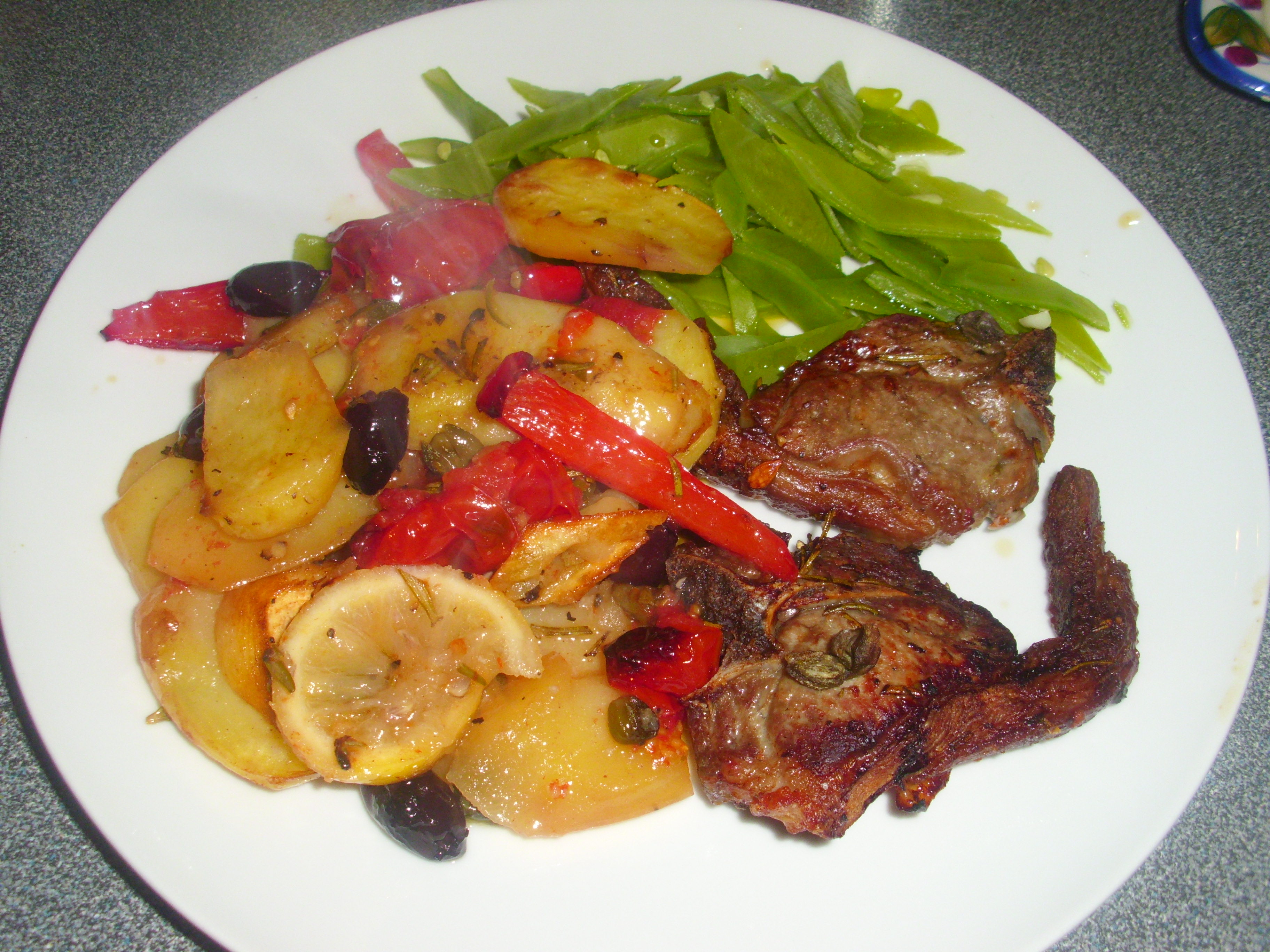
DSCI0095I love one pan meals and this one is absolutely delicious. The combination of olives, lemons and rosemary with lamb is incredible although I can see those who do not like olives turning their noses up already.I can’t blame you as for many years I shared the dislike for olives. I suppose my tastes have changed over the years and now I love them. So does my Grandson Danny.  It is the first thing he searches for when he comes over to stay.

This recipe also includes capers. I love these little green morsels that bring such a distinctive flavour to a dish.  The mild acidity of pickled capers fascinates both French and Italian cooks as well as gourmets. Capers are used in sauces, salads, served with smoked salmon, and even cured with salt.

The prickly caper bush thrives in hot and arid southern European countries and on the North African coast of the Mediterranean Sea. There are 150 species of the 1.20 metre tall creeping bush that likes rocky soil and which thrives well in southern France and Sicily where both regions cultivate the plant as a cash crop. Spain, Florida, and California are also major producers.

Capers are the immature flower buds that are hand harvested and preserved in vinegar or salt-cured. The smaller the caper, the more expensive it is, due to high labour involved in collecting. An appreciably higher and more pleasant acidity is present in smaller capers. Very small berries are called non-pareille, and favoured by chefs due to their delicate texture and more pronounced taste. Capers mix well with mayonnaise as in Sauce Ravigote. German cooks use them in milk and roux-based sauces mostly served with calf’s dumplings.

I found this recipe in my Good Food magazine and adapted it to suit our tastes.  If you want to view the original recipe here is a link to it on their website:

http://www.bbcgoodfood.com/search/recipes?query=lemon+and+rosemary+lamb+traybak

Lemon and rosemary lamb traybake                                         Serves 2 (easily doubled)

  • 1 lemon, half zested, half sliced
  • 2 tbsp olive oil
  • 1 clove garlic, crushed
  • 2 sprigs rosemary, leaves picked from one and chopped
  • 4 lamb chops
  • 400g new potatoes, peeled and sliced
  • 1 red pepper, deseeded and thickly sliced
  • 4 small vine tomatoes, halved
  • 1 oz pitted black olives
  • 1 tbsp capers, drained and rinsed.
  1. Whisk the lemon zest and juice with 1 tbsp olive oil, garlic, chopped rosemary and some seasoning.  Add the lamb chops and toss to coat then set aside to marinate for 30 minutes.  Heat the oven to 220C/200C fan/gas 7.
  2. Toss the potatoes in the remaining olive oil, season lightly then tip into a shallow roasting dish.  Sit the lamb chops on top then put in the oven for 15 minutes.
  3. Remove the dish from the oven, loosen any potatoes that are sticking the add the peppers, lemon slices, rosemary sprig and tomatoes. Mix well making sure the chops stay on the top. Return to the oven for another 10 minutes.
  4. Add the olives and capers and make sure they are evenly distributed. Turn the chops over and continue to cook for 10-15 minutes or until the potatoes are tender and the chops are cooked to your liking.

This slideshow requires JavaScript.

The best Lamb Curry I have ever made!

3 Jan

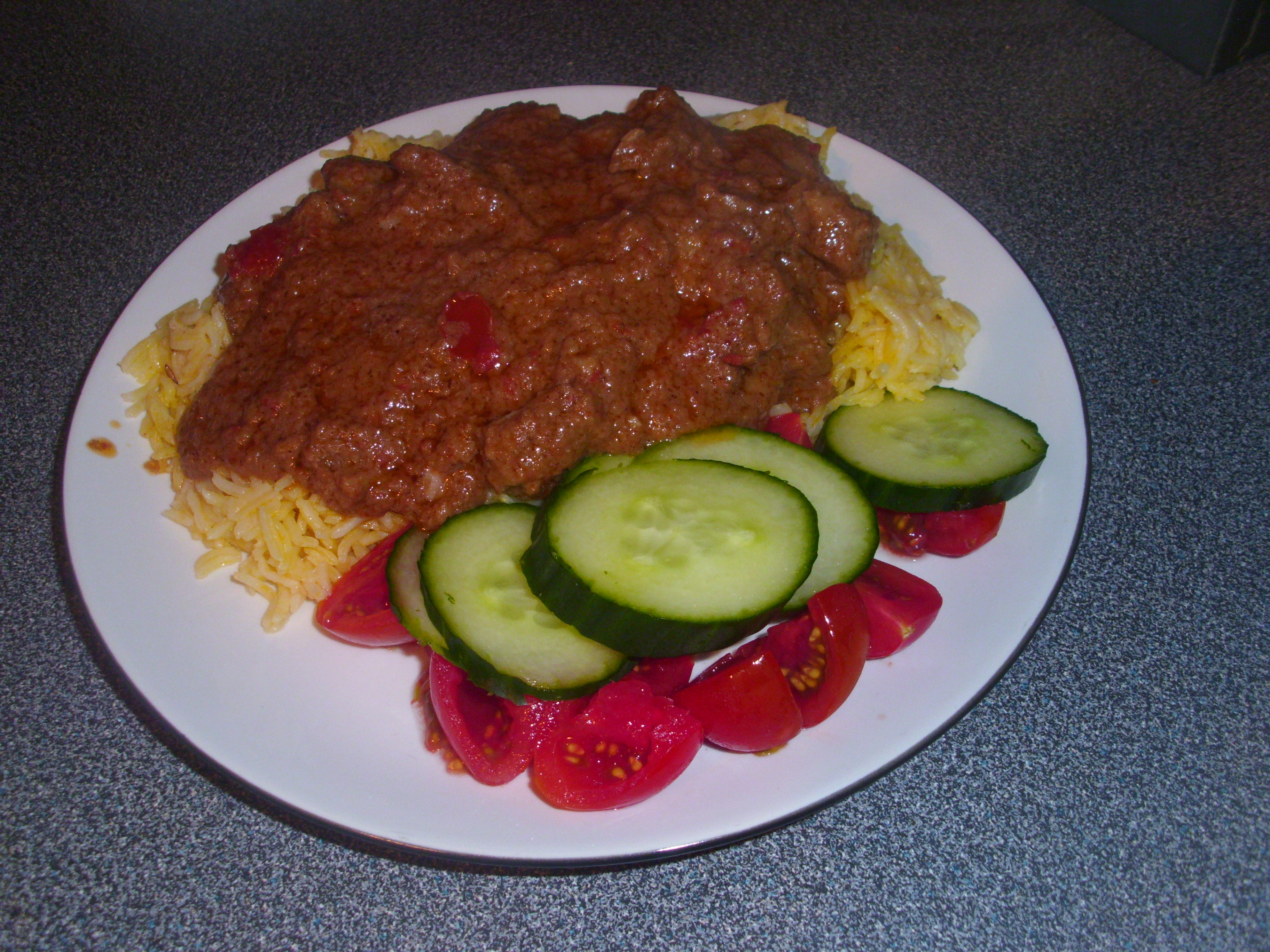
DSCI0297This is a recipe from Rick Steins India cookbook and was given to him by Mr Singh.  On the TV series of the same name he talked about Sikhs and how he had yet to meet an unpleasant Sikh and I entirely agree with him, although I am sure, by the law of nature, that there must be some out there.  All I know is that whenever I have seen or met a sikh they are always incredibly smart with well trimmed beards. They have always been very friendly and helpful.  Most male Sikhs have Singh (lion) and most female Sikhs have Kaur (princess) as their last names.  When they are baptised male Sikhs must cover their hair with a turban, but for female Sikhs this is optional. The greater Punjab region is the historical homeland of the Sikhs, although significant communities exist around the world.

This recipe uses shoulder of lamb. In the past I have opted for leg of lamb for my curry recipe, mainly because my husband hates fatty or chewy meat.  This time I decided to go along with the shoulder option and, although I did cut out excessive fat and all sinews that I could find, I did leave in some of the fat. The result was the tenderest most succulent lamb I have ever tasted. i will definitely be using shoulder of lamb in future for any slow cooked recipes.

I have previously provided a link to this recipe on the BBC website but, as they have now removed it, here it is.

Mr Singh’s Slow-cooked lamb curry with cloves and cardamom   Serves 4 – 6

  • 8 cardamom pods
  • 4 – 6 cloves
  • 3 medium onions
  • 200g tomatoes
  • 10 cloves garlic
  • 4cm root ginger
  • 75 ml vegetable oil
  • 100 ml full fat natural yoghurt
  • 700g boneless lamb shoulder, trimmed of excess fat and cut into 4 cm pieces
  • 1 tsp salt
  • 1 tsp Garam Masala
  • 1 tsp hot chilli powder
  • 1 tbsp single cream
  1. Grind the cardamom and cloves into a powder and set aside.
  2. Using a mini processor roughly chop the onion then add a little water and process to a puree. Set aside.
  3. Rinse processor then blend tomatoes to a puree. Set aside
  4. Rinse processor the blend garlic and ginger with a little water. Set aside.
  5. Heat the oil in a heavy based pan over medium heat and gently fry the onion puree for about 15 minutes until golden.  Add the  ginger and garlic paste and continue to fry for another 3 minutes. Stir in the yoghurt then ad the meat and mix well so it is coated. Season with the salt then cook over a low – medium heat for 30 minutes until browned.  Stir in the Garam masala and chilli powder, cook for about 30 seconds then pour over enough water to barely cover the meat. Cover and simmer for 40 minutes.
  6. Stir in the cream and tomatoes then the cardamom and cloves mix. Cover the pan with foil then replace the lid and cook over the lowest heat for 40 minutes or until the lamb is tender.

This slideshow requires JavaScript.

Related articles

Cauliflower, potato and red pepper curry – who needs meat?

26 Dec

I really like vegetable curries but I get a bit fed up with the usual dishes using mainly root vegetables.  This recipe is fantastic and can be eaten either as a main for vegetarians or as a vegetable dish to be served with a meat curry and rice for a dinner party.  You can vary the vegetables to suit your own taste.  The three I have used really went well together and I threw in a few frozen peas near the end of cooking time to add a bit of colour.  If there are any vegetables left over after we have eaten this I am going to make them into pakoras by adding them to a thick batter made of gram flour and water.  We can have them for lunch tomorrow with some raita and a tomato, cucumber and onion salad.  Yum!

I am serving this tonight to accompany a chicken curry and rice to share with friends.  I remember years ago when I first cooked for friends, I was absolutely terrified.  As the years went on I realised that a stressed hostess was no good at all so I started to relax and enjoy myself.  We went through a phase of having themed dinner parties.  My Mum bought me a leather-bound menu holder for 10p at a car boot sale and I would type up the menu, using the language of origin, and put it on the table for a bit of fun.  We would scour the shops for ethnic beer and wine to accompany whatever meal I was preparing and we even went as far as sourcing typical music for the area.  Some might call this anal but we had lots of fun times while it lasted.  One of the funniest was when I did a Chinese meal for my brother and sister-in-law.  Our next door neighbour at the time was Chinese and he typed up my menu for me in Chinese with the English version underneath.  He even gave us some tea, one lot to have before the meal to improve the appetite and one for when we had eaten to aid digestion.  I remember he lent us a Chinese CD that sounded a little bit like the Goons singing Yinta Yinta.  I don’t know how we ate the food for laughing.  I suppose all this led up to me wanting to write this blog.  It isn’t because I think I am a fantastic cook but I thought it may help others who feel as terrified as I did all those years ago.  The aim is to cook simple meals that taste great and have been tried and tested, as well as provide pictures of each step to help others visualise what it should be looking like.  I’ve messed up a bit for this recipe as I forgot to take a photo of the first 2 steps.  Hopefully it will not mar the ability to replicate.

Cauliflower, potato and red pepper curry                      Serves 4

  • 100g/4 oz ghee (or unsalted butter if you can’t find any ghee)
  • 1 small cauliflower, cut into small florets
  • 450g/1lb small potatoes,  quartered or cut into 3/4 inch chunks
  • 1 red pepper, deseeded and cut into 1/2 inch squares
  • Handful frozen peas
  • 1 medium onion, finely chopped
  • 450g/1lb tomatoes, sliced thinly
  • 450 ml/3/4 pt hot water
  • salt to taste
  • pinch asafoetida
  • 2 cloves
  • 1 tsp cumin seeds
  • 1 brown cardamom
  • Chopped fresh coriander for garnish

For the paste

  • 1 medium onion, roughly chopped
  • 1 inch root ginger, roughly chopped
  • 4 cloves garlic, roughly chopped
  • 1 tsp turmeric
  • 1 tsp hot chilli powder
  • 1 tbsp coriander seeds
  • 1/2 tsp ground cinnamon
  • 1 tsp garam masala
  1. Heat 1/4 of the ghee in a large saute pan and fry the asafoetida powder for 5 seconds.  Add the cauliflower, potato and red pepper, mix well and fry for about 5 minutes over a moderate heat.  Remove and reserve.
  2. Grind the cloves and brown cardamom to a powder.  Heat the remaining ghee in the same pan and add the onion, ground cloves and cardamom and cumin seeds.  Mix well and cook over a low-moderate heat until the onions have browned.
  3. Put the onion, garlic and ginger into a small processor and chop until very fine, almost a paste.  Grind the coriander seeds and add, with the onion paste and other paste ingredients to the fried onion.  Cook for about 3 minutes.
  4. Return the vegetables plus the sliced tomatoes to the pan, mix well to coat with the onion spice mix and then fry for about 5 minutes.  Add the water and the salt and continue cooking for about 30 minutes or until the vegetables are tender but not mushy.   5 minutes before the end of the cooking time add the frozen peas.
  5. Serve hot, sprinkled with the chopped coriander.

This slideshow requires JavaScript.

Crispy pancakes – a blast from the past!

4 Sep

I can remember buying these for the kids in the 70’s.  They loved them and we would have them once a week with chips.  Really healthy I can hear you say.  You bought them in packs of four and I think the choices were chicken and mushroom or minced beef.  The recipe today is based on the principal of these pancakes but the result is nothing like them.  For a start they are twice as big and secondly the filling is rich and creamy and lots of it.  I still served them with chips although, nowadays, I go for the healthy version in my dry fryer.

This is the first time I have ever made my own savoury pancakes.  I love pancakes but tend to stick to the sweet variety and then only on Pancake Day.  My absolute favourite is a pancake sprinkled with sugar and drowned in the juice of a lemon. Mmmmm!  When my son’s family came to visit us in Fuerteventura in February  I made loads of pancakes on Pancake Day.  Some simple with lemon juice and some elaborate with marinated strawberries and fresh cream, but all delicious.  Clean plates all round!

Pancake Day ( also known as Shrove Tuesday) is the last day before the period which Christians call Lent. It is traditional on this day to eat pancakes.  Lent is a time of abstinence, of giving things up. So Shrove Tuesday is the last chance to indulge yourself, and to use up the foods that aren’t allowed in Lent. Pancakes are eaten on this day because they contain fat, butter and eggs which were forbidden during Lent.  Other religions and Countries observe Lent in a similar way.  For example, in Greece they abstain from eating meat for the whole of Lent then celebrate Easter by spit roast a whole goat. 

The name Shrove comes from the old word “shrive” which means to confess. On Shrove Tuesday, in the Middle Ages, people used to confess their sins so that they were forgiven before the season of Lent began.

Every Pancake Day, windows in Atherstone are boarded up and shoppers dive for cover.  Why? Its time for the famous ball game! It’s possibly the most extroadinary sight you will ever see in Warwickshire – perhaps even through the Midlands and beyond. Hundreds of people gathering to knock seven bells out of one another in an attempt to grab hold of a heavy leather ball – and run the risk of being dismembered in the process.  

The Atherstone Ball Game is one of the oldest traditions in the country – the game has taken place every single Shrove Tuesday for 805 years.  Not even wars could stop it going ahead!  Although the current recession may be it’s downfall.  No one knows exactly where the tradition comes from – whether it came from border disputes or as a challenge between young men from different areas – but it remains and is only one of two such events that survive today, the other being in Ashbourne, Derbyshire. (As reported by the BBC).   

The recipe is from the March Edition of Delicious.  Here is a link to it on their website.  I made the pancakes by using 125g plain flour, an egg, pinch of salt and 250 ml of milk, beaten together to make a smooth mix.  I layered the left over pancakes and the filling in an ovenproof dish, finishing with a pancake and then scattered fresh breadcrumbs and grated cheese on top before freezing.  I’ll have that with salad on another day, thawed then reheated for 25 minutes in a moderate oven.  Can’t wait!

http://www.deliciousmagazine.co.uk/recipes/creamy-chicken-and-mushroom-crispy-pancakes


This slideshow requires JavaScript.


Prawn Saganaki – a wonderful Greek dish

7 Aug

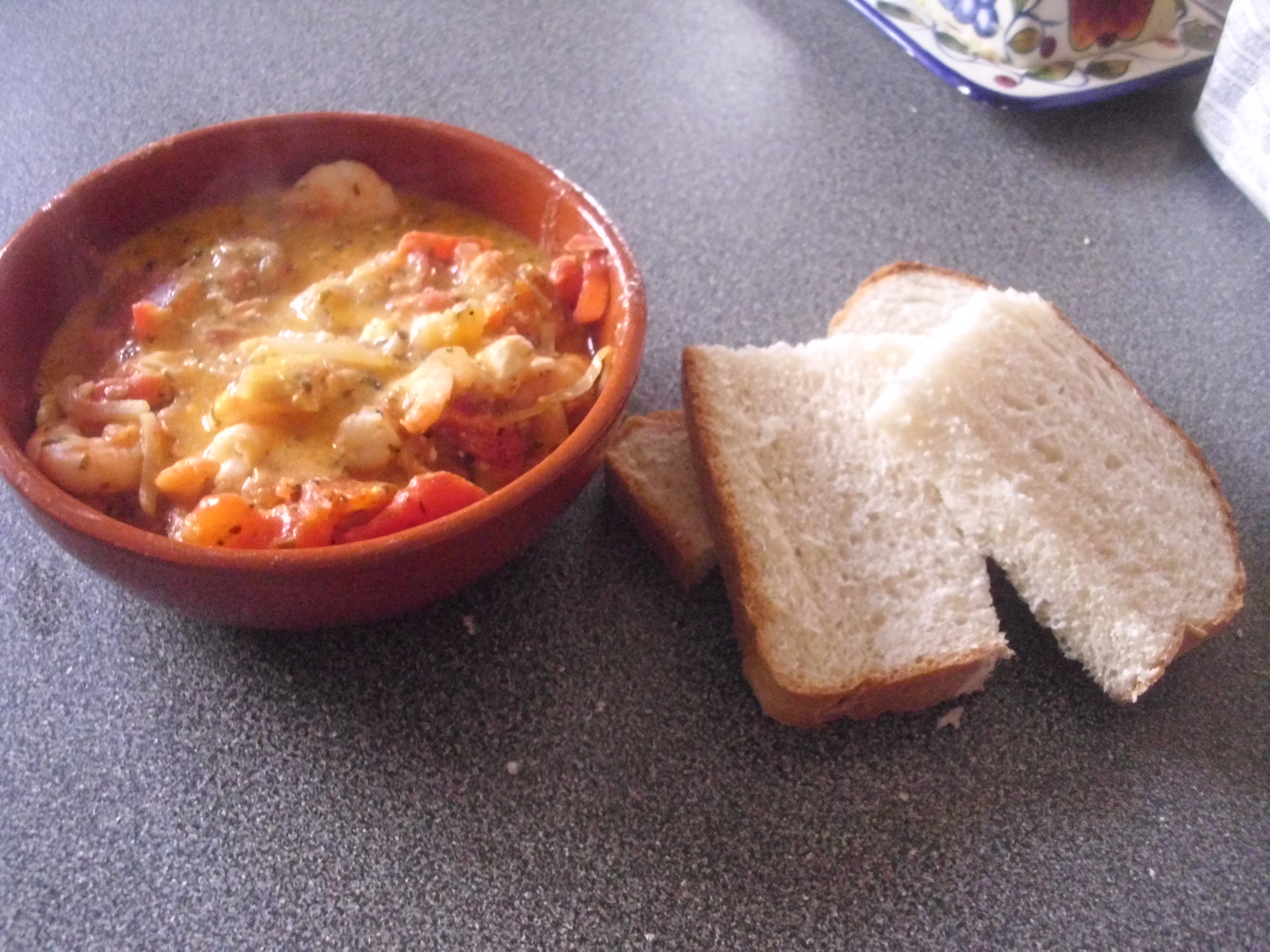
DSCI0112I remember the first time I had Prawn Saganaki. It was on the beautiful island of Aegina, cooked by the sister of a dear friend for their Fathers 90th birthday party. I had to move the dish away from me or I would have eaten the lot.  I have looked many times for the recipe but have struggled to find it.  There are some on the internet but, somehow, the ingredients don’t seem to marry with the taste I remembered.  Recently we went for a week in Stalis, Crete.  I lost count of how many times I ate Prawn Saganaki or Mussel Saganaki while I was there. The most wonderful of all was served in an ouzeri called Tsourlis, almost next door to the apartments where we stayed.  They made their Mussel Saganaki with fresh mussels and it was absolutely to die for.

I had an idea in my head of the ingredients and was delighted when I cross-referenced this with the recipe in my very old Greek cookery book written by Rena Salaman.  Rena is a guru of traditional Greek cooking and, although this little paperback does not include pictures, the way she writes about her food and the places she remembers eating them is so vivid you feel you can almost taste the dishes she is describing.  She does not call her dish Prawn Saganaki but ‘Yarithes Yiouvetsaki’.  The dish is exactly the same as the ones I have tasted – prawns baked in a fresh tomato and feta cheese sauce.  Wonderful on its own  with chunks of fresh bread to mop up the sauce. Rena’s book is simply called ‘Greek Food’. It was published in 1983, not sure if there are newer publications. The ISBN IS 0-00-636467-5. If you want to read about wonderful places in Greek and maybe relive some memories, or simply want to make good Greek food, then this book is a must.

Saganaki (Greek σαγανάκι) refers to various Greek dishes prepared in a small frying pan, itself called a saganaki, the best-known being an appetizer of fried cheese.

Here is the recipe, slightly modified

King Prawn Saganaki                                    Serves 2 as a main, 4 as a starter

  • 200g raw king prawns
  • 4 tbsp olive oil
  • 1 onion, thinly sliced
  • 1 tsp dried oregano
  • 400g fresh ripe tomatoes, skinned and sliced
  • 100ml dry white wine
  • 2 tbsp chopped parsley
  • Salt and black pepper
  • 75g feta cheese
  1. Preheat an oven to 180C/160C fan/gas 4
  2. Heat the oil in a frying pan then add the onions and fry over a lo-medium heat for about 10 minutes or until the onions are soft but not coloured.
  3. Add the oregano, wine and tomatoes then continue cooking for 5 minutes until the tomatoes start to break down. Season, add the parsley then crumble in the feta cheese. Mix well, bring to the boil then remove from the heat.
  4. In the meantime bring a small pan of water to the boil then add the prawns and cook for 2 minutes until turned pink. Be careful not to overcook as they will go hard.
  5. Put the prawns in an ovenproof dish and cover with the sauce.  Cook in the oven for 15 minutes.
  6. Serve with chunks of crusty fresh bread.

This slideshow requires JavaScript.

Potato, asparagus and mint salad – absolutely divine!

3 Aug

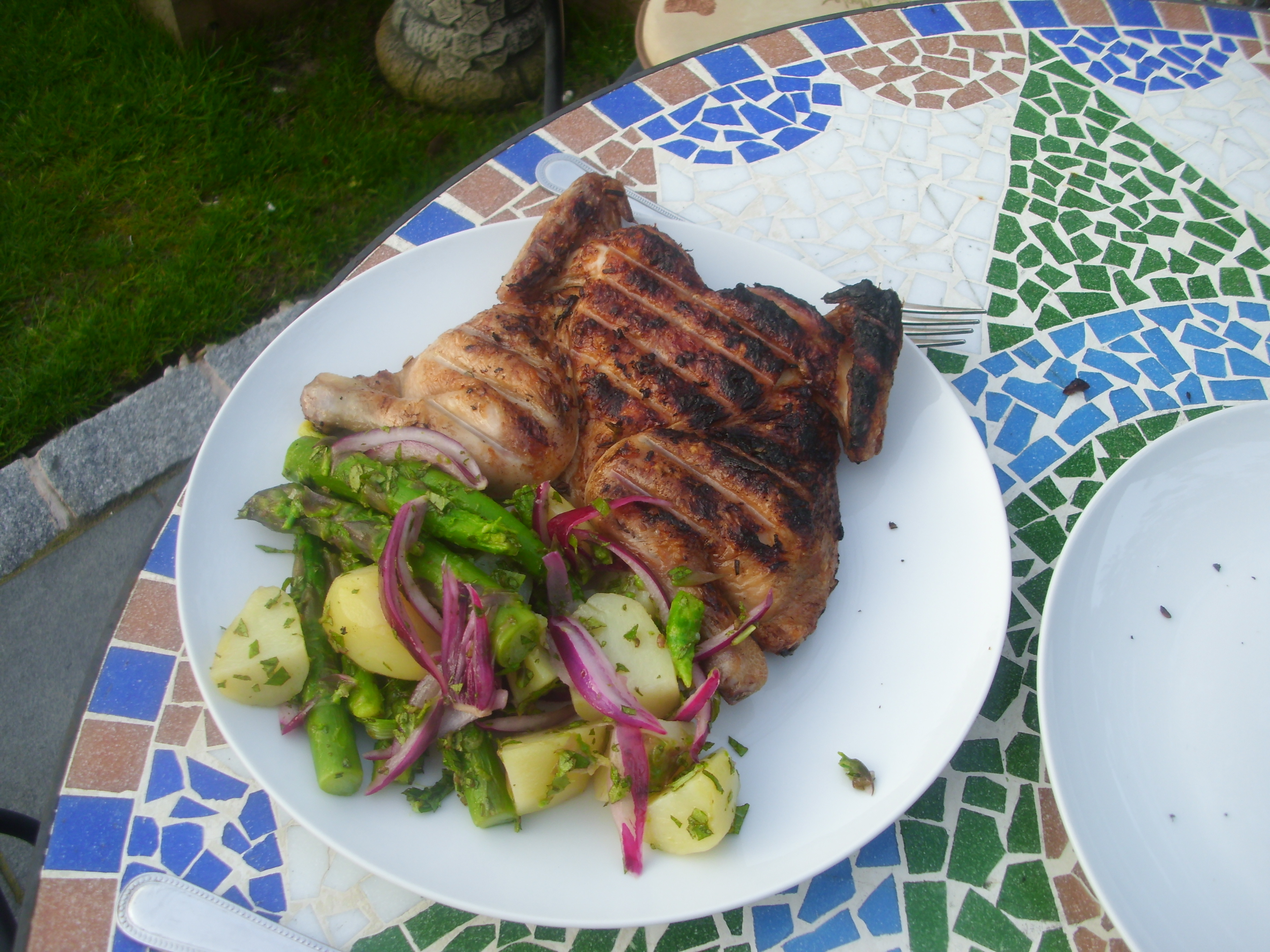
 This salad has to be my number one favourite.  I could eat it alone but it excels as an accompaniment to any meat or fish dish.  We served it with the barbecued poussins and it was absolutely delicious.  The mint flavour really lifts it and, of course, it contains one of my favourite foods, asparagus.

Did you know that asparagus can grow 10 inches in 24 hours?  It comes in three colours, green, white and purple.  The green asparagus is readily available and is possibly the most popular.  I have seen the white asparagus in Spain, usually limp and soggy out of a jar or on a salad.  I, personally, think there is no taste to this and it is repulsive.  I have never seen the purple variety. 

Asparagus is loaded with vitamins and minerals.  Potassium, crucial for heart function and a key player in muscle contraction.  Vitamin K, essential for blood clotting.  Folate, prevents anaemia.  It is a strong diuretic and has been found useful in treating swelling associated with rheumatism and arthritis as well as bloating in PMS related water retention.

The fact that I was most interested in, however, is why does it make your pee smell?  Apparently you must have the right gene to be able to smell it but for those who have, which includes me and my husband, I can tell you it is a really strong, weird smell.  I first noticed it when we started eating asparagus while we lived in California.  I thought there was something wrong with the drains to our apartment!!!  The smell is caused by sulphur-containing compounds that are created when asparagus is digested.  They don’t have any harmful effect on our health so , no worries, just don’t pee in a public lavatory after you have eaten asparagus.  The smell is noticeable after only 15 minutes of eating it!

We were introduced to asparagus by Chinese Eddie.  He was a fantastic old gent (over 90 yrs old) who lived in our complex.  In his youth he used to work in the asparagus fields around Woodland Hills.  His top tips were always buy asparagus with the thickest stalks as these have matured and have a much better flavour. Hold the tip and the end and bend the asparagus, it will break at the natural point so you can discard the woody bit, and don’t over cook, it needs only 3-4 minutes in boiling salted water before it is ready.

Here is the recipe.  I hope you try it, you are in for a treat.

Potato, asparagus and mint salad                                 Serve 4

  • 500g new potatoes
  • 2 packs asparagus tips
  • 1 small red onion, peeled and thinly sliced
  • 3 tbsp white wine vinegar
  • 1 tbsp olive oil
  • handful fresh mint, leaves picked and chopped
  1. Peel the potatoes and cut into bite sized pieces.  Put in a pan of boiling, lightly salted water.  Bring back to the boil then simmer for 10 minutes or until just tender.  Remove with a slotted spoon to a plate and cool.  Reserve the cooking liquid.
  2. In the meantime, put the onion in a bowl and add the vinegar and oil.  Mix well and leave to marinade.
  3. Bring the pan of water back to the boil then add the asparagus.  Bring back to the boil again the simmer for 3 minutes or until the asparagus is just tender.  Drain and run under cold water to stop the cooking process.  Dry on kitchen paper.
  4. Add the potatoes, asparagus and chopped mint to the onion.  Toss lightly so all the vegetables are coated in the dressing and serve.

    This slideshow requires JavaScript.