Archive | My favourite recipes RSS feed for this section

Sausage and pasta – what’s not to love?

6 Aug

We love sausages and pasta, so when it is combined in just one pot, easy and quick to cook with hardly any washing up, then this is food heaven.  I have to say I was a bit dubious that everything would be properly cooked but I enjoyed every mouthful and all I cook hear from Terry, my husband, was something that I could only describe as a purrrrrrr!  Kids will absolutely love this dish, a perfect midweek meal.  One word of advise though, use good quality sausages.  I think cheaper versions might have too much fat and maybe make the dish oily.  The pasta used in this dish is penne so I thought I would look up a few foodie facts.

Penne (pronounced peni) is a cylinder shaped pasta.  It can be either smooth or ribbed and is designed to hold as much sauce as possible.  It was perfect for todays dish and you could actually see the sauce running through the middle of the pasta and oozing out the other end.  The name penne comes from penna, Italian for feather or quill, presumably to describe the similar action of these as writing implements. 

There are some mixed theories of the origins of pasta to Italy.  Some say it was brought to Italy by Marco Polo from China.  However, there is evidence that pasta was already eaten in Italy during Polo’s time and there is even mention of a type of lasagna in 1AD!  In more recent times, the 8th Century to be exact, pasta was introduced to Sicily by the Arabs.  It was made from a hard variety of wheat and is believed to be the origin of dried pasta.  To this day there are many Sicilian recipes that contain influences from Arabian cooking, and include raisins and spices such as cinnamon. Today there are over 350 shapes of dried pasta and Italians eat over 60 lbs of pasta per person, each year!

The recipe I am sharing today is based on one from Woman and Home Dinner Tonight.  I have adapted it to suit our taste.  Hope you enjoy it as much as we did.

Sausage and pasta one-pot         Serves 4

  • 8 good quality sausages (choose the variety you like best)
  • 6 slices pancetta (or smoked streaky bacon), roughly chopped
  • 1 onion, chopped
  • 250g (9oz)chestnut mushrooms, sliced
  • 2 tbsp vegetable oil
  • 400g tin chopped tomatoes
  • 1.5 pints (about 700 ml) ham stock (made with 2 ham stock cubes)
  • 250g (9oz) dried penne pasta
  • 200g (7oz) runner beans, thinly sliced
  • 2 tsp Worcestershire sauce
  • Salt and Pepper
  1. Heat the oil in a very large, deep, frying pan or saute pan.  Fry the sausages, pancetta and onion over a medium heat for about 5 minutes until the sausage is brown all over.  Keep turning and moving around the pan to avoid burning.
  2. Add the mushrooms and fry for a further 2 minutes until they have softened slightly.
  3. Pour in the tomatoes, Worcestershire sauce and stock then add the pasta and beans.  Season then mix well, bring to the boil, then simmer for about 30 minutes until the sausages are cooked and the pasta is tender.  This should give you a rich sauce.  If the sauce is too thick simply add a little more water.  If it is too thin boil rapidly for a couple of minutes to thicken it.
  4. Check seasoning and serve immediately.

Serve with a couple of glasses of red wine! Heaven!!!!! 

This slideshow requires JavaScript.

Courgettes with pasta, my favourite pasta dish!

6 Jun

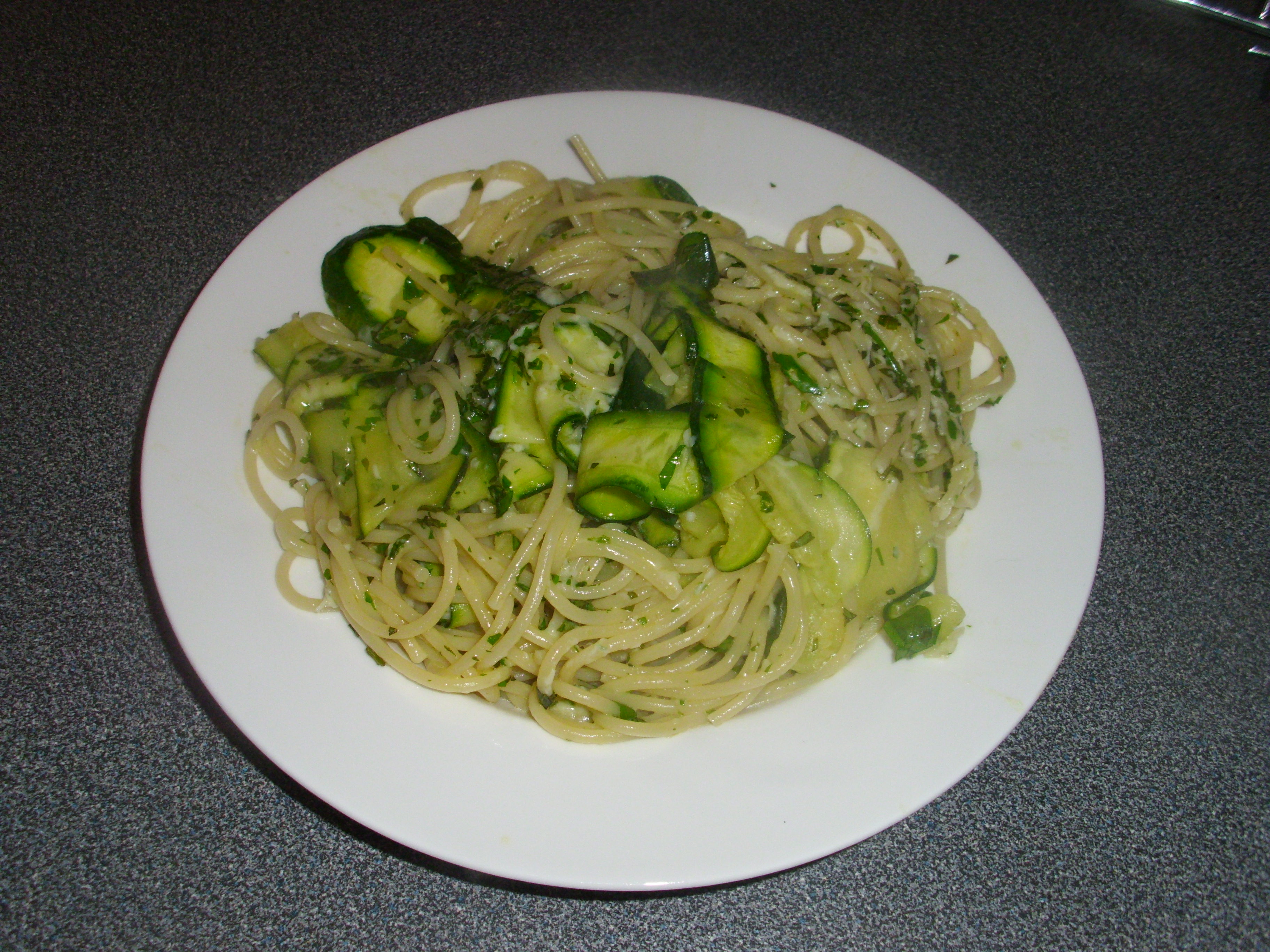
 There was a time when I hated courgettes but, over the years and after trying so many delicious recipes, that has all changed.  I love it when there is a glut of courgettes in the shops but, thankfully, you can now buy them all year round.  When we had this recently it reminded me how much we love it, and how long it had been since we ate it!  I can’t remember when we first had this dish, it must be at least five years ago.  I think our first time was because someone had given us a bag full of courgettes, they were not a vegetable I would have actually bought in those days!  The recipe would probably have come from one of the cooking journals I subscribe to and, if I remember, the picture did not look that tantalising.  I am so glad we tried it though.  Sometimes you come across a recipe that you want to make time and time again.  This is one of those times! We absolutely love this pasta dish.  You would not believe how fresh it tastes or how much flavour it packs in.  Before the recipe though, I thought I would look at some food trivia on Parmesan Cheese.

I can remember, many years ago, buying Parmesan cheese already grated and served in little tubs.  It was disgusting and smelled of sweaty socks.  Yuk!!!  The first time I bought fresh Parmesan I could not believe the flavour.  It is so strong, absolutely beautiful.  It really makes you wonder how they manage to transform such a great taste to an imitation of sweaty socks!!  A lot of people will not buy the fresh cheese as it is expensive and they may only use it occasionally.  Believe me, it is worth the expense!  I grate the whole block at a time and freeze it in a well sealed freezer bag.  That way I can take out just as much as I need when I need it.  I even freeze the rind, it gives a great flavour to soups!

Parmesan cheese is the French name given to Parmigiano-Reggiano, and one that most of the UK have adopted.  Parmigiano-Reggiano is a hard, granular cheese that is cooked but not pressed, and is produced in Italy.  The name is protected under European Law and can only be given to the cheese produced in specified regions of Italy.  Informally it is often called the ‘King of Cheese’.  The cheese is made out of cows milk and any left over whey is used to feed the pigs from which Parma Ham was produced.  Great bit of recycling!!!  The cheese is as pure and organic as possible.  Cows can only feed on grass or hay, giving grass-fed milk, and only natural whey culture is allowed as a starter.  The only additive allowed is salt which the cheese absorbs while being submerged in huge vats of brine made from Mediterranean sea salt, before being left to age for an average of two years.  The end result is a fantastic cheese with a deep, savoury flavour.  It is very strong so, although expensive, you only need a small amount yet still get the full flavour coming through.

Anyway, I’ve tried to trace the recipe to a website and failed so I have written it out for you below.  I really hope you give it a try, I am sure you will not be disappointed.

Courgettes with pasta and herbs.    Serves 4       About 530 calories

  • 12 oz/350g  spaghetti or linguini
  • 4 tbsp olive oil
  • 2 garlic cloves, finely chopped
  • 650g/1lb 7oz courgettes, cut into thin ribbons (a vegetable peeler is great for this)
  • 25g/1oz butter cut into pieces
  • 50g/2oz freshly grated parmigiano-Reggiano (or Grand Padano if you can’t get it)
  • Handful each of chopped fresh basil and flat leaf parsley
  1. Cook the pasta as per packet instructions.
  2. Meanwhile, heat the olive oil in a large frying pan or wok.  Add the garlic and cook gently for a few seconds until it becomes fragrant.  Be careful not to let it burn or it will be bitter.  Tip in the courgettes, stir to coat in the garlic oil then cook gently for about 4 minutes.  They need to be softened but not soggy.
  3. Drain the pasta and add to the courgettes, along with the butter, cheese and herbs.  Toss them gently until the butter has melted, the spaghetti is coated with the cheese and herbs and the courgettes are evenly distributed.  Season to taste and serve immediately.  You can drizzle with a little extra olive oil if you like.

    This slideshow requires JavaScript.

Thai style beef and mango salad, one of our favourite meals!

2 Jun

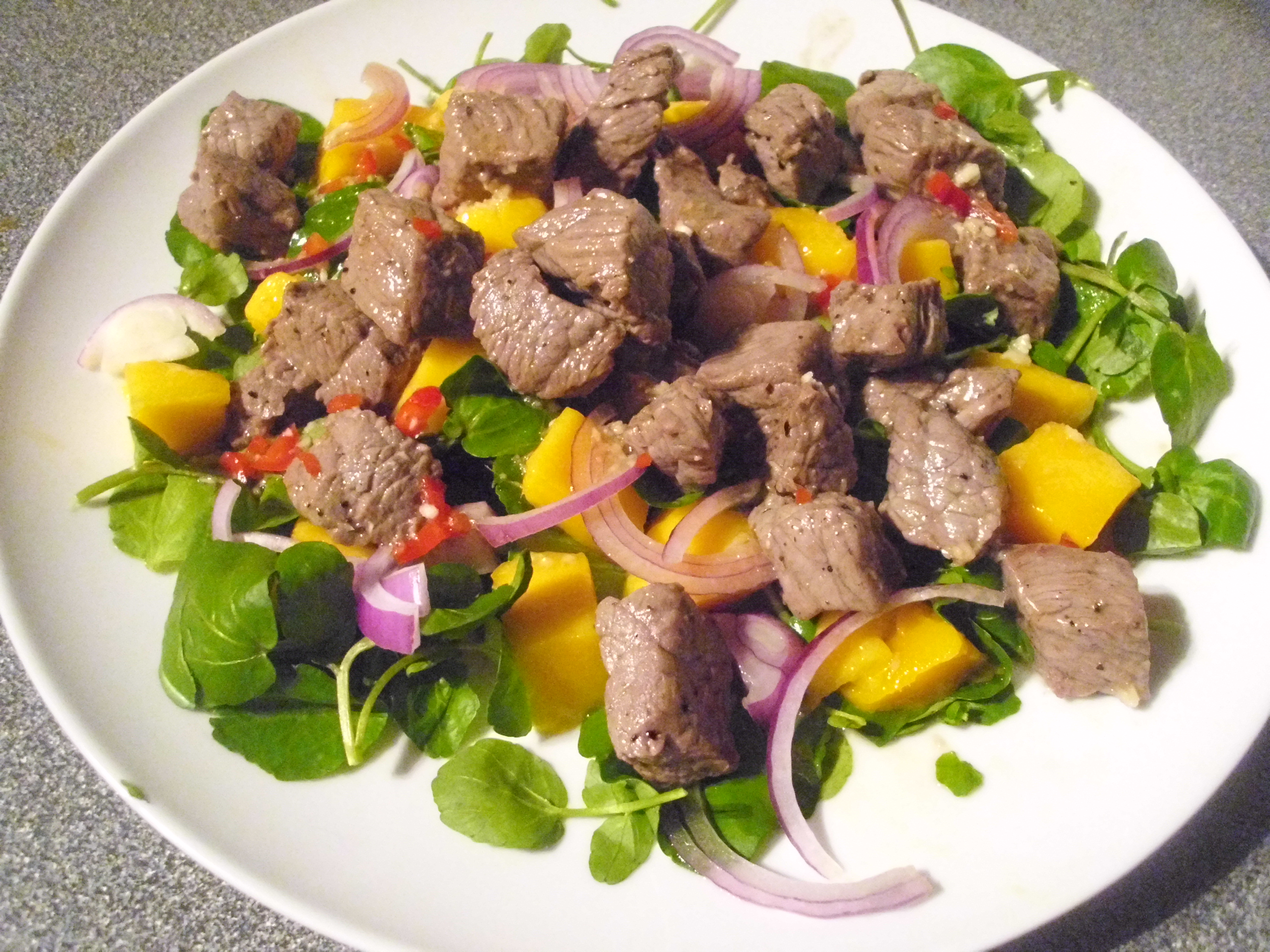
 We first had this salad about eleven years ago, shortly after we returned from living in America.  It has been a firm favourite ever since and we eat it at least once a month and more often if I think about making it.  Although this is classed as a salad it could not be further away from what I grew up to understand salads to be, i.e. lettuce, tomatoes and cucumber!  The tender chunks of beef, straight from the pan, absorb the hot and spicy salad dressing.  The sweetness of the mango is in perfect contrast with the beef and the heat from the red onion and the watercress.  Your senses will rarely be subjected to such an attack on all levels, smell, taste and sight!  Absolutely delicious and very low in fat, carbohydrate and calories so excellent for anyone who is hoping to lose weight.  What more could you ask for?

Thai food is known for its balance of the four fundamental taste senses, sour, sweet, salty and bitter.  It is often spicy as well.  This dish is an excellent example of how this balance is achieved.  Don’t be put off by the ingredients, especially the mango in a savoury dish.  If you like spicy food I think you will love this.

Thai style beef and mango salad    Serves 2 (generously)

  • 2 sirloin steaks, trimmed of fat, cut into 1 inch cubes
  • 1 mango, peeled and cut into cubes
  • 1 red onion, cut in half and thinly sliced into half-moon shapes
  • 1 bag watercress
  • 3 tsp fish sauce
  • freshly ground pepper
  • juice 1 lime
  • small knob fresh ginger, peeled and finely chopped
  • 1 garlic clove, crushed
  • 1 small red chilli, deseeded and finely chopped
  • 1 tbsp soft brown sugar
  • 1tsp sunflower oil
  1. Put the cubes of steak in a dish, add 1 tsp fish sauce and season well with freshly ground pepper.  Mix well and set aside.
  2. Divide the watercress between two plates.  Sprinkle the mango cubes and sliced onion over each plate.
  3. In a small bowl, mix together the lime juice, brown sugar, ginger, garlic and chilli.  Check for taste.  If it is too sweet add more lime, too sour, add a little more sugar.
  4. Just before serving, heat the oil in a wok.  When hot stir fry the steak , turning frequently, until it is browned all over.
  5. Divide the steak between the two plates of salad and dress, to your liking, with the dressing.  Serve immediately. 

    This slideshow requires JavaScript.

Fish Pie, yum yum!

2 Jun

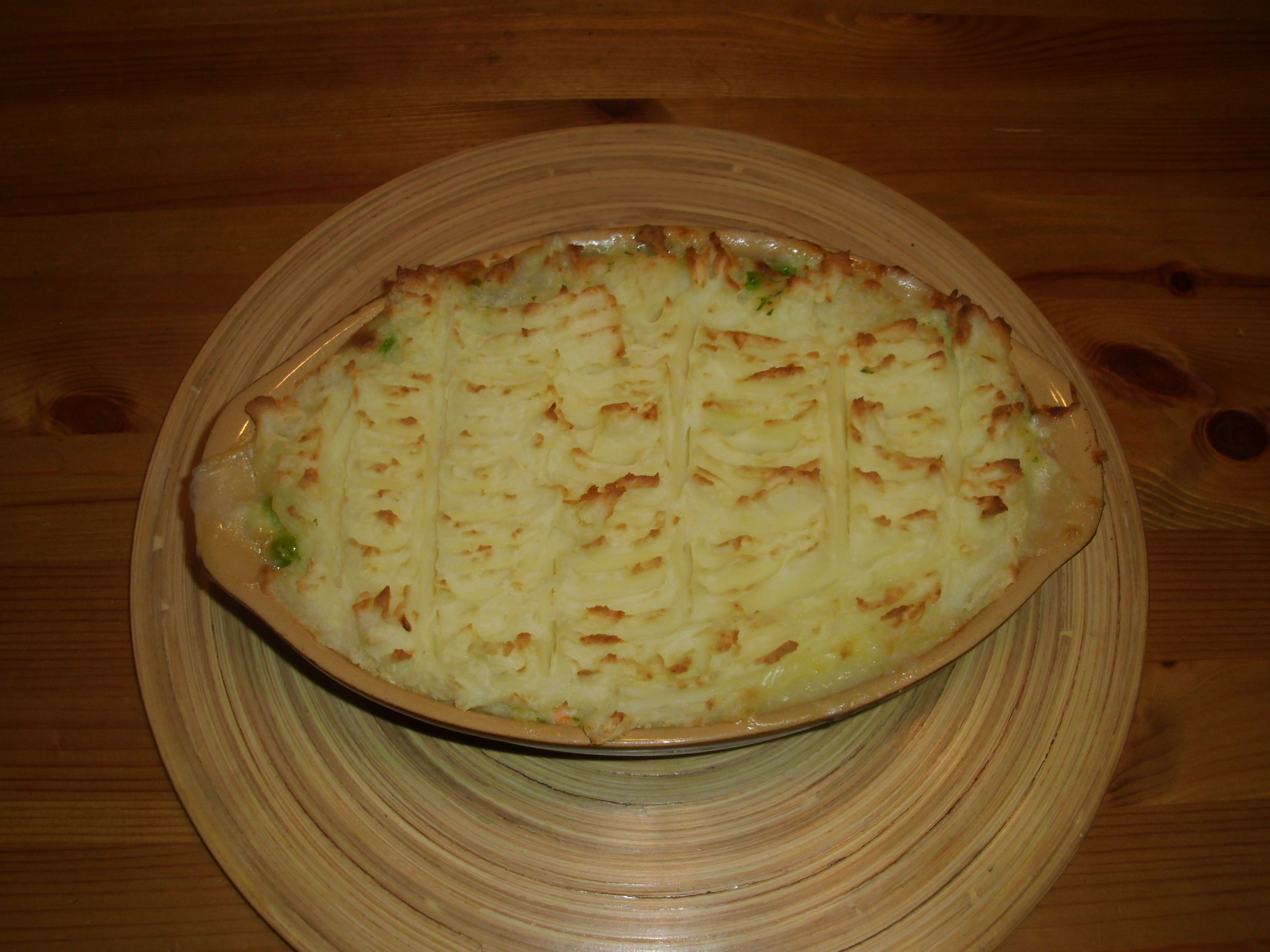
 There are all sorts of fish pie and I have tried loads of recipes but I still prefer the one I have been making for years.  It isn’t complicated and does not contain a lot of fat, it’s just great comfort food.  I can always tell when a recipe is good as there is silence around the table when people are eating, broken with the occasional mmmm!  Last night, when we had this, was just such an occasion.  The best thing about this pie is you don’t need to get hung up on the contents.  Last night I make it with cod, salmon and prawns.  I never put boiled eggs in as some of my friends hate them and, I have to say, I struggle a bit when they are in a fish pie.  Some people don’t like prawns so if I am feeding them, I simply substitute the prawns with smoked haddock.  This works really well and gives the pie a great smoky flavour.

I thought todays food trivia could be about cod.  Cod is a really popular fish with dense white flesh and a mild flavour.  The livers are processed to make cod liver oil, an excellent source of vitamins A, D and E and omega 3 fatty acids.  I remember my Mum making me take cod liver oil tablets in the winter when I was a child.  I hated them, firstly because I couldn’t swallow them and, secondly because they repeated on me and left a foul taste in my mouth.  In the UK, cod is the main fish used in the traditional Fish and Chips, along with haddock, but due to popularity, cod is currently at risk of being over fished in the UK, Canada and most other Atlantic countries.  This has caused controversy dating back to 1990, since when various committees and Government Departments have tried to restrict the fishing of cod.  Thankfully, we are still able to buy it but it is now much more expensive than when I first made this fish pie.

Anyway, here is the recipe.  It is a meal in one so there is no need to add more vegetables when you serve it, unless you want to of course.

Fish Pie                                 Serves 4 (easily halved or doubled)

  • 250g/10oz white fish fillets (cod or haddock are best), skinned, checked for bones and cut into 2 inch pieces
  • 125g/5oz fresh salmon fillets, skinned, checked for bones and cut into 2 inch pieces
  • 125g/5oz smoked haddock, skinned, checked for bones and cut into 2 inch pieces
  • About 12 raw king prawns, all shell removed
  • 750ml/1.5 pts semi-skimmed milk
  • 50g/2oz unsalted butter
  • 50g/2oz plain flour
  • 1 onion, peeled and studded with 3-4 cloves
  • 3 tbsp chopped fresh parsley
  • 100g/4oz frozen peas

For the mashed potato topping

  • 1kg/2lbs potatoes (ones good for mashing)
  • knob of butter
  • a little milk
  1. Heat the oven to 200c/190c fan/gas 6.
  2. Cook the potatoes in salted water until tender.  Drain and mash down.  Add the butter and enough milk to make a soft but firm mash
  3. Put the studded onion and the milk in a pan, slowly bring to a simmer.  Continue to simmer for about 15 minutes.  Make sure the milk does not burn on the bottom of the pan as this will give it a bitter taste.
  4. Remove the milk from the heat, discard the onion and leave the milk to cool a little.
  5. In a separate pan, melt the butter then stir in the flour.  Cook over a low heat for a minute.  Slowly add the milk, stirring between each addition to prevent curdling.  When all the milk has been added bring slowly to a simmer, stirring, and cook until the sauce is thick and smooth.
  6. Add the fish and prawns to the sauce and simmer over a low heat for 5 minutes.  Gently stir in the chopped parsley and the peas, taking care not to break up the fish, and continue to cook for 1 more minute.
  7. Tip the fish and sauce into the bottom of an ovenproof dish.
  8. Top the fish sauce with the mashed potato then cook in the oven for about 25 minutes or until the top is browning and the sauce is bubbling underneath.
  9. Serve, but be careful, it will be very hot!

    This slideshow requires JavaScript.

Beef casserole, perfect for cold winter days!

30 Oct

 There are so many things I love about autumn and winter.  The dark nights when you can snuggle down in front of the fire, warm milky drinks to take to bed, long walks, wrapped up in scarves, gloves and hats and last, but definitely not least, thick warming casseroles, full of goodness and comfort.  I have been making this casserole for as long as I can remember.  My Grandma used to make a casserole out of ‘leg meat’.  I’m not really sure what cut this is, maybe it is peculiar to Derbyshire butchers.  I’ve often asked for it only to be given a blank look.  I have a feeling it is shin of beef but cut long ways instead of across.  Whatever it was, she used to cook it simply in water with maybe a bit of salt.  The result was incredible and the gravy to die for.  Oh well, enough of my memories. 

My version always uses braising steak.  Over the years the recipe has evolved.  Initially I would cook it like my Grandma, then, when we had the children and money was short, I started added vegetables to bulk it out.  Since then I have taken to adding some chopped tomatoes which give a great consistency to the gravy.  What we eat today, therefore, pays little resemblance to my early offerings but the flavour is simply delicious, accompanied by a big helping of mashed potatoes to soak up the gravy.  

Anyway, here is the recipe.  If there is left over meat it is fantastic in a cottage pie.  Simply line a pie dish with a layer of the meat and vegetables cut up into bite sized pieces and top with  potatoes and swede mashed together with a little low fat fromage fraise

Beef casserole                        Serves 4-6

  • 1 kg/2 lbs 4oz lean braising steak, fat and sinews removed and cut into large pieces
  • 4 white onions, peeled and halved
  • 4 large carrots, peeled and halved
  • Spray or Frylight sunflower oil 
  • 1 x 400g can of chopped tomatoes
  • 500 ml water
  • 1 beef stock cube (knorr)
  • Salt and freshly ground black pepper
  • 2 bay leaves
  1. Preheat the oven to 180C/170C fan/gas 4.
  2. Spray a large non-stick ovenproof casserole with a lid with the oil.  Don’t worry if you don’t have one, simply make in a large frying pan and transfer to your casserole when it is ready to go in the oven.  Brown the pieces of beef over a high heat.  The intention is to sear the meat and retain the flavours.  Do this in batches if necessary as you don’t want the meat to steam instead of searing.  When brown remove and reserve.
  3. Spray the same pan again with oil and add the onions and carrots.  Cook for a few minutes until they start to go a light brown.
  4. Add the tomatoes and water and crumble over a beef stock cube.  Season well.  When boiling return the meat to the dish with the bay leaves.  There should be enough water to almost cover the meat and vegetables but not drown them.  If not add a little more.
  5. Cover the casserole and cook in the oven for 2 hours, checking every now and again to make sure it is not going dry.  Check the meat is tender, if not give it another half an hour.   Remove from the oven and serve with mashed potato, pouring the lovely gravy over them.

    This slideshow requires JavaScript.

Mackerel with a Thai style marinade.

9 Oct

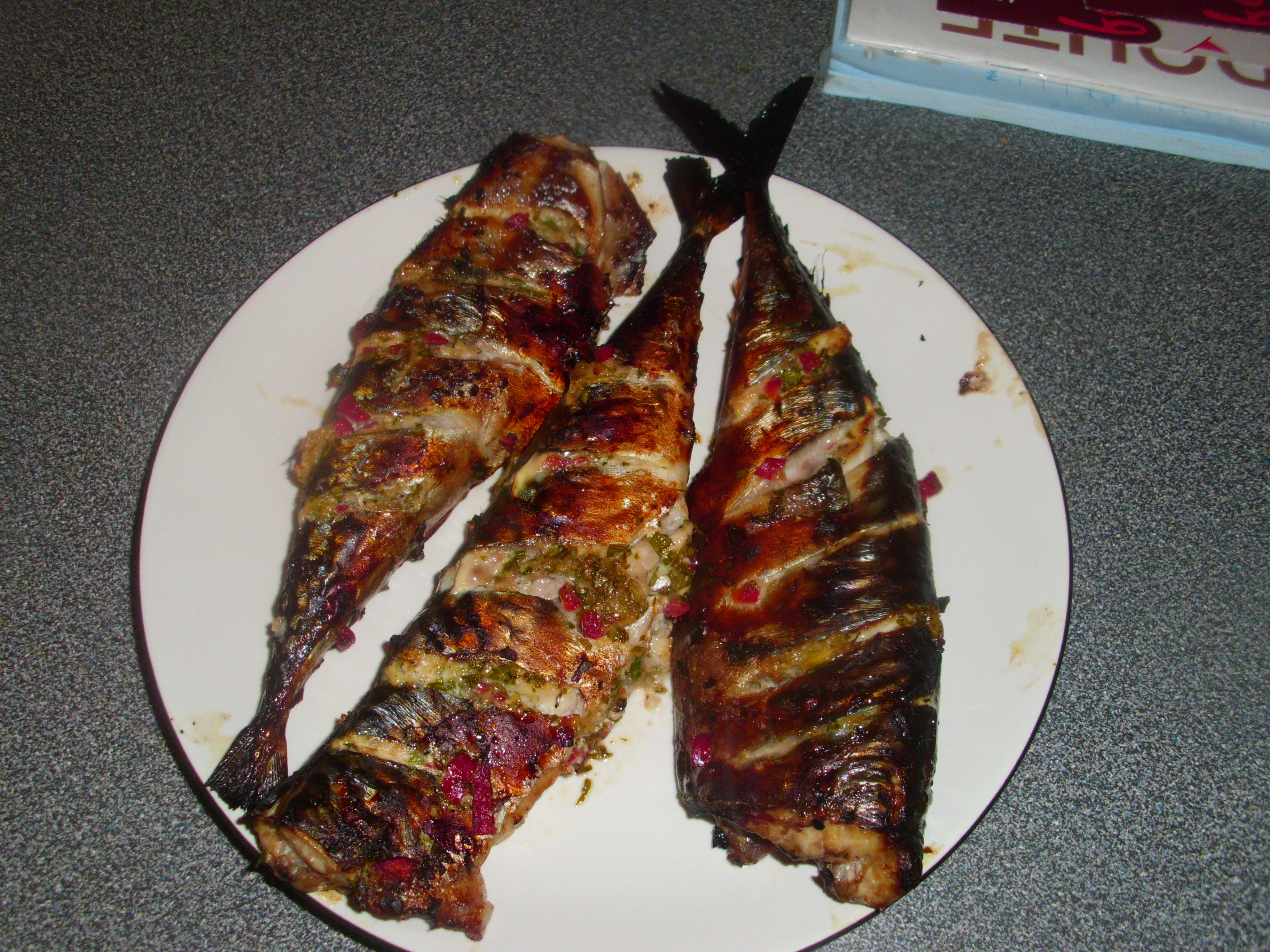
I think Mackerel is probably one of my favourite fish.  It is so tasty that I didn’t think a marinade would do anything for it but how wrong could I be!  This marinade really enhances the flavour but is very subtle so you can still taste the earthiness of the fish.  I honestly believe it is the best mackerel I have ever tasted.  Next Summer I am going to try it on the BBQ.  In the meantime it is fantastic grilled.  You could serve this with potatoes and maybe a salad or green vegetables. 

One of Terry’s, my husband’s, favourite memories are when he left college and, before starting teaching, he and his friend Gus hitchhiked around Wales.  One of the ports of call was Caldy Island where they caught Mackerel and cooked them on a wood fire on the beach.  I bet they were fantastic!  His friend Gus is a bit of an eccentric.  He is always telling tall stories, I think he actually researches them!  We often say he should write a book.  Some stories that are true, however, are so funny.  He went to visit Terry in College for the weekend and ended up staying for a whole term.  He slept on someones dormitory floor, joined the rugby team and attended lectures.  He even answered questions!  No-one ever sussed it out that he was not actually a student.  

Thai cuisine balances four fundamental taste senses, sour, sweet, salty and bitter (optional).  It is also spicy due to the chillies it invariably includes.  Common ingredients are lime, chillies, garlic and ginger.  Fish sauce is often included, usually offset by sugar.  I found this recipe in the Woman and Home Dinner Tonight magazine and modified it a little.  I’ve searched their website but could not find it so I will write it out for you below, along with the usual slideshow.  It is worth looking up their website and getting their magazine, they have some great recipes.  Anyway here is the one for today!

Mackerel with a Thai style marinade.        Serves 2

  • 2 large mackerel, gutted and cleaned, head removed
  • 1 red chilli, deseeded and finely chopped
  • Thumb sized piece of ginger, peeled and grated
  • 1 tsp honey
  • juice and zest of 1 lime
  • 1 tbsp fresh coriander, chopped
  1. Mix the chilli, ginger, honey, lime juice and zest and coriander together in a small bowl.
  2. Make large incisions into both sides of the mackerel.  Rub the marinade all over the fish, making sure you get it some into the incisions.  Put in a dish and cover with cling film and leave to marinade for 2 hours.
  3. Line a grill pan with foil and brush with olive oil to prevent the fish from sticking.  If you are barbecuing oil a foil barbecue tray.  Place the fish into the tray and cook on a medium heat for 5 minutes on each side.  Turn up the heat and cook for a few more minutes on each side until the skin is brown and crispy and the fish is cooked through.  Serve immediately. 

    This slideshow requires JavaScript.

Stuffed tomatoes and peppers – a great veggie recipe!

2 Oct

I remember the days when my husband, Terry, used to say he hated vegetarian food.  That was before our son married a vegetarian, Tracy.  Over the years I have made countless meals without meat and, with the exception of those using Quorn, Terry has enjoyed every one.  I think perhaps our favourite is Stuffed Tomatoes.  There are lots of variations of this dish.  Some add minced meat to the stuffing, others, like my friend Maritsa, add roasted pine nuts and raisins.  I make mine how my adopted YaYa (that is Grandmother in Greek) taught me, many years ago.  Sadly she is no longer with us but whenever I cook this I have memories of standing in her tiny kitchen, working together and not understanding a word said between us.

For those of you who have tried Greek cooking, it can be a bit of a hit or miss affair.  Recipe books written by Greeks rarely give precise measurements and it can be frustrating when you have to decide how much a ‘bit of’ something actually is.  This, however, is perfectly natural for the Greeks.  If you ever get the chance, talk to a Greek about food.  A light will switch on in their eyes and they will start talking with passion about a subject they love.  Rena Salaman writes that cooking for Greeks is a constant reminder of who they are and where they come from.  Recipes were rarely written down and so every household would have their own version of what is known to be a popular Greek dish.  The one thing they would have in common is that the food would always be made of what is in season, and, most importantly, there would always be an extra portion, just in case there is an unexpected visitor.  Such is the Greek hospitality!

Anyway, back to the plot and Yaya’s Stuffed Tomatoes and peppers (Tomates ke piperies yemistes)

Serves 4

  • 4 large tomatoes (ripe beef tomatoes are perfect)
  • 4 green peppers
  • 5oz rice,washed and drained
  • 2 onions finely chopped
  • Small bunch of flat-leafed parsley, chopped
  • 4 tbsp fresh mint, chopped
  • Cold water
  • Extra virgin olive oil (preferably Greek)
  • Salt and pepper
  • 2-3 medium-sized potatoes, peeled and cut into wedges (baking potatoes are best)
  • 8 oz fresh tomatoes, grated, mixed with 1/4 pint water
  • pinch sugar
  1. Wash the tomatoes, slice off the top at the stem end.   Using a teaspoon, carefully remove the tomato pulp and reserve.  Place the tomatoes in an ovenproof dish and sprinkle a tiny amount of sugar in each.
  2. Wash the peppers and slice off the top at the stem end.  Carefully remove all the seeds and white pith inside and discard.  Place in the dish with the tomatoes.
  3. Chop the tomato pulp.  Lightly fry the onion until soft, in a little olive oil.  Add the tomato pulp, the rice and the chopped herbs.  Cover with cold water, about 1 inch above the level of the rice mix.  Bring to the boil then simmer on a low heat until rice is tender to the bite and all the water has been absorbed.  Keep an eye on it and add a little more water if required.
  4. Fill the tomatoes and peppers 3/4 full, top with a tablespoon of water and replace the lids.  Wedge potato slices between tomatoes.  Drizzle with olive oil and pour over the grated tomato mix.  Season with salt and pepper and bake in a preheated oven, 180c/170C fan/gas 4, for 1 hour.  Baste occasionally to keep the vegetables moist.

Kalo Oreksi (Good appetite!) 

This slideshow requires JavaScript.

Chunky chilli, spicy and low in calories!

26 Feb

 How often do people start a weight loss programme and give in because the food is tasteless and boring.  This dish is just what the doctor ordered, Chili con carne!  I am using another Judith Wills recipe from her book of low fat meals, and I have made it more times than I can remember.  I love the rich flavour and the chunks of beef that gives a much better texture than mince, more commonly used in chilli.  I’m making a huge pan full today, enough for our dinner, meals on wheels for my kids and, hopefully, some left over to freeze for another day.  It’s great served with jacket potatoes, topped with grated cheddar, or simply with rice and maybe a side salad.

Chilli con carne is simply a spicy stew, derived from the Spanish Chilli con carne, and is the official dish of Texas.  In the 1880’s, brightly dressed Hispanic women known as ‘chili queens’ would light fires of wood or charcoal around downtown San Antonio, in areas where the public were likely to gather, and reheat huge cauldrons of precooked chili to serve to passers-by.  The aromas coming from their pots was a potent sales pitch and soon they were accompanied by groups of musicians to make it more of a carnival atmosphere.  In 1937, new sanitary laws came into force, requiring the chili queens to adhere to the same standards as restaurants.  I can hear all the shouts of ‘Health and Safety spoil things again!’.  The street cuisine disappeared overnight, although there was a brief remission in 1939, the laws were made permanent in 1943.

Last year we grew chillies for the first time.  If you have ever done this, you will know how profuse the chillies are on the plant.  I think we must have had at least one hundred.  If you find yourself in the same boat, and don’t know what to do with them, they freeze beautifully, whole, exactly as they are when you pick them.  When you are ready to use simply take a frozen chilli out and it can be used whole, sliced or chopped from frozen.  If you don’t want the seeds, simply knock them out of the frozen slices before you chop.

There are an incredible number of recipes to be found for Chilli con carne, most of which contain beans and tomatoes.  This is my favourite and I promise, you will never know it is low-calorie!  For those on a Slimming World diet, by my calculations, free if you use the spray oil and only 3 for people if you measure the oil accurately.


Chilli con carne     Serves 4

  • 1.5 tsp groundnut oil or Fry light sunflower oil spray 
  • 400g (about 1 lb) braising steak, trimmed of fat and sinews, and cut into about 1/2 inch cubes
  • 2 medium onions, peeled and finely chopped
  • 1 red pepper. deseeded and cut into 1/2 inch pieces
  • 1 clove garlic, crushed
  • 2 fresh red jalapeno chillies, chopped (leave the seeds in if you like your chilli hot)
  • 1 tsp Tabasco sauce
  • 1 tsp cumin
  • 1 tsp paprika
  • 400g can chopped tomatoes
  • 1 tbsp tomato puree
  • 400g can red kidney beans, drained
  • 250ml beef stock
  • salt and black pepper
  • Chopped coriander to serve (optional)
  1. Heat half the oil in a large, lidded, non-stick pan and fry the meat over a high heat until brown all over.  Do this in batches rather than overfill the pan as the meat will steam rather than fry.  Remove the meat with a slotted spoon and reserve.
  2. Add the rest of the oil, reduce the heat and saute the onion, garlic, chillies and pepper for 10 minutes.  Stir occasionally and be careful they do not burn.
  3. Add the paprika, Tabasco and cumin, stir and cook for 1 minute more.
  4. Pour in the tomatoes, tomato puree, beans, stock and seasoning, stir well, bring to the boil then reduce the heat to low.  Return the meat to the pan, check for seasoning and ‘hotness’ then cover and simmer for 2 – 2.5 hours until the sauce is thick and rich and everything is tender.

NB:  The heat of the chilli will mature during cooking so when you test for ‘hotness’ you will need to account for this.  It is better to add a bit more Tabasco at the end than try to reduce the heat, which is almost impossible. 

This slideshow requires JavaScript.

Cioppino – an Italian-American fish soup to die for.

22 Sep

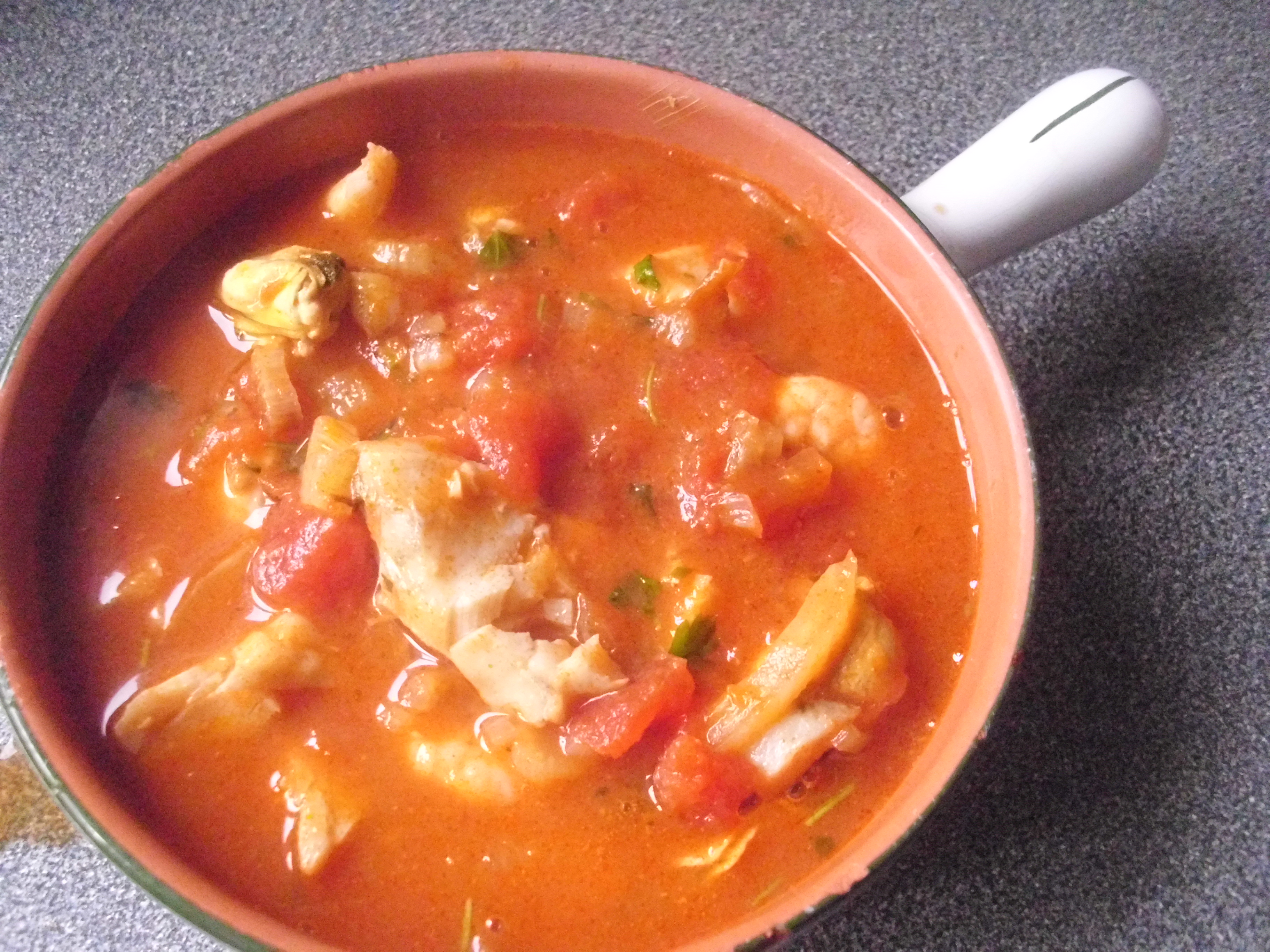
DSCI0101Cioppino is a fish stew originating in San Fransisco. It is considered an Italian-American dish, and is related to various regional fish soups and stews of Italian cuisine.  Cioppino is traditionally made from the catch of the day, which in the dish’s place of origin is typically a combination of Dungerness crabs, clams, shrimp, scallops, squid, mussels and fish. The seafood is then combined with fresh tomatoes in a wine sauce, and served with crusty bread. The dish is comparable to caccissio and brodetto from Italy, as well as other fish dishes from the Mediterranean region such as bouillabaisse, burrida, and bourride of French Provence, and suquet de peix from Catalan speaking regions of coastal Spain.

Cioppino was developed in San Francisco in the late 1800s by the famed Italian fish wholesaler Achille Paladini, (later titled “The Fish King”) who settled in the North Beach section of the city, he came from the seaport town of Ancona, Italy in 1865.  He originally made it when the boats came back from sea and the ‘left overs’ were used to make a fish stew, a few Dungeness Crabs were also added. It eventually became a staple as Italian restaurants proliferated in San Francisco. The name comes from ciuppin, a word in the Ligurian dialect of the port city of Genoa, meaning “to chop” or “chopped” which described the process of making the stew by chopping up various ‘left overs’ of the day’s catch.  Ciuppin is also a classic soup of Genoa, similar in flavour to cioppino, with less tomato, and the seafood cooked to the point that it falls apart.

Generally the seafood is cooked in broth and served in the shell, including the crab (if any) that is often served halved or quartered. It therefore requires special utensils and, importantly, a bib. My version is a lazy version but tastes fantastic and is much easier and quicker to cook.

Cioppino                                 Serves 3-4

  • 2 tbsp olive oil
  • small knob of butter
  • 1 banana shallot, finely sliced
  • 1 fennel bulb, finely sliced
  • 2 cloves garlic, sliced
  • 2 tbsp tomato puree
  • 150ml dry white wine
  • 400g tin chopped tomatoes
  • 1 tsp tabasco
  • 500ml fish stock
  • 500g of firm white fish (I used cod loin), cut into 2 inch pieces
  • 200g raw prawns
  • 1 pack ready cooked mussel meat
  • handful flatleaf parsley, chopped
  1. Heat the oil and butter in a large pan until melted then add the shallot, fennel and garlic. Turn the heat to low, cover and cook for about 10 minutes, checking occasionally to ensure it does not burn.
  2. Stir in the tomato puree, and white wine and cook for a few minutes to allow the alcohol to evaporate. Then stir in the tomatoes, Tabasco and fish stock.  Mix well and simmer gently for 30 minutes.
  3. Add the prawns and cod loin and simmer, uncovered, for 5 minutes then add the mussels and allow them to warm through for a minute.  Add the parsley, mix carefully, then serve with crusty bread.

This slideshow requires JavaScript.

Spicy potatoes with spinach

10 Aug

DSCI0052I love spinach, especially in curries.  One of my favourite side dishes is sag aloo. I have tried many recipes but, until now, have been disappointed.  This recipe is not a traditional sag aloo but it is delicious and, for me, is exactly what I want to accompany an Indian meal.

Full of nutrients and delicious taste, spinach is a winter superfood. But  what’s the best way to eat it? Here are a few tips, courtesy of Care2 website.

  • It’s wiser to choose tender baby spinach leaves. The larger the leaves, the  more mature they are and more likely to be tough or stringy.
  • Spinach  leaves that are placed under direct light in the stores have been found to  contain more nutrients than those stored in darkness.
  • Cooking spinach actually increases its health benefits!  Just half a cup of cooked spinach will give you three times as much nutrition as one  cup of raw spinach. That’s because the body cannot completely break down and use the  nutrients in raw spinach.
  • As an exception to the advice above, research studies show that taking  spinach in juice form is actually the healthiest way to consume it. Blend  spinach with other vegetables or fruits to create a delicious glass of juice.
  • There’s a compound in spinach called oxalic acid, which blocks the  absorption of calcium and iron. An easy way to solve this problem is to pair  spinach with a food high in vitamin C.
  • Freezing spinach diminishes its health benefits. The way to get the best  from the leaf is to buy it fresh and eat it the same day.
  • Do place spinach on your ‘organic shopping’ list, because the leaf tends to  be sprayed heavily with pesticides that don’t come off with normal washing.
  • Everyone talks about the benefits of spinach in nourishing the eyes and  building bones. What few know is that it also very good for digestion. Spinach  eases constipation and protects the mucus lining of the stomach, so that you  stay free of ulcers.  It also flushes out toxins from the colon.
  • Another lesser known benefit of spinach is its role in skin care. The bounty  of vitamins and minerals in spinach can bring you quick relief from dry, itchy  skin and lavish you with a radiant complexion. Regular consumption of fresh,  organic spinach juice has been shown to improve skin health  dramatically.

Read more: http://www.care2.com/greenliving/8-surprising-health-facts-about-spinach.html#ixzz2UwrG42ip

Well, here is the recipe.  Hope you like it.

Spicy potatoes and spinach                                     Serves 2-4 (depending on using as a main or side dish)

  • 400g waxy new potatoes (I used Charlotte), cut into 1 inch pieces
  • 2 tbsp sunflower oil
  • 1/2 tsp fennel seeds
  • 1 x 2 inch piece of cinnamon stick, halved
  • 1/2 tsp ground cumin
  • 1 onion, thinly sliced
  • 1 tsp ginger paste (or 1 inch root ginger peeled and grated)
  • 1 clove garlic, crushed
  • 1 tsp ground coriander
  • 1/2 tsp ground turmeric
  • 1/4 tsp hot chilli powder
  • 200g chopped canned tomatoes
  • 1/2 tsp salt
  • 200 ml warm cooking liquid (reserved from potatoes)
  • 1 bag washed and ready to eat baby leaf spinach
  1. Cook the potatoes in boiling salted water for about 10 minutes or until just tender.
  2. Heat the oil in a large non-stick pan or wok and add the fennel seeds and cinnamon stick.  Cook for a few seconds then add the onion, garlic and ginger.  Fry over a medium heat for about 5 – 10 minutes or until the onion is soft and just turning colour.
  3. Reduce the heat to low and add the coriander, cumin, turmeric and chilli powder. Stir fry for about 30 seconds then add the tomatoes. Increase the heat and cook until the tomato juice has evaporated.
  4. Cook the spinach as per instruction on packet. Drain and squeeze out excess juice then chop roughly and add to the tomatoes with the potatoes and 200 ml of the potato cooking water.  Season with the salt. Mix well and when warmed through, serve.

This slideshow requires JavaScript.