Shepherds pie with a twist

27 May

DSCI0166They say that some people eat with their eyes. Well, if that is the case then please ignore the picture of the finished dish here because it does nothing to sell the fantastic flavours combined in the dish.  My grandson, Danny, is always telling me to smarten up my photos but, to be honest, when I have a piping hot dish in front of me that smells delicious, the last thing I am thinking about is the appearance. All I want to do is eat it. Surely that is what good food is all about!  I am a slave to cookery programmes and often wonder just how warm some of the dishes prepared are for the customer when they have finished messing about with the appearance and ending up with a very pretty but heavily handled meal. A gourmet cook I will never be but at least my food is always hot and barely touched by human hand.

This Shepherds pie is probably unlike any you will have eaten before. The lamb is slow cooked until it droops of the bone and instead of mince (which I often find tasteless) you bite into succulent, meltingly tender pieces of lamb. The spices are subtle but give the meal a wonderful  flavour carried throughout the layers of lamb sauce, spinach and creamy mashed potato. If you like curry you will absolutely adore this.

I did wonder about adding a sauce but wasn’t sure what type would best suit the flavours of the pie. In the end I didn’t bother and I felt that the dish was perfectly moist so didn’t need any additional sauce. In fact, gravy, I believe, would have detracted from the eating experience.

Here is a link to the recipe with my slideshow below.  It is a bit fiddly but, trust me, it is well worth the effort.

http://www.bbc.co.uk/food/recipes/country_captain_95324

This slideshow requires JavaScript.

Jam and almond sponge tarts – served with childhood memories.

7 May

I remember as a small child helping my Grandma make these little tarts.  I don’t know if the recipe was hers or not but I loved cutting out the pastry and carefully putting the jam in the centre.  I wasn’t allowed to spoon the sponge mix on top as it was considered too difficult but I was allowed to do the best job of all – lick out the bowl at the end!  I imagined that everyone would have a childhood memory like this but that is not so.  My husband, for one, was not given home-made cakes so this memory is, for him, an adult one.  Mind you, he licks the bowl out with just as much relish as I did as a child.

I like to think I have carried on the tradition of making cakes and cooking with my own Grandchildren.  The eldest two, Danny and Hayden, used to cook with me every week.  To start with I used to get them cutting up vegetables etc but as time went on they wanted to do the actual cooking so I was relegated to the peeling and chopping.  I think Danny used to fancy himself as another Ainsley Harriet and I dread to think what the neighbours thought when he was yodeling!  Now my youngest Grandson loves cooking with me.  We started off with jam tarts.  I would make the tarts then he would make something similar out of the left over pastry.  It usually ended up looking quite black and unattractive but we all had to try one of his tarts.  The things you do for love!  Since then he has taken over the role I had as a child and he has progressed to making a pizza and popcorn!  I am sure, when they marry, their wives will be eternally thankful that I gave them at least some culinary skills.

Here is the recipe.  I hope you enjoy them as much as we do.

Jam and almond sponge tarts        Makes about 18

  • 8 oz plain flour
  • pinch of salt
  • 2 oz lard
  • 2 oz cooking margarine or butter
  • a little cold water
  • raspberry jam

For the sponge

  • 4 oz cooking margarine
  • 4 oz caster sugar
  • 4 oz self-raising flour
  • 2 eggs, beaten
  • 1/4 tsp almond essence
  1. Whizz the plain flour and salt together in a food processor or, if making the pastry manually, sift into a bowl.  Rub in the lard and margarine or add to food processor and whizz until like fine breadcrumbs.
  2. Carefully add cold water, a teaspoon at a time and work into the mix with a knife until it makes a soft, but not wet dough. 
  3. The experts will tell you to let this rest in the fridge for 30 minutes but neither I nor my Grandma did this and we have rarely, if ever had a failure.  Lightly flour a surface and roll out the pastry until it is about the width of a pound coin.  Cut out he shapes and line a tart tin.
  4. Place 1 tsp of jam in the centre of each tart.  Don’t be tempted to be over generous as the jam will seep out of the tart during cooking.
  5. To make the sponge – whizz together the sugar and margarine in a food process until it is light and creamy (or do this with a fork if you don’t have a processor.  Add the egg and flour a little at a time, alternating, and mix in well to prevent the mix from splitting.  When all the eggs and flour have been added mix in the almond essence.
  6. Carefully spoon about a dessert spoon of sponge mix over the jam, sealing the edges well.
  7. Bake in a an oven, preheated to 190C/180C fan/gas 6, for 20 -25 minutes or until they are golden and the sponge is cooked through.  To test this pierce with a skewer and it should come out clean.
  8. Cool on a wire rack. 

    This slideshow requires JavaScript.

Balti potatoes – my favourite side dish for a curry!

29 Apr

I have been making this side dish for a curry for years.  It was my Mum’s favourite.  Whenever she came down for the weekend, which was about twice a month, she would always ask for either a curry or a stir-fry.  She would never let me get away without making these potatoes if curry was on the menu.  They are quite spicy but you can calm them down a bit by putting in less chilli.  The recipe is for four people but I usually make extra as I find it is never enough.  Fennel seeds are one of the ingredients in this dish giving it a subtle but distinctive flavour.  I thought it would be good to find out a little more about this herb.

Fennel is part of the parsley family, and every part of the plant is edible.  Grown as a perennial in the Middle East and Europe, fennel has been harvested for hundreds of years.  If you have ever grown fennel you will know it is easy to cultivate but difficult to get rid of.  We had a plant in our herb garden and, years after we had pulled it up, we were still finding new fennel plants springing up in the most unlikely places.  Butterflies love it and I think the spread of the plant could be due to the seeds being spread by the butterflies and birds.

The slight licorice flavor of the herb complements sausages, fish and salads, making it popular in many cuisines.  The Greeks know it as maratho, named the herb after the famous Battle of Marathon, which was fought on a field of fennel.  It is used extensively to flavour their meats and stews. It is an ingredient in the Chinese 5 Spice powder and the Italians love to roast the bulbs in olive oil and sprinkled with parmesan or slice them raw in salads.  Fennel seeds are often used to add flavour to Italian sausages and they are a prime ingredient in some Indian cuisines.

Apart from the versatility of fennel in cooking, it has numerous medicinal properties.  Carminative properties of fennel are known from ancient times, as recorded in the Latin phrase “semen foeniculi pellit spiracula culi”, which literally means “the fennel seeds make blow the arsehole”.  Some may recognise the distinctive liquorice flavour in Gripe water, used to calm colic in babies, or in a cough linctus to calm the cough reflex.  In the Indian subcontinent, fennel seeds are eaten raw, sometimes with some sweetener, as they are said to improve eyesight.  Ancient Romans regarded fennel as the herb of sight. Root extracts were often used in tonics to clear cloudy eyes. Extracts of fennel seed have been shown in animal studies to have a potential use in the treatment of glaucoma.

Well, now we know fennel is great to have in the garden, lets look at the recipe.

Balti potatoes                                                    Serves 4

  • 3 tbsp vegetable oil
  • 1/2 tsp cumin seeds
  • 3 curry leaves
  • 1 scant tsp crushed dried red chillies
  • 1/4 tsp each of onion seeds, mustard seeds and fenugreek
  • 1/2 tsp fennel seeds
  • 3 garlic cloves finely chopped
  • 1/2 tsp grated fresh root ginger
  • 2 onions sliced
  • 6 large new potatoes (to make about the equivalent amount of potato to onion when raw)  sliced into 1/4 inch thick slices
  • small handful chopped fresh coriander
  • 1 red or green chilli, seeded and chopped finely
  1. Heat the oil in a wok.  Lower the heat slightly and add the cumin, curry leaves, dried chillies, onion, mustard and fenugreek seeds, fennel seeds, garlic and ginger.  Cook for about 1 minute or until the seeds start to pop then add the onions.  Cook gently for about 10 minutes or until the onions are soft and golden brown.
  2. Add the potatoes, coriander and green chilli.  Mix well, cover the pan and cook over a low heat for about 7 minutes or until the potatoes are tender.  Stir occasionally to prevent sticking.

    This slideshow requires JavaScript.

Mushroom hash – perfect with a fried egg!

21 Apr

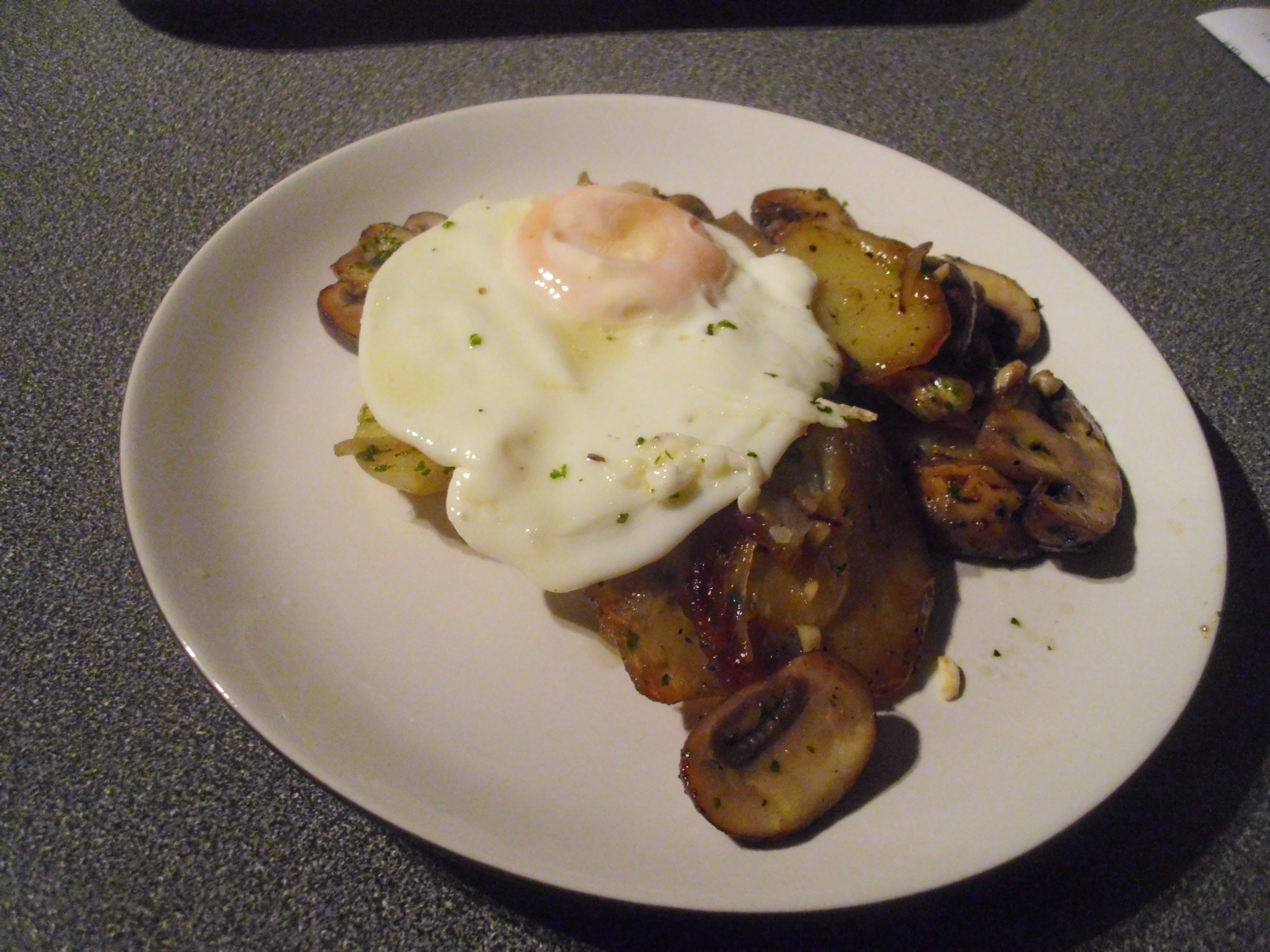
I have been making corned beef hash for years  (see recipe on blog) and thought how great it would be to make a vegetarian hash.  This mushroom hash is so simple and yet so delicious.  I served it with a fried egg to make it a complete meal, they went really well together.  I’ve included a little chopped chilli but this is optional as I know some of my friends don’t like spicy food.  I try to include at least one day a week when I only eat vegetarian food, but of late I have tried so many great vegetarian recipes I have found I am eating them more frequently.  I have to say I am no expert on vegetarianism so I thought I would see what I could find out.

The Vegetarian Society Defines a vegetarian as ‘Someone who lives on a diet of grains, pulses, nuts, seeds, vegetables and fruits with, or without, the use of dairy products and eggs. A vegetarian does not eat any meat, poultry, game, fish, shellfish or by-products of slaughter.” 

in the early 1800’s, there were a number of groups in Britain considering adopting a meat-free diet. They varied considerably but one key group involved in the setting up of the Vegetarian Society were the followers of Reverend William Cowherd, known as the Cowherdites. Reverend  Cowherd was the founder of the Bible Christian Church who believed that eating flesh was unnatural and was likely to make people aggressive.  He would preach abstinence from eating flesh to his congregation in Salford, and worked with them, encouraging self-improvement through education.  It was probably the practical support he gave that swung them around to his way of thinking, by providing warm food, medical help and free burial. His followers continued his work after his death and the wife of one of these, Martha Brotherton, published the first vegetarian cookbook in 1812.

If anyone is interested and wants to know more about the history of vegetarianism it is worth visiting the Vegetarian Society’ website. Just click on the link below:

https://www.vegsoc.org/

Here is the recipe.

Mushroom hash                               Serves 2

  • 12 oz floury potatoes (Desiree are good), peeled and cut into 1/4 inch thick slices
  • 2 oz butter
  • 2-3 tbsp olive oil
  • 1 onion, halved and thinly sliced
  • 1 small handful chopped fresh parsley
  • 1 red chilli, deseeded and thinly sliced (optional)
  • 2 cloves garlic, chopped
  • 10 oz mushrooms, thickly sliced
  1. Simmer the potatoes in boiling salted water for about 4-5 minutes until just tender.  Drain and reserve.
  2. Heat half the butter with a little of the olive oil in a non-stick frying pan and fry the potatoes over a medium to high heat, turning occasionally, until they are starting to go crisp and golden (about 10 minutes).
  3. In a separate frying pan heat half the remaining butter with a little olive oil and fry the onion over a low to medium until it is golden (about 10 minutes).  Tip into the potatoes, mix well and cook together for a couple of minutes.
  4. In the empty pan, melt the remaining butter and olive oil and cook the mushrooms and chilli (if using) over a high heat for a couple of minutes until they are lightly coloured on all sides.  Add the mushrooms, parsley and garlic to the potatoes.  Mix well and cook over a high heat for 1 minute to allow the flavours to meld.  Season to taste and serve with a fried egg. 

    This slideshow requires JavaScript.

Baked lemon sole – light and healthy

17 Apr

DSCI0057 This was such a delicious recipe and so light. It is perfect for a Summers day and even good enough for a dinner party.  I always used to shy away from having tomatoes with fish but have gradually come to realise they make an excellent combination.

I found this recipe in my Billingsgate Market Cookbook.  I bought it in a Charity Shop for just £5, an absolute steal.  Not only include fantastic recipes, all fish of course, but also tips on how to prepare the fish – filleting, preparing squid etc.  It is one of the few cookery books I have actually read from cover to cover!

This recipe is simplicity itself. It takes barely 20 minutes from start to finish and is absolutely gorgeous.

Here it is:

Lemon Sole with Roast Tomato, Basil and Parmesan     Serves 2

  • 2 small lemon sole, whole, filleted (ask your fishmonger to do this)
  • salt and freshly ground pepper
  • 4 small tomatoes, halved
  • 1 tbsp pine nuts
  • 1 tbsp extra virgin olive oil
  • 1 tbsp freshly grated Parmesan cheese
  • 1 tbsp freshly shredded basil
  • 1 tbsp balsamic vinegar
  1. Heat the oven to 200C/180C fan/gas 6
  2. Skin the fish and lightly season on the skinned side.  Fold the fillets into three to make small parcels.
  3. Transfer the fish to an oven-to table dish and tuck the tomatoes around the sides. Sprinkle the fish with the olive oil, pine nuts, Parmesan and a little black pepper.
  4. Roast in the oven for 10 to 12 minutes until the tomatoes are beginning to soften but not break up and the fish is cooked through.
  5. Sprinkle the top with the basil and balsamic vinegar and serve straight from the dish.

This slideshow requires JavaScript.

Lancashire Hotpot – no bones about it!

13 Apr

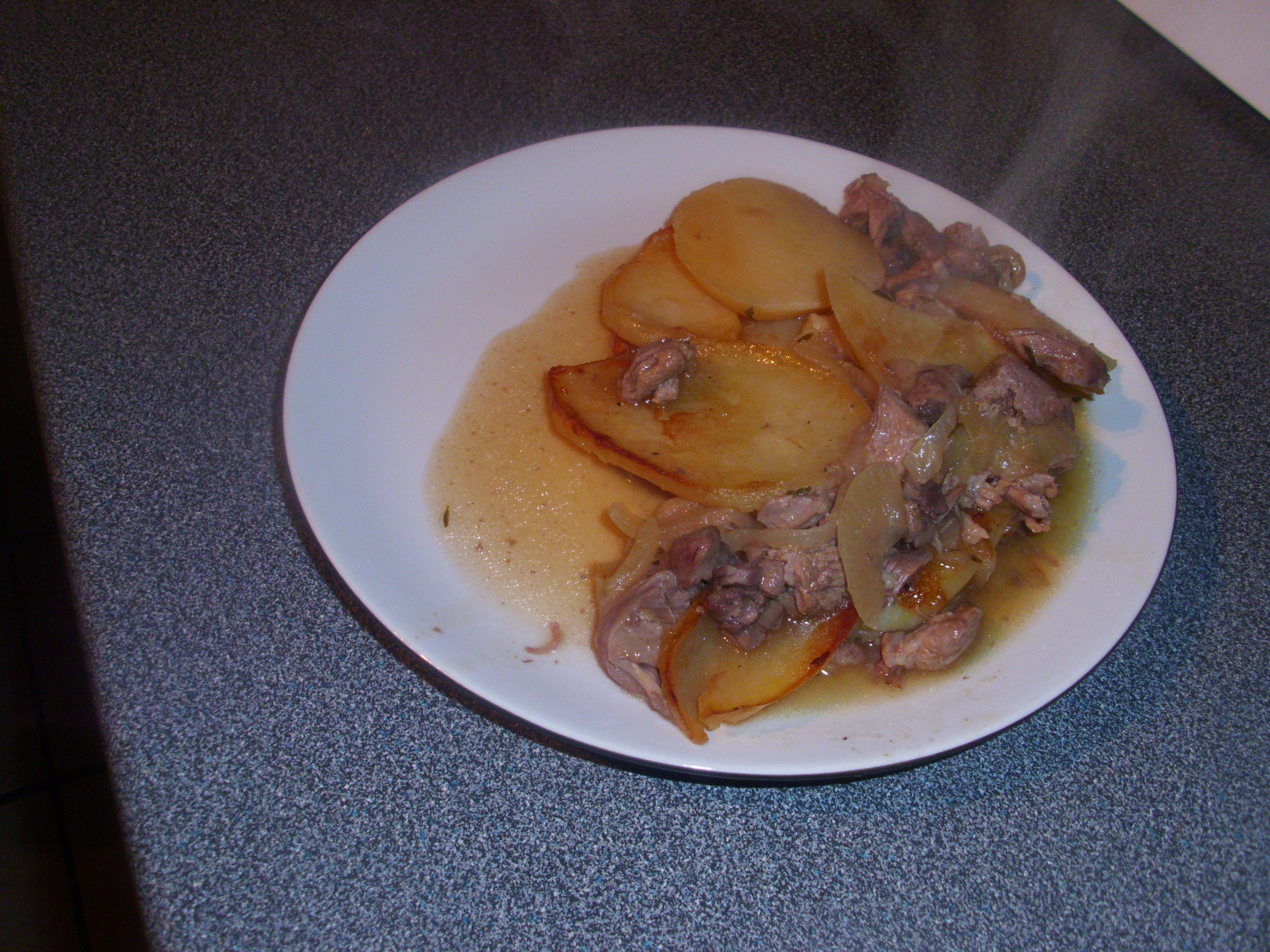
I absolutely love slow cooked meals with good, hearty ingredients of meat, vegetables and potatoes.  Lancashire hotpot is one such meal.  I have seen many recipes for this dish, in fact some have said that finding two cooks who will agree on what should go in a Lancashire hotpot is about as easy as finding a straight-talking politician. There is even disagreement about whether the basic meat included should be lamb or beef.  Most recipes, however, use lamb and this is usually on the bone which, personally, I think makes for messy eating and is almost impossible for small children to get their heads around.  One thing I do believe, is that the cheap cuts of lamb definitely have the sweetest meat and they are great for feeding a family on a low-budget.  I have made this recipe for many years, using either breast of lamb or neck chops, but you will find no bones, just tender chunks of sweet tasting meat.  I thought I would try to find out a little about the origins of Lancashire hotpot.

There is a fair amount of controversy about the origins of this dish but, in the main, the experts seem to concur that this was born from peasant food, used to fill the stomachs of hard-working industrial workers.  Given their finances, even this would probably have been a rare treat at the table.  In the days when cotton was king in towns throughout Lancashire, tall brown earthenware pots would be left on the range to simmer gently, the slow cooking getting the best out of cheap cuts of meat, using the embers of the last night’s fire. If properly assembled the dish needed no attention until the workers returned hungry from their labours. The whole family would be working long shifts in the mills, even the small children earning a few pennies a day there, so the dish was ideal for them.  The traditional meat was mutton, best-end of neck, middle neck, or even scrag end, from sheep farmed on the uplands of Lancashire since time immemorial. It is a sign of the times that mutton is now rarely sold, so modern-day hotpot is usually made from lamb.  Years ago, oysters, once the food of the poor in Britain, seasoned the gravy and gave it a more gelatinous texture, as well as adding cheap protein.  Today these have been replaced by kidneys.  Whatever the recipe this dish continues to be a firm favourite in Lancashire and now, made famous perhaps by Betty’s hotpot in Coronation Street, all over the UK.

Here is my version, made many, many times and has yet to fail.  If you have stock left over from stewing the lamb freeze it in rigid containers for another time.  Don’t worry about the kidneys, you will not know they are in the finished dish and they give the gravy an incredible flavour.  If you don’t want to go to the trouble of cooking the breast of lamb you could use left over roast lamb, cut into bite sized slices and make the lamb stock using a stock cube.

Lancashire hotpot                                 Serves 4

  • 1 breast of lamb or 4 large neck chops
  • 1 tbsp vegetable oil
  • 2 lambs kidneys, core removed and finely chopped
  • 2 onions, sliced
  • 2 tsp cornflour
  • 3/4 pt lamb stock (reserved from cooking the breast or neck chops)
  • 1 beef stock cube (not Oxo as it is too strong)
  • 1 tsp Worcester sauce
  • 1 tbsp thyme, leaves only
  • 2 lb potatoes (Maris Piper or Desiree are good), peeled and thinly sliced
  • Salt and freshly ground pepper
  1. Put the breast or neck chops of lamb into a large pan.  Barely cover with water and add two bay leaves.  Bring to the boil, cover and then simmer for about 1 hour or until the meat is falling off the bones.  Remove the meat and reserve the stock.  When the meat has cooled, remove the lean meat from the bones of the chops or, if using breast of lamb, from between the layers of fat and sinew.  Layer the meat in the bottom of an ovenproof dish.
  2. Preheat the oven to 170C/160C fan/gas 3.
  3. Heat the vegetable oil in a large, non-stick frying pan.  Fry the kidneys for 1 minute then add the onions.  Stir and fry slowly over a low heat for about 10 minutes until the onions are softened and just turning colour.  Stir in the stock, Worcester sauce, stock cube,and thyme.  Mix the cornflour with a little cold water and slowly stir into the onion gravy.  Season well, bring to the boil then pour over the meat.
  4. Top the onions with a layer of potatoes, overlapping them slightly.  Push the potatoes down a little so they become coated with stock.  Cover with foil and bake in the oven for 1-1.5 hours or until the potatoes are tender.  Remove the foil, turn the oven up to 200C/180C/gas 6 and continue cooking for a further 10-30 minutes or until the potatoes are brown.

This slideshow requires JavaScript.

Chicken Tagine – lovely.

5 Apr

DSCI0322I have only recently discovered the exotic flavours of tagines and I have absolutely fallen in love with them.  Previously I have made Lamb Tagines which are possibly more traditional but when I saw this recipe I decided to give it a go.  It tastes absolutely lovely, fragrant from the spices and preserved lemon but with a hint of sweetness from the dried fruit and the nutty flavour of the almonds. Wonderful!  The only change I made to the recipe was to limit the amount of orange peel to two small strips. I have had a few dishes that have included fresh orange and I have found that it can overpower the dish completely and gives it a flavour I am not too keen on.  Of course if you love orange in food feel free to add more of the peel to your liking.

The recipe includes saffron, the most expensive spice in the world.  It is native to the Mediterranean area and most imported saffron comes from Spain. I always buy some when I am there as it is so much cheaper than in the UK.

The ancient Assyrians used saffron for medicinal purposes. The Greeks and Romans used it to perfume their luxurious baths. The bright orange-yellow color also made saffron useful as a dye.

Each saffron crocus flower has 3 stigmas, it takes about 80,000 flowers (240,000) stigmas to make a pound of saffron. It takes an experienced picker about 12 days to pick this many. By the time saffron gets to retail stores, its cost is £450 to £1500 per pound.

In 1444 any merchant caught selling adulterated saffron in Bavaria was burned alive.

Here is the recipe. Serve it with couscous or rice, or maybe even orzo.  It can be frozen but defrost well before reheating.

Chicken Tagine                                              Serves 4

  • 2 tsp coriander seeds
  • good pinch of saffron
  • 2 tsp ground cinnamon
  • 1 tsp ground ginger
  • 6 skin on chicken thighs
  • 2 tbsp olive oil
  • 2 red onions, chopped
  • 4 cloves garlic, crushed
  • 1 inch piece of fresh root ginger, peeled and finely chopped
  • 1 cinnamon stick
  • 3 tbsp flaked almonds
  • 12 dates, pitted and halved if large
  • 2 small strips of orange peel
  • 2 tbsp pure maple syrup
  • 4 tbsp fresh coriander leaves, roughly chopped
  • 1 preserved lemon, rinsed well, flesh discarded and skin thinly sliced.
  1. Heat the coriander seeds in a dry pan until fragrant. Remove and grind.  Put the ground coriander, saffron, cinnamon and ginger in a bowl and mix well.  Rub the spice mix all over the chicken, put on a plate, cover and refrigerate for at least 1 hour or overnight.
  2. Heat the oil in a tagine or casserole over a medium heat. Add the onions, fresh ginger, garlic, cinnamon stick and 2 tbsp of the almonds with a good pinch of salt.  Fry until the onions are soft but not browned. Transfer to a plate.
  3. In the same pan, without washing it, add the marinated chicken, turn the heat up to high and sear the skin, turning as it browns. When golden brown all over return the onion mix and pour over enough water to just cover the chicken. Bring to the boil then cover and simmer for 1 hour, stirring occasionally.
  4. Add the dates, orange peel maple syrup and half the coriander. Simmer, uncovered for 20 minutes until the sauce is thick and syrupy.
  5. Serve the tagine on couscous or rice, sprinkled with the preserved lemon slices, coriander and remaining almonds.

This slideshow requires JavaScript.

Related articles

Pork chops with apples and sage – divine!

1 Apr

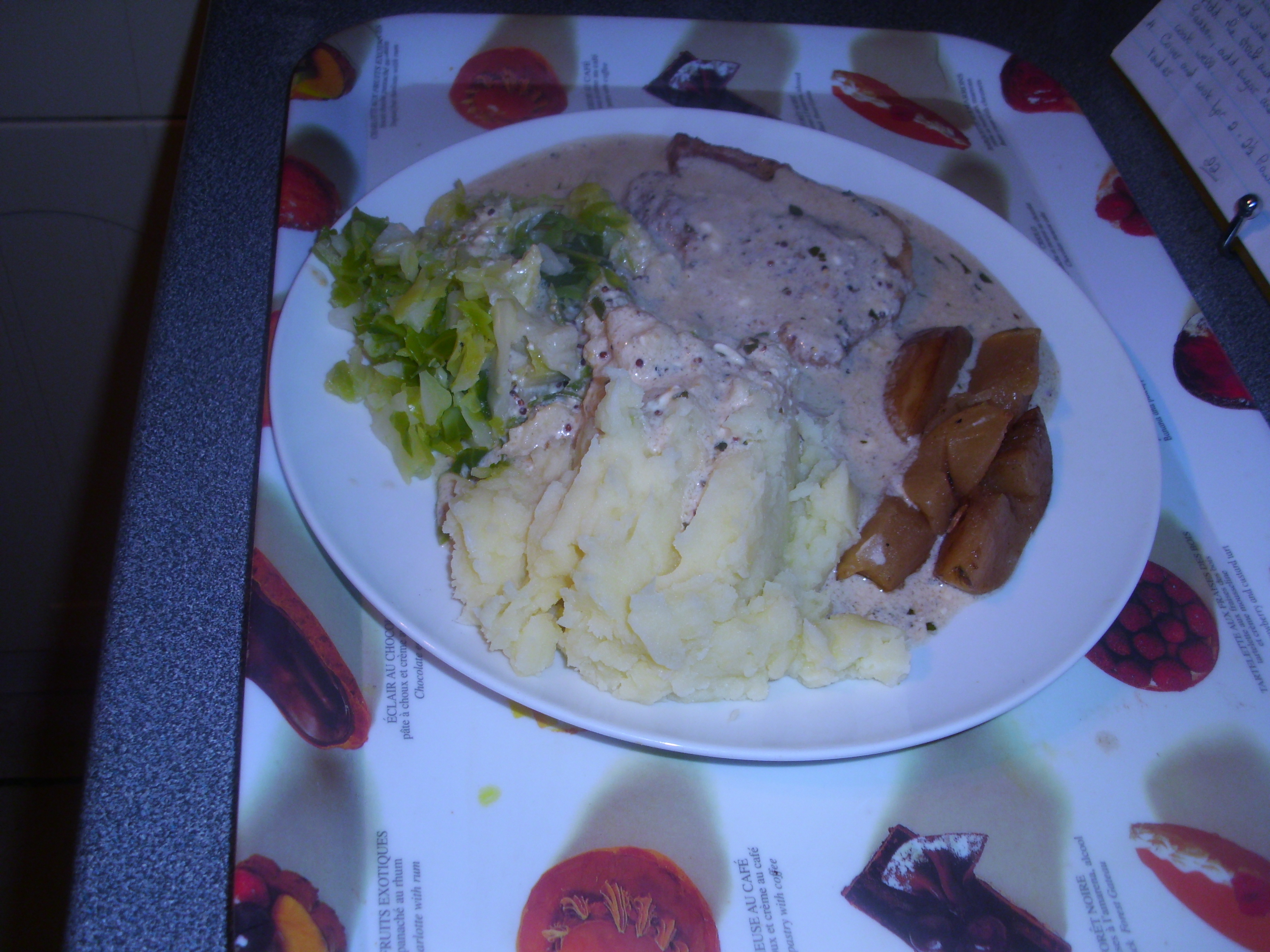
This recipe uses cider as the cooking liquor and I was a bit concerned it would be too sweet.  I shouldn’t have worried, it was absolutely gorgeous.  I served it with mashed potato and cabbage.  I think cabbage is a really underutilised vegetable and I have no idea why.  I often serve it with mashed potatoes and make sure I make more than I need so I can use up the leftovers in Bubble and Squeak for breakfast the following day.  Mmmmmm!!

Jason Atherton has recently presented in the BBC series, The Great British Food Revival.  His commentary stated that the cabbage, in particular the Hispi or pointed cabbage, is in crisis.  Sales of this type of cabbage have fallen by 71% and of cabbages in general by over 30% since the 1990’s.  The belief is that this wonderful vegetable is unpopular due to memories of school dinners, soggy cabbage, stinking cooking vapours and last, but not least, that it causes flatulence.  Mrs Beeton, no doubt the founder of the soggy, smelly cabbage, has stated in her cookery book that cabbage should be cooked for 45 minutes.Cabbage is also thought of as a winter vegetable, hence the decline in the sale of the summer growing Hispi.  The truth is, however, that today cabbages are grown all year round, so at any time you can select a cabbage that is seasonal and buy it from local producers.

Not only does the cabbage taste wonderful but it is also good for you.  Lincoln University have been doing studies on the health benefits of cabbage.  They have found that there is as much Vitamin C in 1 cabbage as there is in 1 orange.  They also contain Vitamin A which is good for eyesight and the greener the cabbage leaf, the more Vitamin A it will contain. Other studies have shown evidence that cabbages reduce cholesterol and protects against some types of cancer, whilst cabbage juice has anti-inflammatory properties.  The most recent studies show that red cabbage is good for memory loss and there are some suggestions that it may prevent the onset of Alzheimer’s.  All good reasons, I think, to eat more cabbage and follow the lead from Eastern European countries where it is part of their staple diet!

Jason did some fantastic cabbage recipes on the programme.  If you missed it you can watch it on the BBC iplayer.  Here is the link:

http://www.bbc.co.uk/iplayer/episode/b0178cf0/Great_British_Food_Revival_Series_Two_Herbs_and_Cabbage/

OK, here is the recipe.  I hope you love it as much as we do!

Pork chops with apples and cider                                Serves 4

  • 4 pork chops
  • 2 tbsp plain flour, seasoned with salt and black pepper
  • 1 tbsp olive oil
  • 1 tsp unsalted butter
  • 2 eating apples (Braeburn are good for this)
  • 250ml/9 fl oz dry cider
  • 1 tbsp chopped sage
  • 100ml/3 fl oz low fat creme fraiche
  • 1 tsp wholegrain mustard
  1. Heat the oven to 160C/150C fan/gas 3.  Lightly coat the chops in the flour.  Heat the oil and butter in a frying pan.  When the butter is dissolved fry the chops on both sides for a couple of minutes until golden brown.  Transfer to a shallow, ovenproof dish.
  2. Quarter and core the apples then cut into half to make 16 wedges.  Lower the heat in the pan then fry the apples until golden on both sides.  Arrange around the chops.
  3. Deglaze the pan with the cider then pour over the chops.  Cover the dish with foil and cook in the oven for 45 minutes to 1 hour, dependant on the thickness of the chops, or until the pork is tender and the apples are cooked.
  4. Transfer the pork and apples to a serving plate and keep warm.  Return the cooking liquor to the pan and add the sage.  Bring to the boil and reduce by half.  Take the sauce off the heat and stir in the creme fraiche and mustard.  Simmer for a few minutes then pour over the chops and serve. 

    This slideshow requires JavaScript.

Corned beef hash with a kick – a great supper dish!

28 Mar

My first taste of corned beef hash was made by my Aunty Bella.  She would be the first to admit that cooking is not her forte, but it tasted delicious, even though it looked a bit off-putting as all the ingredients were mushed together. I made it like this for years, and even packed it into a pie crust to make hash pie.  I have to say that the pastry did make it look more presentable.  Over the years I suppose I have picked up more cooking techniques.  It is true what they say, practice does make perfect although I am a long way from this Utopia at the moment.  The hash I make today is a far cry from my earlier attempts.  Each element of the dish is defined, the potatoes have a crisp outside but are tender and fluffy in the middle, there is an addition of heat from the chopped chillies and the parsley adds a freshness that lifts the dish into a new dimension.

It was interesting to read why the term ‘corned’ was used for this type of beef.  The term “Corned” comes from putting meat in a large crock and covering it with large rock-salt kernels of salt that were refered to as “corns of salt” This preserved the meat. The term Corned has been in the Oxford English Dictionary as early as 888 AD.   Salting meat goes back probably to ancient times in cold areas when they found that meat didn’t spoil if it made contact with enough salt.  This was a boon for soldiers and was actually the mainstay for British Soldiers in the Boer War and World War 1.

I was under the impression that corned beef came from Argentina and Uruguay.  I suppose that is down to Fray Bentos!  It is true that todays supplies come from these countries but, it appears that the origin of corned beef is Ireland.  In the 17th Century Ireland was, in fact, the first Country to make Corned Beef instigated by restrictions on exporting live cattle under the Cattle Acts of 1663 and 1667.  The Irish did not actually et Corned Beef themselves but exported it, canned, in large quantities to England.  The English called it Bully Beef and was the best source of beef during food rationing during the war.  It was the Irish immigrants to America that made the dish ‘Corned Beef and Cabbage’ popular in the US.  This is still eaten in huge quantities on the 17th March, St Patrick’s Day.

Well, here is the recipe.  I serve mine with a fried egg.  Makes a great brunch the morning after the night before, if you know what I mean!

Corned Beef Hash with a kick                 Serves 4

  • 3 tbsp vegetable oil
  • 1kg / 2 ibs waxy potatoes (eg Charlotte), diced into small pieces
  • 1 onion, chopped
  • 1 x 340g can Corned Beef, cut into 1 inch cubes
  • 1 red chilli, seeded and thinly sliced
  • handful of chopped fresh parsley leaves
  1. Heat the oil in a large frying pan over a medium heat and fry the potatoes, stirring occasionally, for about 15 minutes or until they are starting to turn colour.  Add the onion and continue to cook for 10 more minutes until the onion is soft and the potatoes are golden.
  2. Add the chilli and corned beef carefully stir together, then cook for 6 minutes until the hash is starting to go crispy in places.  Stir in the parsley and season with salt and black pepper.
  3. Serve hot, topped with a fried egg.

    This slideshow requires JavaScript.

Yorkshire puddings with lamb and onions – almost a meal in one!

20 Mar

Yorkshire puddings are so versatile.  I love Toad-in-the-hole and I remember having them smothered with jam for a dessert when I was young.  This recipe is taken from the idea of  Toad-in-the-hole but instead of sausages, uses lamb chops.  I have been surrounding my lamb chops roasting in the oven with a batter mix for years.  The juices from the meat give the batter a fantastic flavour and I absolutely love the crunchy bits, making sure I scrape every last one from the bottom of the dish.  Some time ago I made a Toad-in-the-hole which had used onions as well as sausages .  The result was fantastic.  I thought I would try the idea with the lamb chops and I was pleasantly surprised with the results.  I hope you give it a try.

I’ve always been a little confused about the different terminology for meat from a sheep so I took a look on Wikipedia and was amazed at how many classification there were.  Below is some information from their page.

The strict definitions for lamb, hogget and mutton vary considerably between countries. In New Zealand for example, they are defined as follows:

  • Lamb — a young sheep under 12 months of age which does not have any permanent incisor teeth in wear
  • Hogget — a sheep of either sex having no more than two permanent incisors in wear
  • Mutton — a female (ewe) or castrated male (wether) sheep having more than two permanent incisors in wear.

Younger lambs are smaller and more tender. Mutton is meat from a sheep over two years old, and has a less tender flesh. In general, the darker the colour, the older the animal. Baby lamb meat will be pale pink, while regular lamb is pinkish-red.

Other definitions include:

  • Lamb — a young sheep that is less than one year old
  • Baby lamb — a milk-fed lamb between six and eight weeks old
  • Spring lamb — a milk-fed lamb, usually three to five months old, born in late winter or early spring and sold usually before July 1
  • Yearling lamb — a young sheep between 12 and 24 months old.
  • Salt marsh lamb  — the meat of sheep which graze on salt marsh in coastal estuaries that are washed by the tides and support a range of salt-tolerant grasses and herbs such as sampfire, sorrel and sea lavender. Depending on where in the world the salt marsh is located, the nature of the plants may be subtly different.  Places where salt marsh lamb are reared in the UK include Harlech and the Gower Peninsular in Wales, the Somerset Levels and Morecombe Bay.

Well here is the recipe.

Yorkshire pudding with lamb and onions                   Serves 2 (easily doubled)

  • 4 lamb chops
  • 1 small onion, peeled and cut into wedges
  • 1 tbsp olive oil
  • 100 g/4 oz plain flour
  • 2 eggs
  • 250 ml/1/2 pt semi skimmed milk
  1. Heat oven to 220c/200c fan/gas 7.
  2. First make the batter.  Sift the flour into a bowl, add a pinch of salt and beat in the eggs and then sufficient milk to make a smooth batter that is thick enough to coat the back of a wooden spoon.  Chill in the fridge until needed.
  3. Arrange the lamb chops and onion wedges in an ovenproof dish and drizzle with the oil.  Roast for 20 minutes.
  4. Remove from the oven and then quickly pour in the batter.  Return to the oven and cook for 35 minutes or until the batter is risen and a golden brown. 

    This slideshow requires JavaScript.