Chicken Oregano on the BBQ – just need the sunshine and you could be anywhere in the Med!

12 Apr

The first time we had this chicken dish was in Rhodes in the Spring.  I had just retired and we had rented a Villa for a month.  We cooked it on an old tin BBQ in the garden and I don’t think food ever tasted better.  Since then we have cooked it over and over again.  It is such a simple recipe and it never fails, unless of course you burn the chicken before it is cooked in the centre. Jamie Oliver has a top tip for BBQing chicken that prevents this. Butterfly the joint (pare the meat away from the bone so it is exposed).  The bone is then able to conduct the heat so that the chicken is cooked through without running the risk of having a burnt outside while the middle is still raw.  Works every time for us!

Before I share the recipes I am reminded of a great evening we spent with friends in Aegina.  I am sure I have mentioned Aegina before, and no doubt will do again.  It is, without doubt, one of our favourite Greek Islands.  Marc and Jane have a lovely house just outside of Aegina town and they had invited us to stay with them for a few days.  On this particular evening we were going to have a BBQ. Marc had made his own BBQ out of half an oil drum, a sight many that have been to Greece will be familiar with. He confessed that he was not very good at lighting the BBQ and that he always started early as it usually took umpteen attempts.  I can still see Terry’s face when he watched him prepare the charcoal, and Marc’s face when Terry took over the proceedings and lit the BBQ first time.  Marc was amazed and promised undying gratitude for the lesson.

The chicken has been marinating in the fridge for 3 hours and is now ready to be cooked.  All we need now is for our neighbours to arrive and let the party begin! Here are the recipes.

Chicken Oregano                                                 Serves 4

  • 8 chicken portions (Drumsticks and thighs) skin on, butterflied (see above)
  • 120 ml/4 fl oz olive oil
  • 120 ml/4 fl oz dry white wine
  • 2 tbsp. dried oregano
  • Salt and freshly ground black pepper, to taste
  • 2 cloves garlic, crushed
  1.  Arrange the chicken portions in a large shallow dish. 
  2. Mix all the other ingredients together well then pour over the chicken.  Cover and refrigerate for 2 – 3 hours, turning occasionally.
  3. Half an hour before you are ready to eat, remove the chicken from the marinade and cook on an oiled BBQ rack or under a preheated grill for about 30 minutes, turning occasionally, until the chicken is golden and cooked through and the skin is crisp.  Serve the chicken immediately.

    This slideshow requires JavaScript.

Feta and watermelon salad – really refreshing

8 Apr

DSCI0622Sometimes the simplest of recipes are the best. This salad is so refreshing. Perfect for a Summers day, shared with friends, in the sunshine, washed down with a chilled bottle of wine. Although we have never had a salad with watermelon as an ingredient, we both thought this reminded us of holidays in the Mediterranean, especially the great times we had in Greece over the years.  It does contain olives which I know are not to everyone’s taste but they are definitely an integral part of this salad as their saltiness perfectly offsets the sweetness of the melon, creaminess of the Feta and crunchiness of the cucumber.  Altogether a delightful salad and one I am sure we will be having over and over again.

When a recipe is as simple as this it is absolutely imperative that you choose the freshest and best ingredients possible.  The salad has to be served chilled so put all the ingredients in the fridge for at least 24 hours so you can serve it immediately when assembled.  Feta can vary in flavour and texture from the cheap variety to the sublime. In Greece it is cut off a block which is kept in a bath of brine and this is definitely the way to buy Feta wherever you are.  It is sold in tubs, soaked in brine, usually oak aged, in most supermarkets and it is definitely worth the few extra pence.  Terry’s Mum, who came from Crete, always told us never to buy melon that had been cut up as it was poisonous. I think this was possibly an exaggeration but I have always bought my melons whole just in case.  The olives, in my mind, have to be Kalamata, possibly the best olives in the world and please use good extra virgin olive oil for the dressing. You will reap the rewards.

Well, here is the recipe.

Feta and watermelon salad                 Serves 2

  • 1/2 cucumber, cut into quarters lengthways, deseeded and sliced
  • 1/2 small watermelon, deseeded, cut into 1 inch pieces
  • 150g tub of Feta cheese
  • Handful go Kalamata olives, pitted and halved
  • Small handful of chopped mint
  • Drizzle of extra virgin olive oil (about 1 tbsp)
  • About 1 tbsp of lemon juice (from a fresh lemon)
  1. Put the cucumber and watermelon in a salad bowl.  Scatter with the olives and mint. Drizzle with the olive oil and lemon juice then carefully mix.  Crumble the feta on top.
  2. Serve immediately, chilled.

This slideshow requires JavaScript.

Cardamom butter chicken – absolutely delicious.

23 Mar

This is a fantastic curry, fragrant and creamy and not too hot.  It suited my palate perfectly.  A large number of cardamoms are used in the recipe so here is a little information on this aromatic spice.

  • Cardamom is the dried, unripened fruit of the perennial Elettaria cardamomum. Enclosed in the fruit pods are tiny, brown, aromatic seeds which are slightly pungent to taste.
  • Throughout the Arab world, Cardamom is one of the most popular spices, with Cardamom coffee being a symbol of hospitality and prestige.
  • The spice is also very popular in the Scandinavian countries where it is used more extensively than cinnamon.
  • Cardamom is one of the oldest spices in the world, and the most popular spice in ancient Rome was probably cardamom. It is the world’s second most expensive spice, saffron being the most expensive.
  • In the Canterbury Tales, cardamom is “the spice of paradise.”
  • A member of the ginger family, cardamom can be traced as far back as the 4th century.
  • It makes appearances in famous written tomes like The Bible and The Arabian Nights.
  • The spice has been used as a form of bartered currency in India for centuries, and now is cultivated in roughly half a dozen exotic locations across the globe.
  • Most closely associated with Indian, Middle Eastern, and Scandinavian cuisine, cardamom has had many uses throughout its long life. Its enticing aroma was said to have been used as perfume by the Greeks and Romans, while the Egyptians used it to freshen breath. The spice is more commonly used in the complex curry and masala dishes of Indian and Middle Eastern cuisine. Scandinavian cookery uses it in baked goods such as pastries and breads, while Turkish and Arabic cuisines throw it in with pilafs and other flavorful rice dishes. The spice adds dimension to pickles, and to a surprising array of beverages including Russian liqueurs, various mulled wines and punches, Indian and Moroccan sweet drinks, and Arabic coffee.
  • Cardamom blends very well with other spices and is therefore found in numerous spice blends, including Moroccan ras el hanout (cardamom, cassia, mace, clove, cumin, rose petals, etc.), Middle Eastern zhug (cumin, cardamom, garlic, chilli), and Indian garam masala (cumin, coriander, cardamom, pepper, clove, mace, cinnamon, etc.). (Courtesy of Foodreference and Professor’s House websites)

The recipe was in the June edition of Good Food.  Here is a link to it on their website

This slideshow requires JavaScript.

http://www.bbcgoodfood.com/recipes/2220652/cardamom-butter-chicken

Prawn and salami with spaghetti

19 Mar

DSCI0567I cannot begin to tell you how delicious this recipe is.  Normally I struggle to eat all the food on my plate but this was an exception. In fact, it was so lovely, I could happily have gone back for seconds if there were any.

I would never have imagined salami would be a match for prawns but they work so well together.

Salami is cured sausage, fermented and air-dried meat, originating from one or a variety of animals. Historically, salami was popular among Southern European peasants because it can be stored at room temperature for periods of up to 30–40 days once cut, supplementing a possibly meager or inconsistent supply of fresh meat. Varieties of salami are traditionally made across Europe.

Varieties of salami include:

  • Cacciatore (Cacciatora, Cacciatorini) “Hunter” salami. Italy.
  • Chorizo, also spicy Iberian variant
  • Ciauscolo, typical of Marche
  • Fegatelli
  • Felino, Province of Parma
  • Finocchiona, typical of southern Tuscany
  • Genovese
  • German salami
  • Kulen spicy salami characteristic for Slavonia, Vojvodina and parts of Baranya
  • Milanese
  • Pepperoni
  • Saucisson sec (French “dry sausage”)
  • Soppressata, typical of Calabria
  • Spegepølse (Danish, means salted and dried sausage)
  • Winter salami (Hungarian Téliszalámi)

Here is the recipe. Hope you enjoy it.

Prawns and salami with spaghetti                          Serves 2 – 3

  • 1 tbsp rapeseed or olive oil
  • 1 small red chilli, seeds removed then thinly sliced
  • 1 fat clove garlic, finely chopped
  • 5 slices of Italian Salami, thinly sliced into strips
  • 10 cherry tomatoes, halved
  • 1 pack (240g) raw prawns
  • small handful parsley, roughly chopped
  • 200g spaghetti
  1. Heat the oil in a wok and bring a saucepan of salted water to the boil
  2. Turn down the heat under the wok to low and fry the chilli and garlic for 2 minutes. Make sure they don’t burn.
  3. add the salami and fry for a couple of minutes then add the tomatoes.  Cook for 5 – 10 minutes until the tomatoes have broken down and formed a sauce.
  4. In the meantime add the spaghetti to the boiling water and cook as per packet.
  5. Add a couple of spoons of the pasta cooking water to the tomato sauce and then add the prawns.  Mix well and cook for 5 minute or until the prawns have turned pink and cooked through, stirring occasionally and adding a little more pasta water if it becomes too dry.  Add the chopped parsley and mix together.
  6. Drain the spaghetti and add to the prawn mix.  Toss together to coat the spaghetti in the sauce then serve immediately.


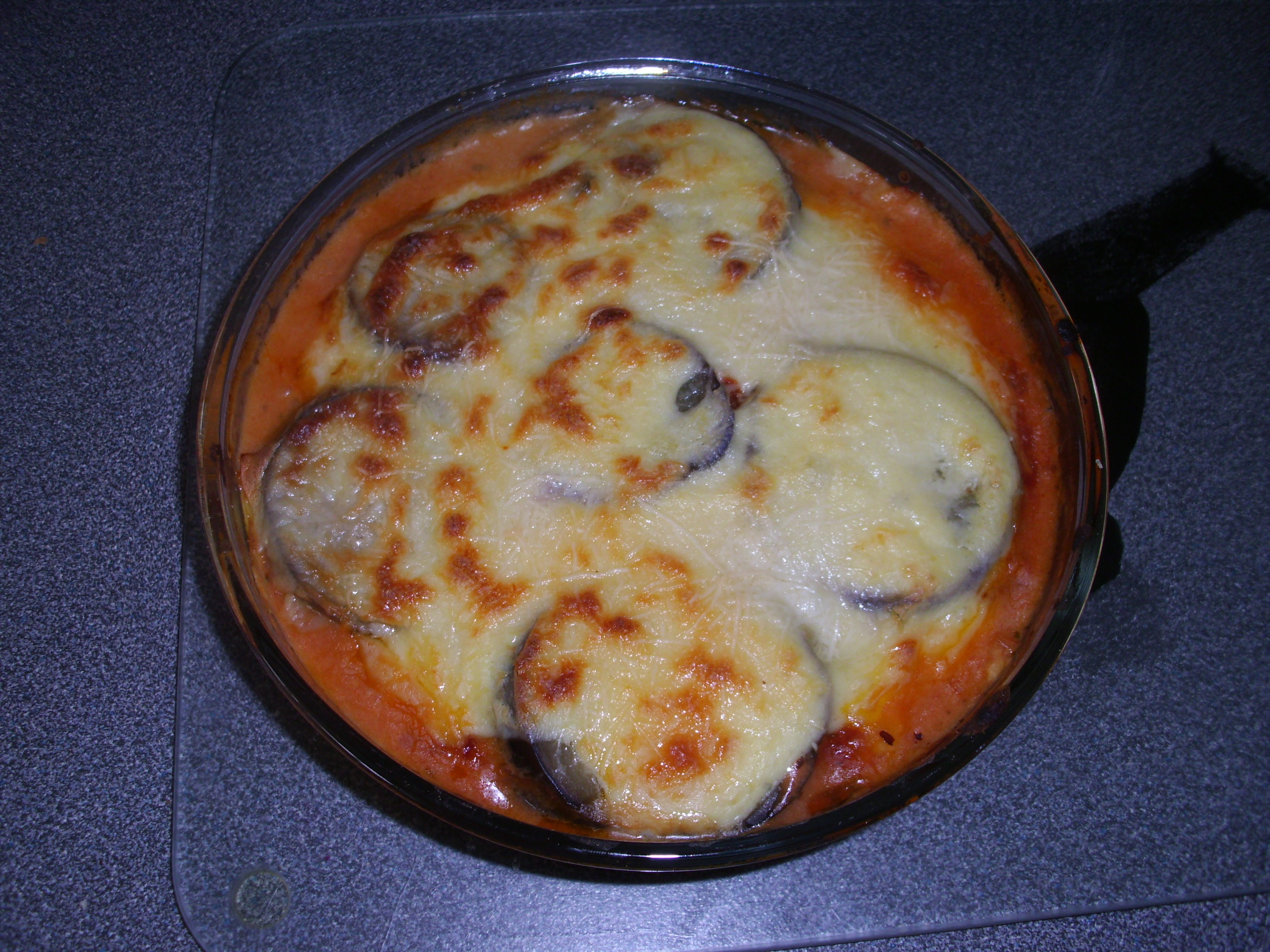
Melanzane, all the flavours of the Mediterranean.

15 Mar

  My daughter-in-law is vegetarian and I am always on the look out for tasty vegetarian recipes.  The funny thing is that, since I have started doing this, my husband has started eating vegetarian meals and loving them.  I never thought I would see the day.  This recipe is an excellent example of a meal Terry can’t get enough of.  He loved it so much the first time we had it, that he ate the leftovers for lunch on the next two days.  That’s another thing that is unheard of!

I’m not sure what I like best about this meal.  It’s a bit fiddley to make but, once all the layers are prepared, takes second to put together.  It’s a meal in itself, just eat it with crusty bread.  It warms up well and I have even frozen it successfully.  Best of all though, is the creamy taste of the cheese sauce as it melds with the tomatoes and aubergines.  Mmm!

The dish is from Southern Italy.  There are numerous recipes for it, you will find one in almost all Italian cookbooks and I have seen a few over the years in the cooking journals I subscribe to.  I can’t remember where I saw this recipe as it was so long ago, but I have made it numerous times, at home and on holiday, and it always turns out the same, delicious.  If you are trying to watch the calories I believe it will turn out just as well if you make the sauce with semi-skimmed milk and use half fat cheddar.  There is very little fat in the remainder of the dish as the aubergines are blanched rather than fried.  As they absorb so much fat when fried, this will automatically make the dish lower in fat and healthier.

Aubergines are a common ingredient in Mediterranean cooking so it would be easy to assume they originated there.  Not so!  Aubergines are native to India and it is thought it was introduced to the Mediterranean area by the Arabs in the Middle Ages.  There are numerous varieties.   The most common in Europe and North America is the large, deep purple variety.  In Thai they prefer the small berry type, sometimes green and sometimes pale purple.  Indian cuisine favours the small round or long thin purple fruit.  The seeds are bitter as they contain nicotinoid alkaloids, not surprisingly as it is related to the tobacco plant.  At one time aubergines were thought to be poisonous as they are related to the Nightshade family but in India they use it daily in cooking and even grind it to a paste to help heal wounds.

Anyway, to the recipe.

Melanzane

  • 1tbsp olive oil
  • 1 onion, finely sliced
  • 2 large garlic clove, crushed
  • 700g jar passata
  • 6 ripe tomatoes, skinned and deseeded
  • 2 tsp dried oregano
  • 1tsp caster sugar
  • 2 large aubergines, thinly sliced into rounds
  • 500ml/1 pt cheese sauce (bought or home-made)
  • 100g Parmesan, grated.
  1. Preheat oven to 200C/fan 180C/gas 6.
  2. Make the tomato sauce by heat oil in a deep frying pan and frying the onions for 4 minutes until softened.  Add the garlic and cook for a couple more minutes, making sure it does not burn.  Add passata, chopped tomatoes, oregano and sugar.  Bring to boil and remove immediately from the heat.  Set aside.
  3. Make the cheese sauce (if using) by adding 2oz/50g butter, 1.5 oz/37g plain flour and 500 ml/1pt milk in a pan over a medium heat.  Whisk continually until the sauce thickens.  Add 4oz/100g grated cheddar cheese and 1 tsp English Mustard.  Set aside.
  4. Blanch the aubergine slices in a large pan of boiling salted water for about 5 minutes until softened but still holding their shape.  Drain onto kitchen paper.
  5. To assemble the dish, place half the tomato sauce in the bottom of a ovenproof dish.  Arrange half the aubergines on top then drizzle with the cheese sauce.  Sprinkle with cheese.  Repeat ending with the remaining cheese sauce and grated parmesan.
  6. Bake in the oven for about 30 minutes until golden and bubbling.

    This slideshow requires JavaScript.

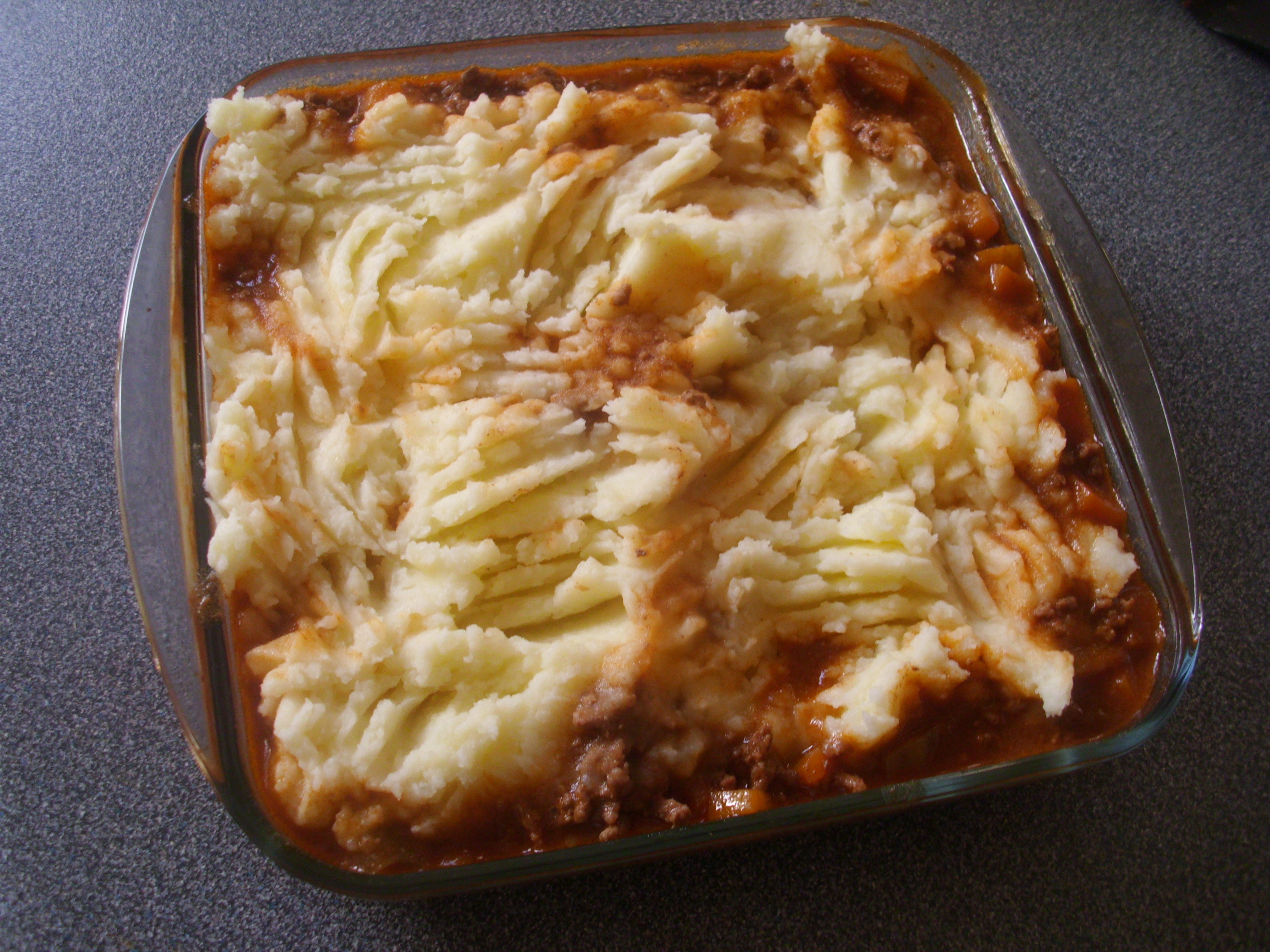
Cottage Pie! Comfort food at it’s best!!

7 Mar

There are days when nostalgia takes over and you want to eat something great that you remember from your childhood.  This is one of those days!  The sunshine from yesterday has gone, replaced by dark clouds.  Its time to eat something really comforting like Cottage Pie.

I remember eating cottage pie at my Grandmothers on a Monday dinner time.  Dinner time , in those days, was always 1300 hours.  If you were a minute late your dinner would be in the dog!!!!  She would have been a great sea captain! 

There is something fantastic about the smell of cottage pie as it cooks in the oven and the crunch as the spoon breaks through the crispy edges of the mashed potato to reveal the luscious beef mix below.  Yum!!!!!!!!  Grandma used to make hers using the beef left over from Sunday Lunch.  There was never very much beef, not even on the Sunday, so she would mince it and pad it out with chopped up vegetables.  I suppose it was one way of getting her Grandchildren to eat them.  Whatever the agenda, I know that we all loved her pie.  While we are talking of not wasting food, for tea we would eat dripping from the roast beef, spread onto warm toast and sprinkled with a little salt.  Oh, the memories! 

There are all sorts of variations on the cottage pie.  Shepherds pie is the most common, and is associated with minced lamb rather than beef.  Cottage Pie was first recorded in 1791 when the potato was used by the poor.  Cottage came from the work cottages they lived in.

I’ve tried all sorts of Cottage Pie recipes.  One included baked beans, some with cheese mixed into the potato topping, some tending towards an Italian version, using pancetta and red wine in the beef mix.  All were really tasty and healthy too.  My favourite though has to be my Grandmas version.  I am serving it with boiled cabbage and gravy.  Heaven!

Grandmas’s Cottage Pie          (Serves 4)

  • 1 tbsp vegetable oil
  • 1 onion, roughly chopped
  • 2 carrots, roughly chopped
  • 1 stick celery, roughly chopped
  • 500g (1lb) beef mince (lean)
  • 2 tbsp tomato puree
  • Splash Worcestershire sauce (or to taste)
  • 500 ml (1pt) beef stock
  • 1kg (2 lbs) old potatoes (I use Maris Piper), peeled and cut into 2 inch chunks
  • Knob of butter
  • A little milk.
    1. Heat the oil in a pan then add the onion, carrots and celery.  Fry on a medium heat for about 10 minutes until the vegetables are starting to soften but are not coloured.
    2. Add the beef mince, crumbling to break up any large lumps.  When browned, add the tomato puree and Worcestershire Sauce.  Cook for a couple of minutes, stirring so it doesn’t catch on the bottom of the pan.  Add the stock, mix well.  Bring to the boil then simmer over a low heat for about 30 minutes.
    3. Heat the oven to 180C/160C fan/Gas 4. 
    4. Meanwhile, make the mashed potato.  Add the potatoes to salted boiling water, cover and simmer over low heat until potatoes are tender (about 15 minutes).  Drain well then return to pan.  Add the butter and milk and mash everything together until smooth.
    5. When the beef is ready tip into ovenproof dish.  Top with the potato then bake in the oven for about 20 minutes or until the top is browned and the beef is bubbling around the edges.
    6. If you want to, you can freeze this at the end of Step 4.  Make sure it is cold before you put it in the freezer.  Defrost and continue with Step 5 when you want to eat it. 

      This slideshow requires JavaScript.

    Vegetarian chilli – really tasty

    3 Mar

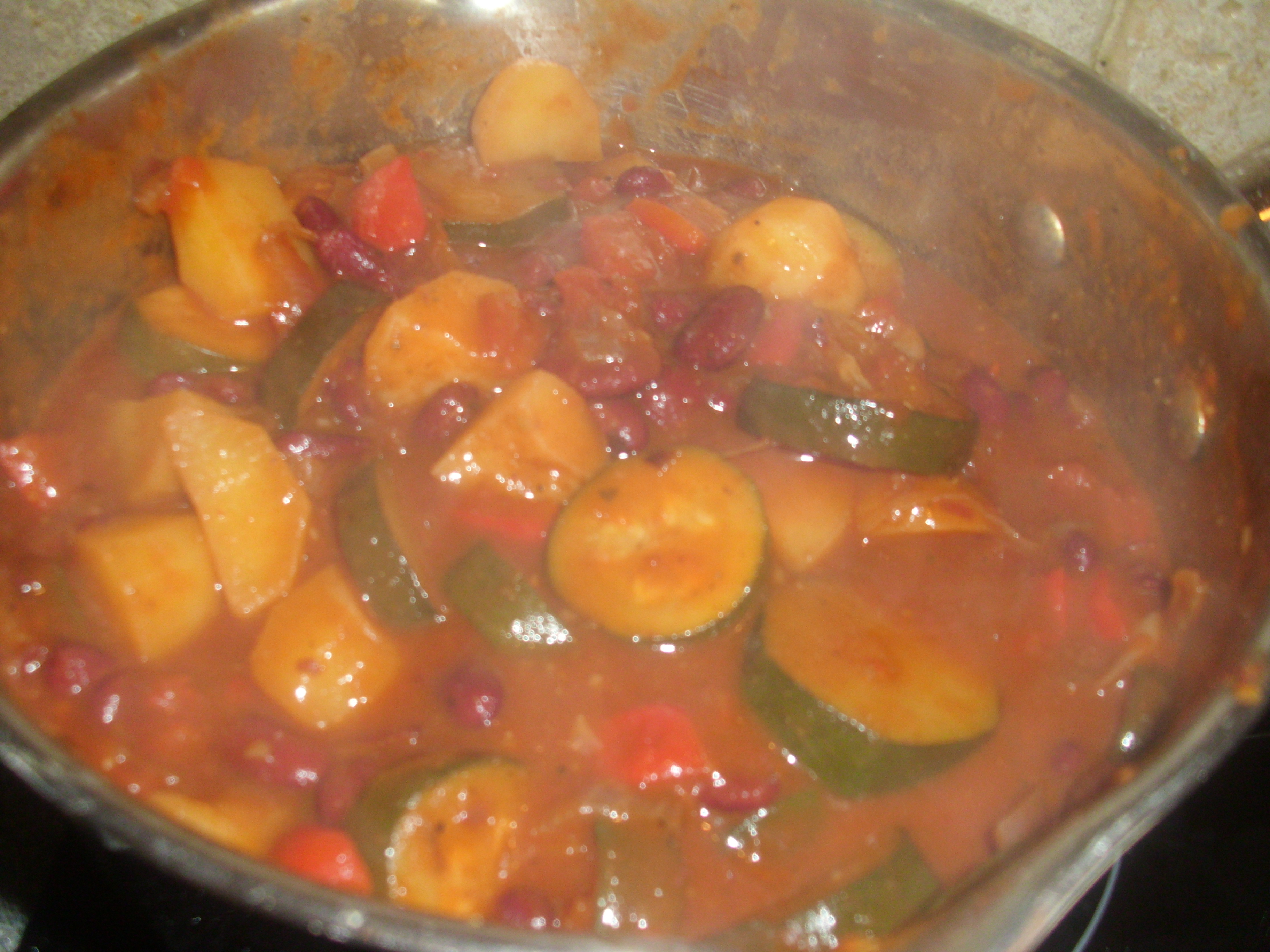
    DSCI0516I am beginning to think my husband is a closet vegetarian.  If my son and his family are coming for a meal I always have to cook a vegetarian version of the recipe for my daughter-in-law.  This time it was a chilli and I have to say, he admitted to it being outstanding.  I like it so much I opted for the veggie version rather than the beef chilli myself!

    I always use canned red beans for my chillies, rinsing them under water as directed on the can before adding to my recipes.  You can of course, cook red beans from dried yourself.  Be careful, however, that these are cooked properly.

    Raw kidney beans contain lectin, a glycoprotein that can bind to sugars in membranes, causing changes in the membrane that lead to agglutination (clumping of cells) and mitosis (cell division). In the digestive tract, they bind to intestinal cells and block absorption. An episode of red bean poisoning lasts about four hours, beginning with nausea and severe vomiting and proceeding to diarrhea. Hospitalization is rarely necessary. The kidney bean lectin (phytohaemagglutinin) is destroyed by thorough boiling for about 10 minutes, after which water should be discarded and replaced before cooking. Red kidney beans are not appropriate for crock pot cooking.

    I found this recipe in my well used and trusted cookery book by Judith Wills -‘Top 200 Low Fat recipes’ and adapted it to my own tastes.  It is so thick and unctuous you don’t miss the meat at all.

    Vegetable chilli                             Serves 4 – 6

    • 1 tbsp groundnut oil
    • 2 medium red onions, thinly sliced
    • 1 red pepper deseeded and chopped roughly
    • 2 cloves garlic, crushed
    • 1 birds eye chilli, chopped
    • 1 tsp each ground coriander and cumin seeds
    • 1 tsp mild chilli powder
    • 400g new potatoes, peeled and cut into 1 inch pieces
    • 2 large courgettes, sliced
    • 400g can of red beans
    • 400g can chopped tomatoes
    • 1 tbsp tomato puree
    • 200 ml vegetable stock
    • salt and pepper
    • Tabasco to taste
    • handful of fresh coriander, chopped
    1. Heat the oil in a large pan and sauté the onions and peppers over a medium heat for 5 minutes until softened and just turning brown. Add the garlic, chilli, coriander, cumin and chilli powder and stir for a couple of minutes.
    2. Add the remaining ingredients except the Tabasco and fresh coriander, mix well and bring to the boil.
    3. Reduce the heat, cover and simmer gently until the vegetables are tender. Half way through the cooking time test the chilli for heat. If you want it a bit hotter then add a little Tabasco sauce.
    4. When cooked, check the season and serve with the fresh coriander.  I like to sprinkle mine with grated cheddar cheese. Perfect on rice or jacket potatoes.


    This slideshow requires JavaScript.

    Chilli chicken and broccoli noodles

    2 Mar

    DSCI0598I cannot tell you how wonderful this dish is.  Not only is it delicious but it is quick and really easy to make.  I was a bit concerned when I saw I had to add sugar to the sauce but it gave a wonderful caramelised finish to the dish. Never again will I be phased or put off trying a savoury recipe that has sugar in the ingredients.

    I would not normally make Chinese food if I am having guests for dinner as I’ve found recipes can be hit or miss and also because all the cooking is done when the guests are there so it can be quite stressful. I might make an exception for this one though as you can blanch the broccoli and noodles in advance as long as you warm them through properly before you serve.

    The one change I would make to the dish is to cut the chicken thigh meat into smaller pieces, perhaps about 1 inch, as it was difficult to know when they were cooked through when quartered. Mind you, keep an eye on them as you don’t want the chicken to dry out and many, including myself, have a habit of over cooking chicken to make sure it is cooked properly.

    Here is a link to the recipe.  Serves 2

    http://www.olivemagazine.com/recipes/chilli-chicken-and-broccoli-noodles/4020.html

    This slideshow requires JavaScript.

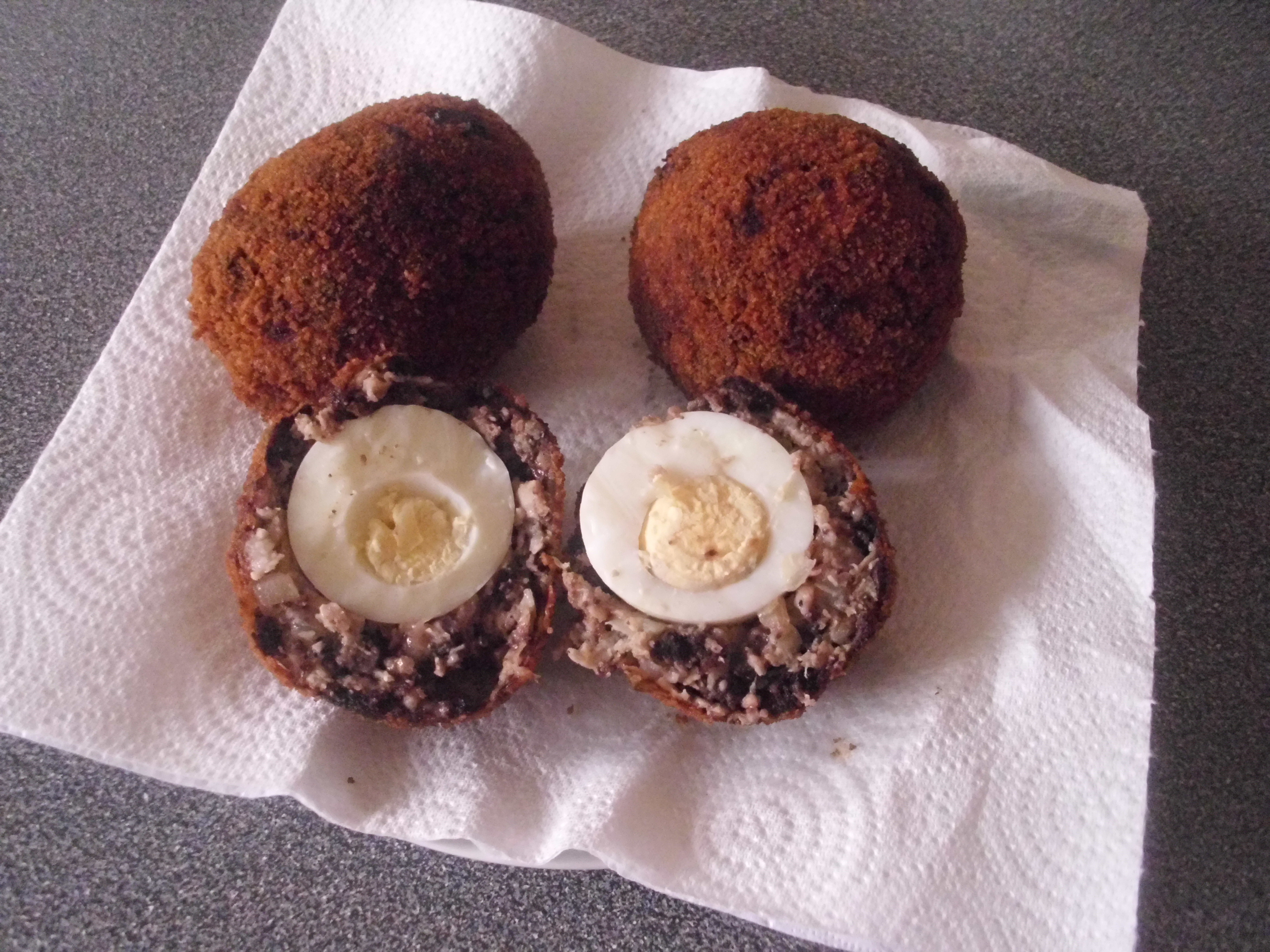
    Black pudding Scotch Eggs – love them!!

    27 Feb

    On the third Saturday of each month we have a Farmers Market in our town.  Our favourite stall is run by a young couple who make Scotch eggs.  The come in all sorts of flavours.  Apart from the original they make Piri piri, sweet chilli, onion and black pudding eggs.  By far the best is the black pudding scotch egg.  We all love it, even our 5-year-old Grandson!

    I have made Scotch Eggs many times before so I used my basic method but added a little fried onion for sweetness and chopped black pudding to the sausage meat.  The eggs were absolutely delicious.  I believe even those who do not like black pudding will love.

    The Scotch egg’s origins are obscure. According to an article in the Telegraph (Feb 2011) the exclusive London trader Fortnum & Mason claims it invented the portable snack for rich coach travellers in 1738. “The eggs would have been smaller in those days,’’ says the company’s archivist Dr Andrea Turner. “They would have been pullet’s eggs rather than hen’s eggs, and the meat would have been gamier, like a strong Victorian pâté.’’

    She believes that the eggs then filtered down the social ranks, first becoming a Victorian savoury using cheaper meats, and finally arriving at the mass-produced egg served in the pubs, cafés and at picnics in second half of the last century.

    An alternative theory, suggested by Annette Hope in her book A Caledonian Feast, claims that the Scotch egg evolved from Nargisi Kofta, an Indian dish that is also made from minced meat and a boiled egg.

    Neil Chambers’s explanation seems more likely: that it was a northern variant of the Cornish pasty produced by Scottish smallholders, who would have kept chickens and pigs.  “It was a poor man’s lunch produced from leftovers that was easy to transport,’’ Neil says.

    Meanwhile, the Scotch egg’s fame has spread abroad. “Skorchi eggs” have become a Japanese New Year delicacy and they are a best seller for the Nigerian food chain Mr Bigg’s.

    Black pudding Scotch eggs                                        Makes 3

    • 1/2 small onion, finely chopped
    • oil
    • 200g good quality pork sausage meat
    • 100g good quality black pudding, finely diced
    • 3 eggs
    • plain flour
    • 1 egg, beaten
    • Dried natural breadcrumbs
    • Oil for frying
    1. Fry the onion in a little oil until softened but not coloured.  Remove from the heat and add to the sausagemeat in a bowl.
    2. Add the black pudding and mix carefully until the black pudding is evenly distributed in the sausagemeat mix.  Divide the mix into three balls then wrap in cling film and refrigerate for 1 hour to rest.
    3. Boil the eggs for approximately 6 minutes then cool in iced water and peel.
    4. Flatten each ball of mix until it is about 1 cm thick then wrap around the egg and mould so it is covered completely.
    5. Put some flour, beaten egg and breadcrumbs into separate bowls then coat the covered eggs  firstly with flour, then beaten egg then breadcrumbs.
    6. Heat the oil in a deep-fat fryer to 160- 180C.  If you are using a pan use a deep pan and 3/4 fill with oil to prevent it boiling over during cooking.  Heat to the same temperature as before (best measured by a cooking thermometer).  Carefully lower the eggs into the oil and cook for about 9 minutes until golden brown and cooked through.  Carefully remove from the oil and stand on kitchen paper to absorb any excess fat.

      This slideshow requires JavaScript.

    Chicken Balti – a low-fat version for the health conscious!

    11 Feb

    Curries sometimes have a reputation for being high in fat due to the ghee in the ingredients.  This Chicken Balti dish is just the opposite!  I got the recipe from one of my Good Food magazines, made it ahead and then ate it when we came back from the pub on a Friday night.  A perfect end to the evening!

    There is an area in Birmingham called the Balti Triangle.  I have only eaten there once but it was a truly memorable experience.  the Balti Triangle is an area of Birmingham in Sparkhill, Balsall Heath and Moseley bounded by sections of the Moseley Road (A435) and the Stratford Road (A435).  I am sure my friend Sheila is probably an expert on all the restaurants there, she loves curries so much! 

    Did you know that The “Birmingham Balti” could soon have its name protected by an EU scheme, if a bid by the Birmingham Balti Association (BBA) is successful. The BBA say the Birmingham Balti originated in the city during the late 70s, when curry chefs started to make their dishes lighter, healthier and served faster to suit Western tastes. If the Birmingham Balti is successful in gaining EU Traditional Guaranteed Status, restaurants with Birmingham Balti on the menu will be annually inspected to ensure they meet the correct curry criteria.   Here are a few other bits of trivia on Birmingham Balti:

    • A true Birmingham Balti must be served in the same thin steel bowl it is cooked in over a hot flame, as it is this “Balti” bowl that gives the dish its name.
    • The purpose of the Balti dish is to keep the curry hot after it has been cooked over a high heat.
    • As well as keeping curry sizzling, the metal Balti dish retains all the dish’s flavours. The curry should then be scooped up and eaten with a naan bread instead of using cutlery, in a traditional fashion.
    • The high heat method of cooking Balti is thought to have stemmed from Western customers’ expectations to be served their meal quickly.
    • While ghee is the traditional cooking ingredient used on the south Asian sub-continent, the use of vegetable oil in Birmingham Baltis is stipulated as a key unique feature in the BBA’s application to EU.  This makes it a much lighter, fresher curry.
    • Another requirement is for all meat to be “off-the-bone” to allow it to be cooked quickly over the hot flame
    • Pre-prepared generic commercial curry pastes and powders are not used and not permitted in any true Birmingham Balti.

    Here is a link to the recipe on the Good Food website, along with the usual slide show of when I made it.

    http://www.bbcgoodfood.com/recipes/2220666/healthier-chicken-balti?countView=false

    This slideshow requires JavaScript.