Archive | My favourite recipes RSS feed for this section

Raspberry and Orange Tiramasu

21 Jul

DSCI0653I am not a lover of traditional Tiramasu, but this version is absolutely delicious.  I gave the recipe to a friend of mine recently who wanted a large pudding for guests coming for lunch.  This is a large pudding and a little goes a long way as it is quite rich. He made the pudding and all his guests were ecstatic. From what he said I think he will be making it again in the future by popular request.

The Italian translation for tiramisu is “carry me up.” Also known as Tuscan Trifle. Tradition tiramisu is a pudding-like dessert that usually consists of sponge cake or ladyfingers dipped in a liqueur, then layered with grated chocolate and rich custard. Tiramisu was originally made as a loose custard, it is only in recent years that using mascarpone cheese has come into fashion.  It was first made, according to researchers, in the 1970’s but there is a story that believes it was made much earlier than that, in fact in the 1600’s. The story goes that a dessert similar to tiramisu was created in Siena, in the northwestern Italian province of Tuscany. The occasion was a visit by Grand Duke Cosimo de’ Medici III (1642-1723), in whose honor the concoction was dubbed zuppa del duca (the “duke’s soup”). He brought the recipe back with him to Florence. In the 19th century, tiramisu became extremely popular among the English intellectuals and artists who lived in Florence. The dessert made its way to England, where its popularity grew. (Linda Stradley, What’s cooking America)

Well, here is the recipe. I didn’t have any Grand Maniere when I made this so substituted half and half brandy. It was delicious.

Raspberry and Orange Tiramasu                   Serves at least 6

  • 6 egg yolks
  • 175g/6oz caster sugar
  • 284g double cream
  • 2 x 250g tubs mascarpone
  • 2 tbsp vanilla extract
  • 100ml freshly squeezed orange juice
  • 100ml Gran Maniere (or half brandy half Quantro)
  • 24 sponge fingers
  • 350g/12 oz fresh raspberries
  1. Place a heatproof bowl over a pan of simmering water. In the bowl, whisk the egg yolks and caster sugar together until pale, creamy and doubled in volume. Remove from heat and whisk for 1 minute to cool.
  2. In another bowl beat together the cream, mascarpone and vanilla extract until combined, thick and creamy. Fold into the creamy yolks.
  3. Combine the orange juice and Gran Maniere then dip in half of the sponge fingers and arrange over the bottom of a serving dish. Pour over half the creamy mixture then top with most of the raspberries (reserve some of the best for decorating the top).  Repeat layers finishing by decorating the top with raspberries.
  4. Cover and chill for 2 hours.


This slideshow requires JavaScript.

Sweet and sour prawns

17 Jul

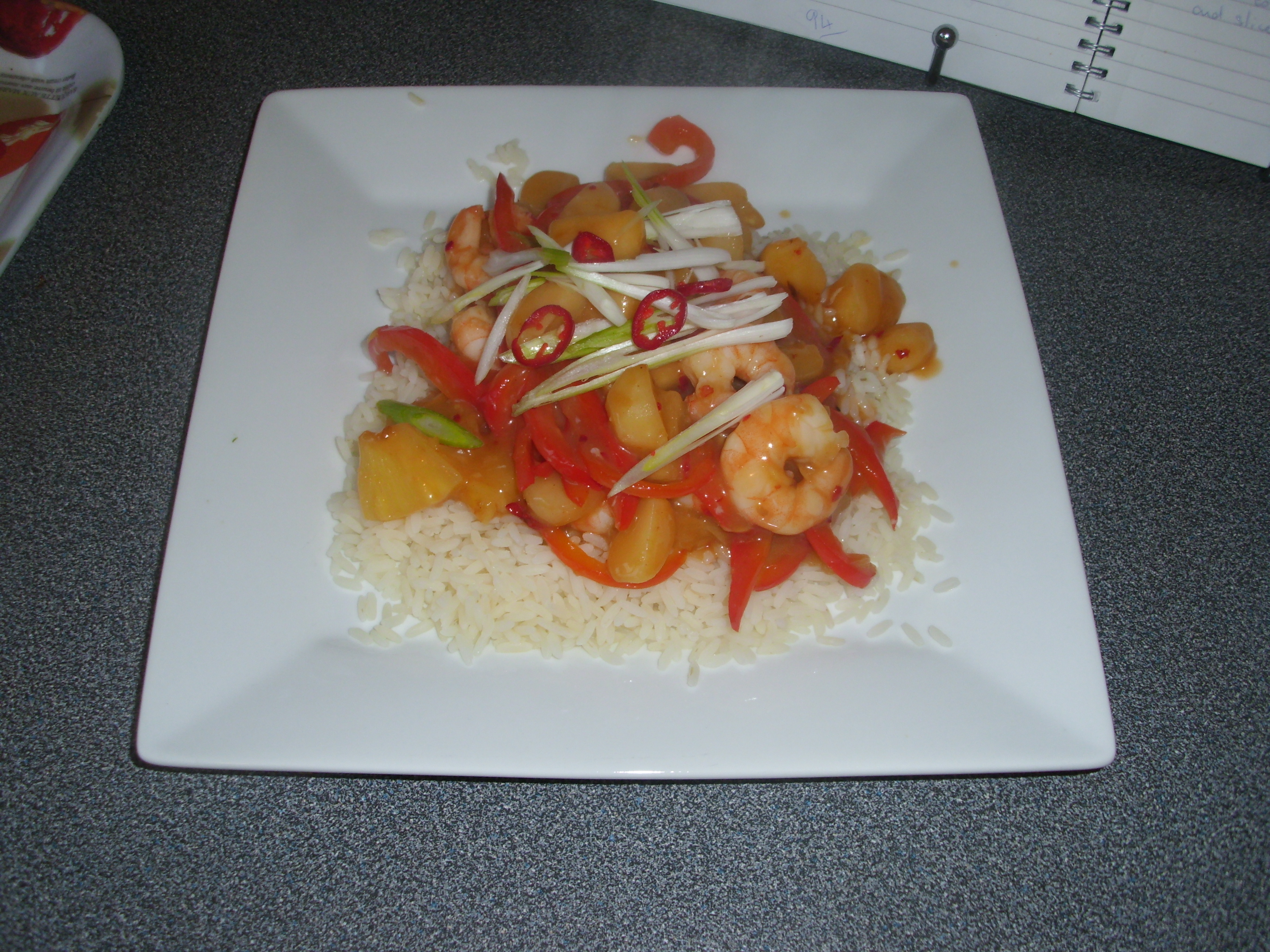
 I love Chinese food.  Come to think of it, I love most food, which is why I will never be anorexic!  Still, Chinese food is one of my favourites, and Sweet and Sour dishes are usually my choice off the menu when we eat out.  Last night I made an old favourite, Sweet and Sour Prawns.  Terry, my husband, always insists that he hates sweet and sour dishes. The fact that he did not leave even one grain of rice on his plate says everything about this recipe.  Another thing that amazes me is that it didn’t make my husband sneeze!! He always sneezes when we go out for a Chinese meal.  I wonder if it is the monosodium glutamate? 

Sweet and Sour sauce originated in China, particularly in the North-east of China.  It is cheap to make and, because of this, it is sometimes known in China as the people’s sauce.  This local name probably reflects the fact that it was once, distributed by the Chinese Communist Party during the Cultural Revolution.  Often, in China, this is a dipping sauce rather than one added to the wok to produce a dish we are familiar with in the UK.  Perhaps one of the most famous exceptions to this is Cantonese Sweet and Sour Pork.

I love this recipe.  I think it’s the fact it includes chillies.  They give the dish a heat that enhances the flavour in a spectacular way.  It is quick and easy, and only contains 161 calories! I served it with plain boiled rice but I think it would be good with noodles as well.  Give it a try, but be warned, you may find you will be disappointed afterwards if you choose this at the local Chinese restaurant!  The recipe is from the Delicious Website.  I have included my own photographs to demonstrate each step.  My advice would be to prepare everything before starting to cook as the cooking time is less than 10 minutes altogether, so there is very little time to waste if you don’t want to overcook the ingredients.

Sweet and Sour prawns

 www.deliciousmagazine.co.uk/recipes/sweet-and-sour-prawns

This slideshow requires JavaScript.

Mini chicken pies, ideal for a packed lunch, buffet or, in the summer, a picnic

9 Jul

Here we are again with leftover roast chicken.  I thought, this time, I would make a chicken pie.  I wasn’t sure what to put in the filling but I know leeks go well with chicken, as does tarragon, so I decided to include those in the ingredients.  The other consideration was the calorie content.  As you may remember, I am trying to watch what I eat in a hopeless attempt to lose weight, or at least not to put any more on!  If I make a large pie I know we will keep eating it until it is all gone.  So I decided to make small individual pies.  I was so pleased with the end result.  I’m sure these would freeze well, uncooked, but I made the mistake of putting them all in one muffin pan so I’m going to try freezing them cooked and see how they turn out.  That is if I can stop my husband, Terry, from eating them!

These are perfect for a picnic.  There is something so very English about picnics.  Mrs Beeton certainly thought so, although I think you would need a lorry to carry her idea of a picnic ie it should contain no less than 35 different dishes.  I’m not sure how many guests she had invited. 

Picnics have been quoted in literature for centuries but, perhaps the most famous quote is from the Wind in the Willows:

“The Rat brought the boat alongside the bank, tied it up, helped awkward Mole safely ashore and swung out the picnic basket. The Mole begged to be allowed to unpack it all by himself. He took out all the mysterious packages one by one and arranged their contents, gasping ‘Oh my! Oh my!’ At each fresh surprise”.

Anyway, here is my recipe.  I hope you enjoy them as much as we did.

Mini Chicken Pies   Makes about 12

  • 1lb shortcrust pastry (homemade is great or bought is fine)
  • 25g/1oz unsalted butter
  • 1 leek, washed well and chopped
  • 2 tbsp plain flour
  • 500 ml/1 pt semi-skimmed milk
  • 1 tsp dried tarragon
  • 250g/1/2lb cooked chicken, cut into small pieces (about 1/2 inch)
  • 50g/2oz frozen peas
  • Salt and pepper
  • 1 beaten egg
  1. Preheat an oven to 190c/180c fan/gas 5.
  2. Melt the butter in a saucepan, add the leeks and saute gently for about 10 minutes until soft but not discoloured.
  3. Stir in the flour and cook for about 1 minute over a low heat.
  4. Gradually add the milk, stirring between each addition to prevent curdling.  Cook over a medium heat, stirring, until the sauce is thickened.  Add the tarragon, and season with salt and black pepper.  Mix well.
  5. Add the chicken and peas, stir so they are evenly distributed.  Remove from heat and allow to cool.
  6. Roll out the pastry and cut out circles large enough to fill a muffin tin with a little overhang.  Fill the pastry case to just below the top.  Brush edges with beaten egg.  Place lid on top and tuck in around the edge.  Bring over the overhanging pastry to ensure the contents are secure.
  7. Brush tops with the beaten egg.
  8. Bake in oven for 30 minutes.  Remove from oven and leave in tin for a few minutes.  Remove to a wire tray.  Serve immediately for hot or leave to cool.  Good either way.

This slideshow requires JavaScript.

Thai fish curry – fragrant and not too hot

5 Jul

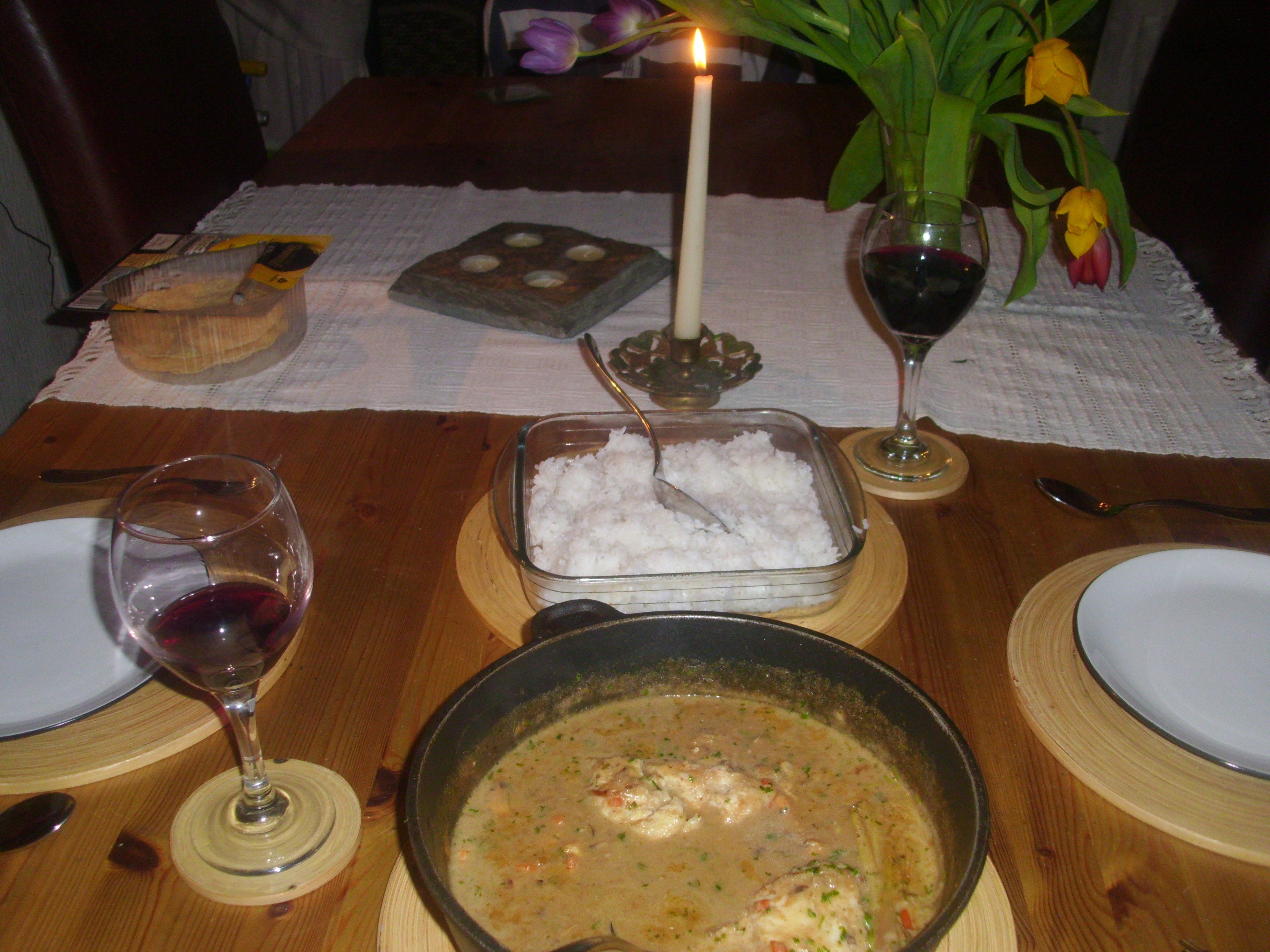
DSCI0637I love the flavours of Thai food. The freshness of the limes and lemongrass and the warmth of the chillies. This curry is slightly different as it has added depth by the addition of curry powder. The end result is a fragrant curry that is not too hot. It is really easy to make and, as the sauce is made first, you can make this in advance and either finish it off when you are ready to eat or freeze for another day then thaw and continue by adding the fish when the sauce has heated up. This flexibility makes it a great dish to come home to after work or for a dinner party when you can use the free time to socialise with your guests.

Fish curry                  Serves 4

  • 1 tbsp groundnut oil
  • 1 onion, finely chopped
  • 1 heaped tsp ginger paste
  • 1 tsp garlic paste
  • 1 tsp shrimp paste
  • 1 red chilli, sliced (omit the seeds if you don’t like it hot)
  • 2 lemongrass stalks, outer leaves removed and bruised
  • 1 heaped tbsp medium curry powder
  • 1 tbsp light brown sugar
  • small bunch coriander, stems finely chopped
  • 400g can coconut milk
  • 4 fillets of firm white fish, skinless. I used cod but you could use hake. Cut into 3 inch pieces
  • 200g raw king prawns
  • Juice of a lime
  1. Heat the oil in a large frying pan or skillet and fry the onion until softened, about 5 minutes, over a medium heat. Stir in the ginger, garlic and shrimp pastes and the chilli and lemongrass. Cook over a low heat for 1 minute, stirring so it doesn’t burn.
  2. Add the curry powder and sugar. When the sugar is melted add the coriander stems, coconut milk and 2 tbsp water then bring to a simmer.  You can freeze at this stage if you want to.
  3. Add the fish and the prawns to the sauce then squeeze over half the lime juice. Cover and simmer for 7 minutes until the fish is cooked through and the prawns are pink. Taste for seasoning and add a little more lime juice if you like. Scatter with the coriander leaves and serve hot with boiled rice.

This slideshow requires JavaScript.

Beef in Oyster Sauce, better than a take away

19 Jun

DSCI0632OK, so all my followers will know by now that I love Chinese food.  I also like Ken Hom recipes so this dish was a reasonably safe bet to turn out well. I was not disappointed.  Mind you, I did go all out with the beef and bought fillet steak. Some may think this was a waste but my husband is really fussy about meat and hates chewy bits in recipes where the meat is in a sauce and so they are well disguised.  This beef just melted in our mouths and was absolutely delicious. In actual fact, there wasn’t that much difference in the price of the fillet to other steaks so I feel my choice was justified.

Another essential is your choice of oyster sauce. Some oyster sauces taste fishy so buying the best you can afford always pays in the end. Ken Hom recommends Lee Kum Kee sauce found in most major supermarkets.

The dish is very savoury so goes well with plain boiled rice.

Here is a link to the recipe on the Good Food website:

http://www.bbcgoodfood.com/recipes/stir-fried-beef-oyster-sauce 

This slideshow requires JavaScript.

Lamb Tagine – prepare ahead for an easy life!

15 Jun

 I picked up a leg of lamb today. half price. from the supermarket and I am going to make a Lamb Tagine.  The recipe looks easy enough and I can prepare it ahead. I think it will actually improve with standing and it will give me a chance to use my new Tagine pot!  Lots of good reasons then to make it.

Tagine is a dish from North Africa, named after the earthenware pot it is cooked in.  The traditional Tagine has a flat circular base with low sides and a dome-shaped top.  The top is shaped like this to allow the steam to condense and return to the stew below, keeping the moisture in.  There is a knob at the top to facilitate easy removal of the top to allow additions to the stew whilst it is cooking.

Moroccan tagines are slowly braised at low temperatures.  This results in meltingly tender meat in aromatic sauces.  This cooking process is ideal for cheap cuts of meat so many recipes will use cheap cuts of lamb or chicken.  You will often find they include sweet ingredients such as dried fruits, preserved lemons and honey.  They will always, however, include spices, traditionally these will be a mix of  cinnamon, ginger, turmeric and paprika.  I used a leg of lamb, boned and cut into cubes, because my husband hates fat or chewy lamb.  The cooking time was almost halved, but I have kept the recipe as intended, ie, using cheaper cuts of lamb.

For years I would avoid cooking this meal.  I am not a lover of stews that combine meat with dried fruit and nuts.  What a fool I was!  The end result is absolutely gorgeous!!  Tagines are usually served with couscous.  I have never had any success with couscous and usually find it bland and tasteless.  This time I cheated and gave a ready mixed Moroccan couscous a try. All I had to do was add water and it was delicious.  I may have a go at making my own like this another time.  If you don’t like couscous, try serving it with rice or Orzo. I’m sure these would be just as good!

Here is the recipe.

Moroccan Lamb Tagine         Serves 6

  • 1 tbsp ground ginger
  • 1-2 tsp ground black pepper
  • 2 tsp ground cinnamon
  • 1 tbsp turmeric
  • 1.5 tbsp paprika
  • 1/2 tsp chilli powder
  • 2.5 lbs boned lamb, cut into 1 inch cubes
  • 3 cloves garlic, crushed
  • 1.2 tsp salt
  • 5 tbsp olive oil
  • 1 lb onions, finely chopped
  • 6 oz ready to eat dried apricots
  • 3 oz toasted, flaked almonds
  • 1 tbsp clear honey
  • 1/2 pt tomato juice
  • 400g can chopped tomatoes
  • 1/2 pt hot lamb stock
  • chopped coriander to garnish
  1. Heat oven to 170C/150C fan/gas 3.Mix the spices together in a small bowl then add to the lamb, mixing to coat well.
  2. Heat 1 tbsp oil in an hob to oven casserole on a high heat. Brown the lamb in batches so as not to overcrowd the pan, adding extra oil for each batch.
  3. Turn down the heat to low and add the remaining tbsp oil. add the onions and cook until softened but not browned. Add the garlic and salt towards the end of cooking.
  4. Return the lamb to the casserole and stir in the remaining ingredients. Bring to the boil and transfer to a tagine or cover the casserole and cook in the oven for 2 hours or until the lamb is meltingly tender. Check occasionally and stir to ensure it is not drying out.
  5. Serve sprinkled with the coriander.

This slideshow requires JavaScript.

Chicken Chow Mein

3 Jun

DSCI0658Whenever we go to a Chinese restaurant I am drawn to the Chow Mein section of the menu. I know it sounds boring but I do love this style of Chinese food. I have tried many times to capture the same authentic flavour and have never quite made it but not this time! this dish tastes divine. It is very authentic and, if anything, actually tastes better than the ones I have eaten in a restaurant.  The recipe is very easy but, as with all Chinese recipes, make sure you have all the food prepared beforehand as the cooking takes no time at all and many end results are spoilt because someone has to chop a food and the rest is overcooking in the wok.

The word means ‘fried noodles’, chow meaning ‘fried’ and mein meaning ‘noodles’. The pronunciation chow mein is an English corruption of the Taishanese pronunciation chāu-mèing’.

This is a Ken Hom recipe so how could it fail?  Here is a link to the recipe on the Good Food website:

http://www.bbcgoodfood.com/recipes/chow-mein

This slideshow requires JavaScript.

Mussels in a creamy curry sauce – divine!b

30 May

They say every cloud has a silver lining.  For me, when summer is over, it means that for 8 months there is a ‘R’ in the month and I can get fresh mussels.  It never fails to amaze me how many people have never tried mussels because they are put off by the look of them.  For me, they are the most delicious of all the sea foods.  I know they come bottled in vinegar and you can buy them ready cooked in the supermarket.  You can even get them vacuum packed and ready to cook, but there is absolutely no comparison to the wonderful, soft, melt-in-your-mouth morsels that are cooked from raw.

I have been making this mussel recipe for years and yet, every time I make it, the fantastic flavours still surprise me.  This time was no exception.  I could almost hear myself purring as I dipped my crusty french stick into the delicious sauce.  Wonderful!

So lets take a look at why I can’t buy mussels in months without an ‘R’.   Mussels are often regarded as poor man’s shellfish because they are cheap and plentiful. In the wild, they grow on coastline rocks and stones but the majority of mussels available in the UK are farmed in suitable coastal waters. Mussels are one of the most environmentally sound types of fish or shellfish available. There’s no hefty price tag and, what’s more, these little creatures are in abundance.  They have two shells (bivalves) through which they filter water and feed on the algae and plankton they find in it. Plankton in the water for a shellfish is like grass in a field for a cow. In this way, the shellfish are grazing upon the sea. What they’re grazing on are tiny (as small as 1/50th of a millimeter) aquatic life forms called flagellates.  One reason for this old saying is that during the summer months the flagellates bloom and become more prolific.  At this time they can create ‘red tides’ and it is these that have been associated with poisoning from shellfish.  If the mussels are farmed it is unlikely this is the cause of not being available.  More likely it is because the mussels themselves are reproducing along with the fact that it is much easier for mussels to go bad during high temperatures.

There are a few golden rules when cooking mussels.  Firstly, always wash them well and remove any ‘beard’ you see poking out between the shells.  Only ever cook mussels that are closed when raw but do not discard them until you have tried tapping them sharply with a knife.  If the mussel is still alive the shells will close as it will think this is the beak of a bird trying to eat it.  If it remains open throw it away, its dead and may well be toxic.  Once cooked, only eat the mussels that have opened sufficiently for you to see them nestled between the shells.  This last point has not really been proved but I am not going to argue with the experts.

Anyway, I really hope you give this recipe a try, it is absolutely wonderful!

Mussels in a creamy curry sauce                     Serves 2 (easily doubled)

  • 1 kg/ 2lbs 4 ozs fresh mussels
  • 150 ml/1/4 pt dry white wine
  • 2 shallots, peeled and finely chopped
  • 25 g/1 oz butter
  • 1tsp plain flour
  • 2 tsp madras curry paste (I use Pataks)
  • 100 g/4 oz creme fraiche (you can use low-fat if you are watching your weight but the sauce will be slightly thinner
  • a small handful of parsley
  1. Prepare the mussels as discussed above.  Put them in a large pan with the wine.  Cover, bring to the boil then cook over a high heat for 3-4 minutes or until all the mussels have opened.  Shake the pan a few times during this process and be careful not to overcook them.
  2. Strain the mussels over a bowl so you capture the cooking liquor.  You will need this for the sauce so don’t throw it away.  Cover the mussels with a cloth to keep them warm while you make the sauce.
  3. Fry the shallots in the butter in a frying pan until it is soft and not browned.  This will only take a couple of minutes.  Stir in the flour and curry paste and mix well.  Cook for about 1 minute.  Add the cooking liquor carefully so as not to disturb any gritty bits which will have sunk to the bottom.  Discard the last of the liquor to avoid this going into your sauce.  Season with salt and freshly ground black pepper.
  4. Reduce the heat slightly and stir in the creme fraiche until the sauce is thick and glossy.  Check the sauce is hot then add the parsley.  Divide the mussels between two large bowls and pour the sauce over.  Serve with large chunks of crusty bread to mop up the sauce.

    This slideshow requires JavaScript.

Home made faggots – make a batch and freeze some for another day!

22 May

 I remember some time ago, my friend Pam asked if I had a recipe for faggots.  At the time I said no and that I thought it was too much of an effort to make faggots when you can buy them in the butchers ready-made.  How wrong was I!  This faggot recipe is wonderful.  Not only do you know what is going into the faggots ie no rubbish, but they taste better than any faggots I have ever eaten. I was absolutely amazed at how authentic they were and how they retained their shape, even when cooked in the delicious onion gravy.  The recipe makes a tray of 24 faggots.  Don’t panic! They can be frozen in packs of four (or however many you want, in foil containers and then cooked from frozen when you want them.  They are so easy I think they would make perfect food for a Bonfire or Halloween party, served in plastic dishes with a spoon of mash.  Perfect!!!

When I was a child we used to have Savoury Duck.  I have no idea why it is called this.  It appears to be something you can only buy in the north of England.  If I had to describe it I would say its a sort of savoury mix of subtle spices, probably some form of starch and bits of meat that usually do not get eaten.  Mum used to slice it and cook it in the fat left over from frying the bacon for breakfast.  She would remove it from the pan then reheat tinned tomatoes in the same pan so they picked up some of the lovely spice infused oil.  My favourite breakfast!

I spent some time in Guildford when I left school but could not buy Savoury Duck anywhere.  That is when I first came across faggots.  I would cook them the same as Mum did and, although their flavour is stronger, I found them to be just as delicious.  According to Wikipedia, faggots and savoury ducks are one in the same.  Not true, I can definitely tell the difference!

I believe most countries will have a similar foodstuff that uses up lots of meat left overs, probably first cooked years ago when meat was expensive and to prevent waste.  The Scottish Haggis springs to mind and, in Greece, there is Kokoretsi.  I love them both!!   Apparently there is also a similar dish in Portugal called Almondega.   I will need to give it a try when I next go there.

Anyway, the recipe was in one of my Good Food magazines, here is a link along with a slideshow for each step I made when making them.  Shaping the faggots is a bit messy so wear an apron.  You will find it is well worth it.

http://www.bbcgoodfood.com/recipes/2552644/faggots-with-onion-gravy  

This slideshow requires JavaScript.

Cheese and potato pie – a really simple recipe with shortcuts!

14 May

 Before we start, the picture is of the pie before it was cooked.  It was so delicious we had eaten it before I remembered to take one of the finished product!

When I started writing this blog my intention was to help all those who wanted to cook but needed help.  I had been one of those people myself when I first married, even though I had years of cooking with my Grandma to help me.  Confidence in cooking is so important.  Without it the  opportunity to experience happy moments of sharing good food with friends are missed and, of course, so is the ability to prepare healthy food from scratch for yourself and your family.  I was reminded of this fact recently when my daughter-in-law asked for advice on cooking.  With that in mind I am sharing this very simple, yet delicious pie recipe.  I think it was perhaps one of the first things I cooked for myself when I was a student.  I can remember sharing it with some of the girls, served with a very simple salad.  A great meal and a great memory.

I have used bought prepared shortcrust pastry for the recipe.  Trust me, there is no shame in that and, nowadays, it is so good I am sure you could pass it off as your own.  Oh dear, I can almost hear members of the WI screaming in horror! In the past I have always used bought puff pastry as this is more complicated to make at home, but would never entertain the idea of buying shortcrust as it is quite easy to make.  I think my snobbery has wasted a lot of time and, although I still make my own on occasion, when time is short and you need to knock up a meal in a hurry, bought is perfect.  Nowadays you can buy a whole range of ready-made pastry from most large supermarkets.

  • Sweet shortcrust – perfect for fruit pies and flans etc
  • Shortcrust – great for pasties, pies and savoury flans etc
  • Puff pastry – perfect for great looking meat of vegetable pies, or vol-u-vents etc
  • Butter puff pastry – gives pies that extra richness
  • Filo pastry, perfect for a lower calories pie topping, scrunched over fruit or meat, or for Greek spinach pies, samosas etc

Well, here is the recipe.  Eat it hot or cold, perfect for picnics or a buffet.

Cheese and potato pie                                         Serves 6 – 8

  • 1 x 500g pack chilled, ready-made shortcrust pastry
  • 200g new potatoes, peeled and cut into 1/2 inch chunks
  • 1 onion, chopped
  • 200g cheddar cheese, cut into 1/2 inch cubes
  • 1 egg, beaten
  1. Take the pastry out of the fridge before you start to prepare the filling.  It will give it time to soften and will roll out without cracking or breaking up.
  2. Put the potatoes and onion in a pan of boiling salted water.  Bring back to the boil then simmer over a low heat for 5 minutes until just tender.  Do not allow the potatoes to boil rapidly as they will break up.  Drain and leave to cool.
  3. While the potatoes are cooling, cut the pack of pastry in half and need each half gently and quickly into a ball shape.  Flour the work surface and rolling-pin lightly then roll one ball of the pastry out into a circular shape.  You can do this by turning the pastry round in a clockwise motion in-between rolls, it will help with the circular shape.  When the pastry is about as thin as a pound coin lift gently using the rolling-pin and line your pie dish, making sure it fits snug into the corners and leaving excess hanging over the edge.
  4. Add the cheese to the potatoes and mix gently so as not to break up the potatoes.  Make sure the mix is completely cold and fill the lined pie dish.
  5. Roll out the second ball of pastry as before. Dampen the edge of the pastry lining then lower your second circle of pastry on top.  Pinch the edges together to make a good seal the, using a sharp knife, run it around the edge of the pie dish to remove all excess.
  6. Make a cross in the middle of the pie to allow the steam to escape.  Decorate if you want with diamond-shaped pieces of pastry.  Put in the fridge to allow the pastry to recover while the oven heats up.
  7. Preheat the oven to 190C/fan180C/gas 5.  Brush the top of the pastry with the beaten egg then bake for 30 – 40 minutes or until the pastry is golden and firm.

    This slideshow requires JavaScript.