Archive | Fish RSS feed for this section

Prawn Saganaki – a wonderful Greek dish

7 Aug

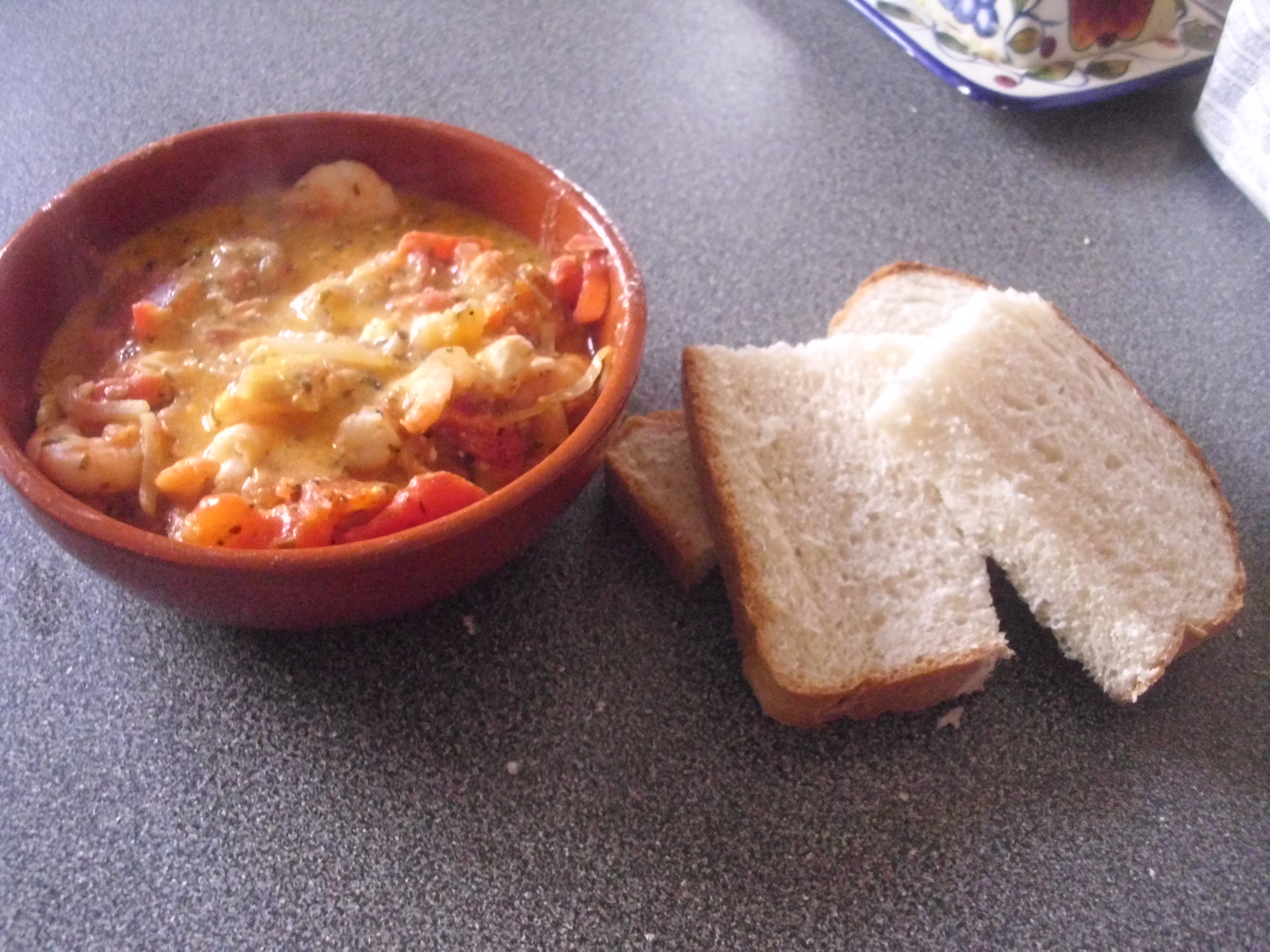
DSCI0112I remember the first time I had Prawn Saganaki. It was on the beautiful island of Aegina, cooked by the sister of a dear friend for their Fathers 90th birthday party. I had to move the dish away from me or I would have eaten the lot.  I have looked many times for the recipe but have struggled to find it.  There are some on the internet but, somehow, the ingredients don’t seem to marry with the taste I remembered.  Recently we went for a week in Stalis, Crete.  I lost count of how many times I ate Prawn Saganaki or Mussel Saganaki while I was there. The most wonderful of all was served in an ouzeri called Tsourlis, almost next door to the apartments where we stayed.  They made their Mussel Saganaki with fresh mussels and it was absolutely to die for.

I had an idea in my head of the ingredients and was delighted when I cross-referenced this with the recipe in my very old Greek cookery book written by Rena Salaman.  Rena is a guru of traditional Greek cooking and, although this little paperback does not include pictures, the way she writes about her food and the places she remembers eating them is so vivid you feel you can almost taste the dishes she is describing.  She does not call her dish Prawn Saganaki but ‘Yarithes Yiouvetsaki’.  The dish is exactly the same as the ones I have tasted – prawns baked in a fresh tomato and feta cheese sauce.  Wonderful on its own  with chunks of fresh bread to mop up the sauce. Rena’s book is simply called ‘Greek Food’. It was published in 1983, not sure if there are newer publications. The ISBN IS 0-00-636467-5. If you want to read about wonderful places in Greek and maybe relive some memories, or simply want to make good Greek food, then this book is a must.

Saganaki (Greek σαγανάκι) refers to various Greek dishes prepared in a small frying pan, itself called a saganaki, the best-known being an appetizer of fried cheese.

Here is the recipe, slightly modified

King Prawn Saganaki                                    Serves 2 as a main, 4 as a starter

  • 200g raw king prawns
  • 4 tbsp olive oil
  • 1 onion, thinly sliced
  • 1 tsp dried oregano
  • 400g fresh ripe tomatoes, skinned and sliced
  • 100ml dry white wine
  • 2 tbsp chopped parsley
  • Salt and black pepper
  • 75g feta cheese
  1. Preheat an oven to 180C/160C fan/gas 4
  2. Heat the oil in a frying pan then add the onions and fry over a lo-medium heat for about 10 minutes or until the onions are soft but not coloured.
  3. Add the oregano, wine and tomatoes then continue cooking for 5 minutes until the tomatoes start to break down. Season, add the parsley then crumble in the feta cheese. Mix well, bring to the boil then remove from the heat.
  4. In the meantime bring a small pan of water to the boil then add the prawns and cook for 2 minutes until turned pink. Be careful not to overcook as they will go hard.
  5. Put the prawns in an ovenproof dish and cover with the sauce.  Cook in the oven for 15 minutes.
  6. Serve with chunks of crusty fresh bread.

This slideshow requires JavaScript.

Fish curry – light and spicy, perfect for Summer.

17 Jul

 I am not a lover of fish in curry, except for prawns that is.  My husband feels the same way, unusual as he loves curry of all kinds.  When I first saw this recipe I was struck by the fact that I loved all the ingredients.  It promised it was not too spicy and, as it was also low in fat, I decided to give it a try.  Thank God I did as this has to be one of the most delicious curry I have ever tasted.

The sauce contains coconut milk so I thought I would try to find some trivia about coconuts.  (ref: www.foodreference.com)

  • Near Port Royal, Jamaica a stone monument on the Palisadoes commemorates the planting of the first coconut tree on the island on March 4, 1869 by John Norton, the Superintendent of the General Penitentiary.  Over the next 20 years, 20,000 coconut trees had been planted. Disease eventually destroyed all of the Palisadoes coconut trees.
  • Falling coconuts kill 150 people every year – 10 times the number of people killed by sharks.
  • Coconut oil was the world’s leading vegetable oil until soybean oil took over in the 1960s.
  • There are more than 20 billion coconuts produced each year.
  • Coconut juice or coconut water is the liquid inside a coconut. Coconut milk is produced by steeping grated coconut in hot water then straining; coconut cream is coconut milk cooked down until it thickens, or grated coconut steeped in hot milk instead of water.

Here is the recipe.  Serve with basmati rice and a tomato and cucumber salad on the side.

Fish curry                                                Serves 2 (easily doubled)

  • 1 tbsp vegetable oil
  • 1 onion, very thinly sliced
  • 4 vine tomatoes, roughly chopped
  • 2 cloves garlic, peeled
  • 1 inch piece of root ginger, peeled and roughly chopped
  • 1 – 1.5 tbsp madras curry paste (depending on how hot you want it)
  • 100 ml coconut milk
  • handful of coriander leaves, finely chopped
  • 300g cod, skinned and cut into large pieces
  • 2 tbsp pl flour
  1. Heat half the oil in a pan and cook the onions with a pinch of salt over a medium heat until soft and just starting to change colour.
  2. Put the tomatoes, garlic and ginger in a food processor and whizz until smooth.
  3. Add the curry paste to the onions and fry for a couple of minutes.  Stir in the tomato mixture and simmer for 10 minutes or until the sauce has thickened.  Add the coconut milk and coriander.
  4. Dust the fish with the flour, shaking off excess and season.  Heat the remaining oil in a non-stick pan and fry the fish over a high heat for 1 minute on each side so they are light brown.  Carefully transfer the fish to the tomato sauce and cook for about 5 minutes or until the fish is cooked through (will depend on thickness of fillets).  Serve immediately.

    This slideshow requires JavaScript.


Prawn Balti – what a fantastic curry!

24 Apr

There are times when only a curry will do and last night was one of them.  I’m not a lover of fish curries but absolutely love prawn curries.  This is the first time I have tried to make this recipe and the taste was unbelievable, spicy and fairly hot but also somehow fresh tasting.  Delicious!  I served it with plain boiled rice and threw on a vegetable samosa (don’t ask me why, I just fancied one).

There is a bit of controversy as to why these currys are called Balti.  Some say it is because they originated in Pakistan in the Baltistan region of Kashmir.  Others say they are named after the pan in which the curry is cooked and that they originated in Birmingham.  One thing for sure, Birmingham certainly made Balti dishes popular.  I remember being taken to Sparkhill in the 1980’s to have my very first Balti.  Originally this is where you would find Balti Houses, on and behind the main road between Sparkhill and Moseley.  It was a real experience for me.  The restaurant was more like a cafe, hard chairs and a glass-topped table under which you could read the menu.  It was brightly lit, no romantic lighting here!  If you wanted to drink alcohol you had to take your own and the owners would willingly open it for you and the Naan bread was the size of the table leaving hardly any room for the actual Balti pans.  I loved it! The people were really friendly and the food was fantastic.  Obviously, today you can choose a Balti curry from the menu of most Indian restaurants but they will never compare to my first experience of eating one.

Anyway, here is the recipe.  It is definitely one worth trying if you like curries.

Prawn Balti                           Serves 4 (easily halved)

  • 3 tbsp/45 ml sunflower oil
  • 1 inch piece of root ginger, peeled and cut into thin strips
  • 1 large onion, finely chopped
  • 2 tsp/ 10 ml garlic paste
  • 3/4 tsp ground cardamom
  • 1/2 tsp ground cumin
  • 1/2 tsp fennel seeds
  • 1/2 tsp hot chilli powder
  • 1/2 tsp ground turmeric
  • 7 oz/200g tomatoes, chopped
  • 1 tbsp/15 ml tomato puree
  • 1 lb/500g raw peeled prawns
  • 1 tsp/5 ml salt
  • 1/2 tsp dried fenugreek leaves, crumbled
  • 1/2 tsp garam masala
  • 6 fl oz/175 ml warm water
  • 1/2 oz chopped fresh coriander or flat leaf parsley
  1. Preheat a Balti pan (if you have one) or a large frying pan over a medium heat.  Add the oil and, when hot, stir-fry the ginger for 30 seconds.  Add the onion and stir-fry for about 7 minutes or until the onion is soft and just starting to turn brown.
  2. Add the garlic, cardamom, cumin, fennel, chilli and turmeric.  Reduce the heat slightly and stir-fry for about 30 seconds.  Add the tomatoes and stir-fry for 4-5 minutes or until cooked down slightly.  Add 50 ml/ 2 fl oz of water and continue cooking until the water is absorbed and the il floats on the surface.
  3. Add the tomato puree, prawns, salt, fenugreek and garam masala. Stir fry for about 2 minutes.  Add the water, increase the heat slightly and stir fry for about 4 minutes more or until the prawns are pink and cooked through.  Stir in the coriander or parsley and serve immediately.

    This slideshow requires JavaScript.