Archive | June, 2025

Courgettes with pasta, my favourite pasta dish!

6 Jun

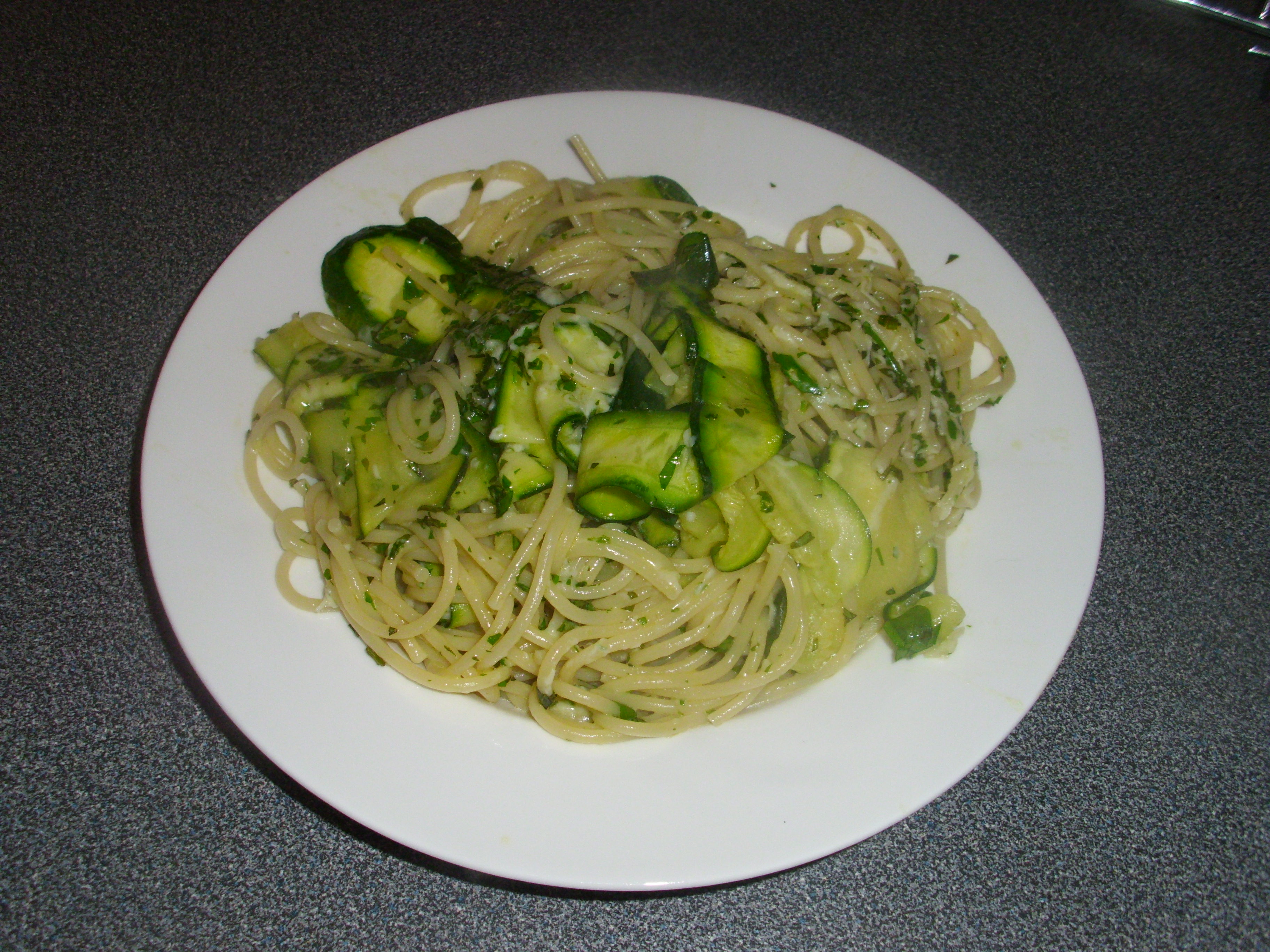
 There was a time when I hated courgettes but, over the years and after trying so many delicious recipes, that has all changed.  I love it when there is a glut of courgettes in the shops but, thankfully, you can now buy them all year round.  When we had this recently it reminded me how much we love it, and how long it had been since we ate it!  I can’t remember when we first had this dish, it must be at least five years ago.  I think our first time was because someone had given us a bag full of courgettes, they were not a vegetable I would have actually bought in those days!  The recipe would probably have come from one of the cooking journals I subscribe to and, if I remember, the picture did not look that tantalising.  I am so glad we tried it though.  Sometimes you come across a recipe that you want to make time and time again.  This is one of those times! We absolutely love this pasta dish.  You would not believe how fresh it tastes or how much flavour it packs in.  Before the recipe though, I thought I would look at some food trivia on Parmesan Cheese.

I can remember, many years ago, buying Parmesan cheese already grated and served in little tubs.  It was disgusting and smelled of sweaty socks.  Yuk!!!  The first time I bought fresh Parmesan I could not believe the flavour.  It is so strong, absolutely beautiful.  It really makes you wonder how they manage to transform such a great taste to an imitation of sweaty socks!!  A lot of people will not buy the fresh cheese as it is expensive and they may only use it occasionally.  Believe me, it is worth the expense!  I grate the whole block at a time and freeze it in a well sealed freezer bag.  That way I can take out just as much as I need when I need it.  I even freeze the rind, it gives a great flavour to soups!

Parmesan cheese is the French name given to Parmigiano-Reggiano, and one that most of the UK have adopted.  Parmigiano-Reggiano is a hard, granular cheese that is cooked but not pressed, and is produced in Italy.  The name is protected under European Law and can only be given to the cheese produced in specified regions of Italy.  Informally it is often called the ‘King of Cheese’.  The cheese is made out of cows milk and any left over whey is used to feed the pigs from which Parma Ham was produced.  Great bit of recycling!!!  The cheese is as pure and organic as possible.  Cows can only feed on grass or hay, giving grass-fed milk, and only natural whey culture is allowed as a starter.  The only additive allowed is salt which the cheese absorbs while being submerged in huge vats of brine made from Mediterranean sea salt, before being left to age for an average of two years.  The end result is a fantastic cheese with a deep, savoury flavour.  It is very strong so, although expensive, you only need a small amount yet still get the full flavour coming through.

Anyway, I’ve tried to trace the recipe to a website and failed so I have written it out for you below.  I really hope you give it a try, I am sure you will not be disappointed.

Courgettes with pasta and herbs.    Serves 4       About 530 calories

  • 12 oz/350g  spaghetti or linguini
  • 4 tbsp olive oil
  • 2 garlic cloves, finely chopped
  • 650g/1lb 7oz courgettes, cut into thin ribbons (a vegetable peeler is great for this)
  • 25g/1oz butter cut into pieces
  • 50g/2oz freshly grated parmigiano-Reggiano (or Grand Padano if you can’t get it)
  • Handful each of chopped fresh basil and flat leaf parsley
  1. Cook the pasta as per packet instructions.
  2. Meanwhile, heat the olive oil in a large frying pan or wok.  Add the garlic and cook gently for a few seconds until it becomes fragrant.  Be careful not to let it burn or it will be bitter.  Tip in the courgettes, stir to coat in the garlic oil then cook gently for about 4 minutes.  They need to be softened but not soggy.
  3. Drain the pasta and add to the courgettes, along with the butter, cheese and herbs.  Toss them gently until the butter has melted, the spaghetti is coated with the cheese and herbs and the courgettes are evenly distributed.  Season to taste and serve immediately.  You can drizzle with a little extra olive oil if you like.
    This slideshow requires JavaScript.

Thai style beef and mango salad, one of our favourite meals!

2 Jun

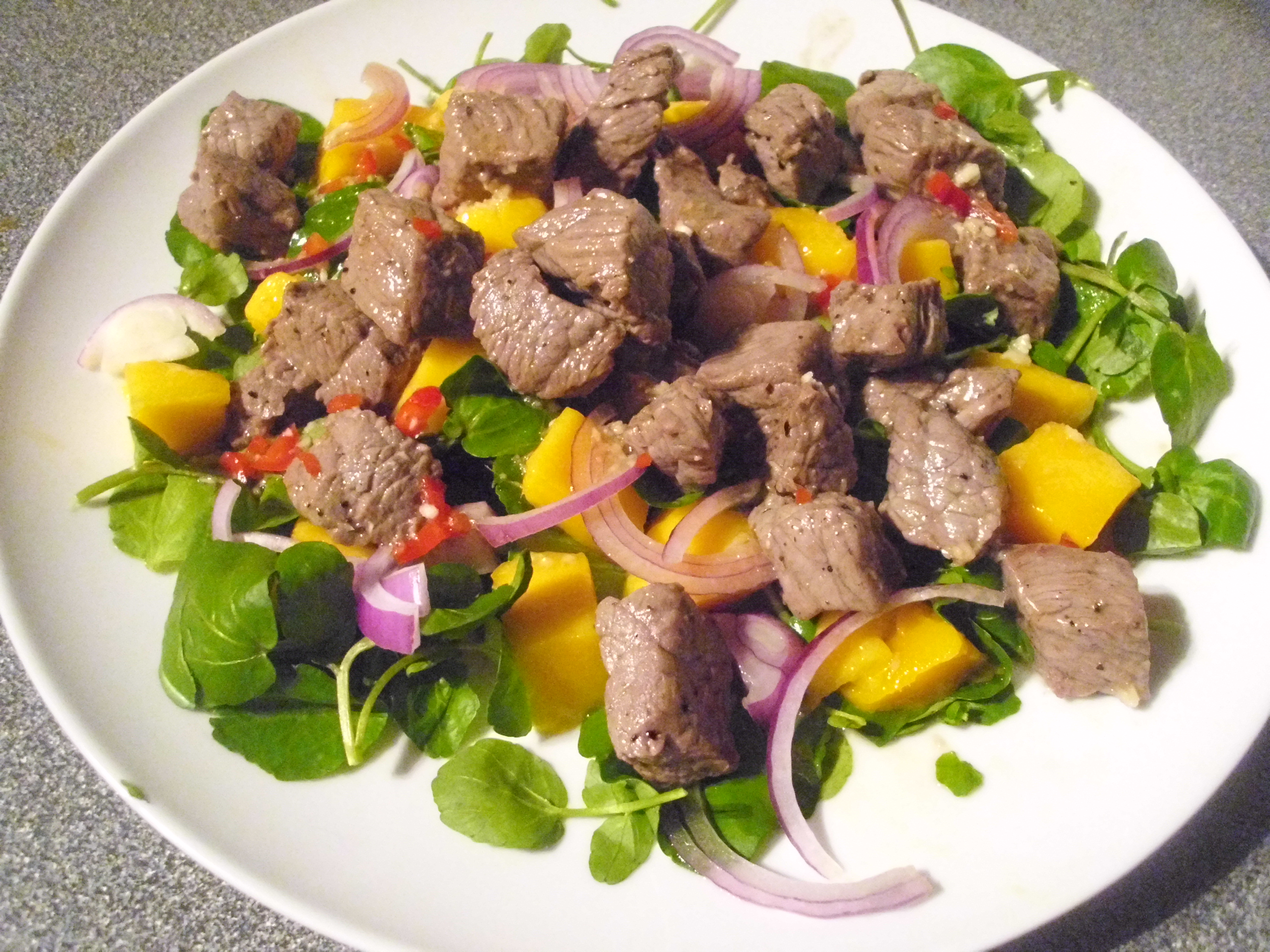
 We first had this salad about eleven years ago, shortly after we returned from living in America.  It has been a firm favourite ever since and we eat it at least once a month and more often if I think about making it.  Although this is classed as a salad it could not be further away from what I grew up to understand salads to be, i.e. lettuce, tomatoes and cucumber!  The tender chunks of beef, straight from the pan, absorb the hot and spicy salad dressing.  The sweetness of the mango is in perfect contrast with the beef and the heat from the red onion and the watercress.  Your senses will rarely be subjected to such an attack on all levels, smell, taste and sight!  Absolutely delicious and very low in fat, carbohydrate and calories so excellent for anyone who is hoping to lose weight.  What more could you ask for?

Thai food is known for its balance of the four fundamental taste senses, sour, sweet, salty and bitter.  It is often spicy as well.  This dish is an excellent example of how this balance is achieved.  Don’t be put off by the ingredients, especially the mango in a savoury dish.  If you like spicy food I think you will love this.

Thai style beef and mango salad    Serves 2 (generously)

  • 2 sirloin steaks, trimmed of fat, cut into 1 inch cubes
  • 1 mango, peeled and cut into cubes
  • 1 red onion, cut in half and thinly sliced into half-moon shapes
  • 1 bag watercress
  • 3 tsp fish sauce
  • freshly ground pepper
  • juice 1 lime
  • small knob fresh ginger, peeled and finely chopped
  • 1 garlic clove, crushed
  • 1 small red chilli, deseeded and finely chopped
  • 1 tbsp soft brown sugar
  • 1tsp sunflower oil
  1. Put the cubes of steak in a dish, add 1 tsp fish sauce and season well with freshly ground pepper.  Mix well and set aside.
  2. Divide the watercress between two plates.  Sprinkle the mango cubes and sliced onion over each plate.
  3. In a small bowl, mix together the lime juice, brown sugar, ginger, garlic and chilli.  Check for taste.  If it is too sweet add more lime, too sour, add a little more sugar.
  4. Just before serving, heat the oil in a wok.  When hot stir fry the steak , turning frequently, until it is browned all over.
  5. Divide the steak between the two plates of salad and dress, to your liking, with the dressing.  Serve immediately. 

    This slideshow requires JavaScript.

Fish Pie, yum yum!

2 Jun

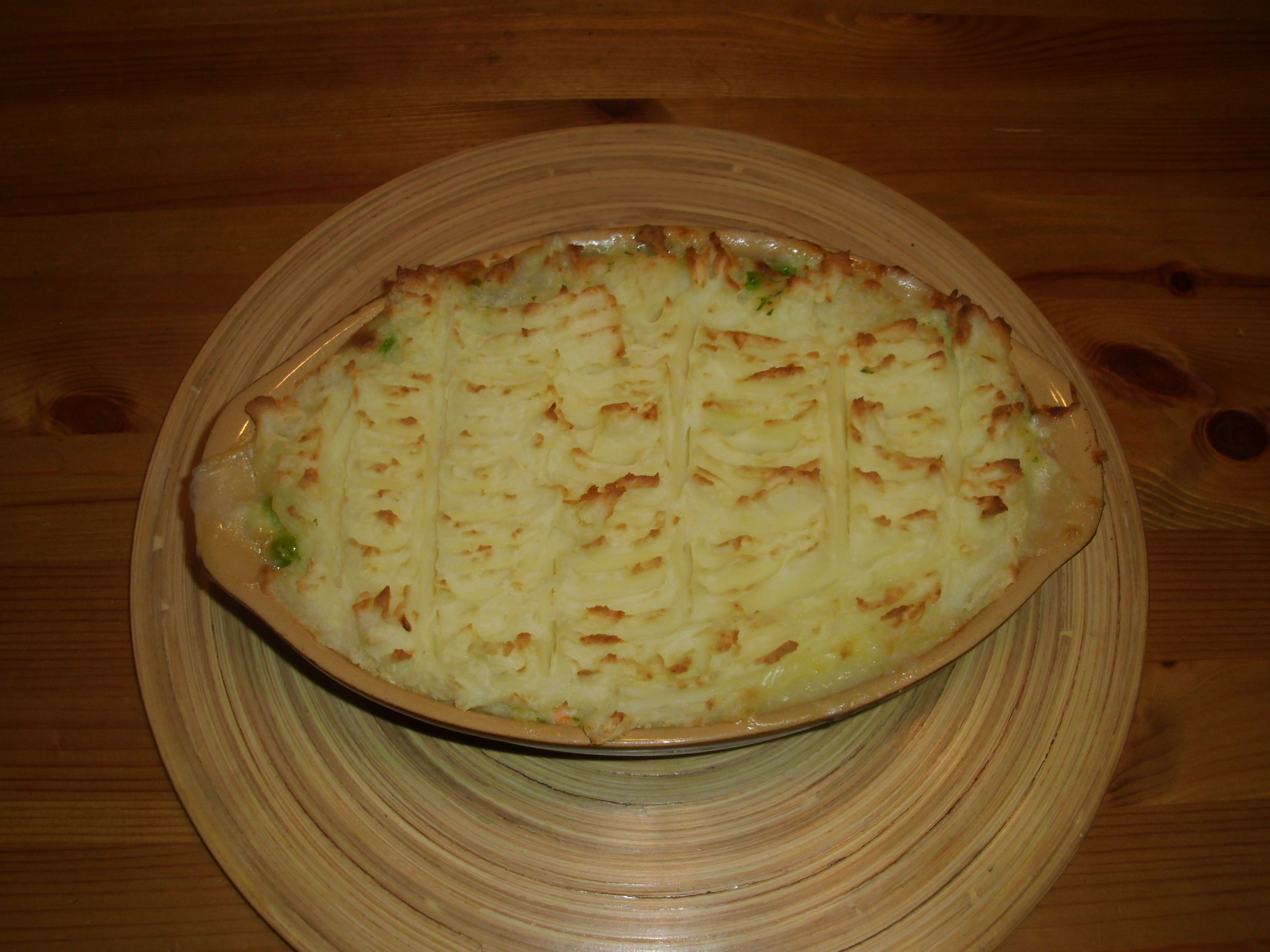
 There are all sorts of fish pie and I have tried loads of recipes but I still prefer the one I have been making for years.  It isn’t complicated and does not contain a lot of fat, it’s just great comfort food.  I can always tell when a recipe is good as there is silence around the table when people are eating, broken with the occasional mmmm!  Last night, when we had this, was just such an occasion.  The best thing about this pie is you don’t need to get hung up on the contents.  Last night I make it with cod, salmon and prawns.  I never put boiled eggs in as some of my friends hate them and, I have to say, I struggle a bit when they are in a fish pie.  Some people don’t like prawns so if I am feeding them, I simply substitute the prawns with smoked haddock.  This works really well and gives the pie a great smoky flavour.

I thought todays food trivia could be about cod.  Cod is a really popular fish with dense white flesh and a mild flavour.  The livers are processed to make cod liver oil, an excellent source of vitamins A, D and E and omega 3 fatty acids.  I remember my Mum making me take cod liver oil tablets in the winter when I was a child.  I hated them, firstly because I couldn’t swallow them and, secondly because they repeated on me and left a foul taste in my mouth.  In the UK, cod is the main fish used in the traditional Fish and Chips, along with haddock, but due to popularity, cod is currently at risk of being over fished in the UK, Canada and most other Atlantic countries.  This has caused controversy dating back to 1990, since when various committees and Government Departments have tried to restrict the fishing of cod.  Thankfully, we are still able to buy it but it is now much more expensive than when I first made this fish pie.

Anyway, here is the recipe.  It is a meal in one so there is no need to add more vegetables when you serve it, unless you want to of course.

Fish Pie                                 Serves 4 (easily halved or doubled)

  • 250g/10oz white fish fillets (cod or haddock are best), skinned, checked for bones and cut into 2 inch pieces
  • 125g/5oz fresh salmon fillets, skinned, checked for bones and cut into 2 inch pieces
  • 125g/5oz smoked haddock, skinned, checked for bones and cut into 2 inch pieces
  • About 12 raw king prawns, all shell removed
  • 750ml/1.5 pts semi-skimmed milk
  • 50g/2oz unsalted butter
  • 50g/2oz plain flour
  • 1 onion, peeled and studded with 3-4 cloves
  • 3 tbsp chopped fresh parsley
  • 100g/4oz frozen peas

For the mashed potato topping

  • 1kg/2lbs potatoes (ones good for mashing)
  • knob of butter
  • a little milk
  1. Heat the oven to 200c/190c fan/gas 6.
  2. Cook the potatoes in salted water until tender.  Drain and mash down.  Add the butter and enough milk to make a soft but firm mash
  3. Put the studded onion and the milk in a pan, slowly bring to a simmer.  Continue to simmer for about 15 minutes.  Make sure the milk does not burn on the bottom of the pan as this will give it a bitter taste.
  4. Remove the milk from the heat, discard the onion and leave the milk to cool a little.
  5. In a separate pan, melt the butter then stir in the flour.  Cook over a low heat for a minute.  Slowly add the milk, stirring between each addition to prevent curdling.  When all the milk has been added bring slowly to a simmer, stirring, and cook until the sauce is thick and smooth.
  6. Add the fish and prawns to the sauce and simmer over a low heat for 5 minutes.  Gently stir in the chopped parsley and the peas, taking care not to break up the fish, and continue to cook for 1 more minute.
  7. Tip the fish and sauce into the bottom of an ovenproof dish.
  8. Top the fish sauce with the mashed potato then cook in the oven for about 25 minutes or until the top is browning and the sauce is bubbling underneath.
  9. Serve, but be careful, it will be very hot!

    This slideshow requires JavaScript.

Beef Stifatho, a fantastic Greek casserole!

1 Jun

  I remember the first time I ate this dish.  It was in Aegina, a small island not far from the Greek Mainland and the port of Piraeus.  I was in the company of good friends, the wine flowed and I ended up singing with a group of four Greeks, none of whom spoke English.  The owner of the restaurant, Costas,  gave up at 2 am, brought us a final jug of Retsina, turned off all the lights and left us to it.  What a great memory!

Stifatho is a rich casserole of braised meat, and varies from one Greek island to another, and probably one household to another!  Some prefer rabbit in the casserole but I prefer beef.  It’s not that I don’t like rabbit but the tiny bones can be a bit fiddley.  The recipe I love best is one I found in a book written by Pamela Westland, ‘A Taste of the Greek Islands’.  If you ever get the chance to read it you will love it. 

Costas serves his Stefatho with Krithiraki, a rice shaped pasta, sometimes known as orzo.  Whenever I have cooked this I do exactly the same.  My kids love it and I never have to worry about leftovers.  You can buy it in most large Supermarkets.  The recipe is absolutely perfect for dinner parties, especially served with the krithiraki, as most people will never have had it and, those that have, will relish the memories it brings back of sun-kissed beaches, golden sunsets and friendly Greek people.  It can be prepared ahead and reheats well, it can also be frozen. Perfect for busy people! 

First a bit about the island of Aegina.  Aegina is part of the Saronic Islands, alongside Hydra, Spetses and Poros.  It is a beautiful island, very fertile and green and full of pine and olive trees, pretty villages and lovely beaches.  For those interested, there are also archaeological monuments, such as the Temple of Aphaia.  Aegina is probably best known, however, for pistachio nuts.  They have been grown on the island for as long as records existed and, today, you can buy them prepared in so many ways, roasted and salted in shells, packed into jars of local honey, covered in caramel to make a nut brittle and in their local nougat, just to name but a few.  The island is only small and it is possible to see it all in one day if you hire a car.  If ever I was tempted to live abroad it would be a tough decision as to whether to go to Aegina or Lardos in Rhodes.  For now I am happy to visit all my friends as often as possible and recreate wonderful Greek dishes such as this one.

Beef Stifatho (Braised beef casserole)  Serves 4 – 6

  • 6 tbsp olive oil
  • 1kg (about 2 lbs) braising steak
  • 2 small onions, finely sliced
  • 3 cloves garlic, finely chopped
  • 4 tbsp tomato puree
  • 200 ml (6 fl oz) red wine
  • 3 tbsp red wine vinegar
  • 2tsp sugar
  • 1/2 tsp cloves
  • 1/2 tsp cumin seeds
  • 2 bay leaves
  • 2 inch cinnamon stick
  • salt and black pepper
  • 450g (1 lb) shallots
  • 1 tbsp lemon juice
  • 2 tbsp chopped parsley
  1. Set the oven to 170C/150C fan/gas 3.
  2. Heat half the oil in a flameproof casserole and fry the meat over a high heat, stirring, until it is browned all over.  Don’t overfill the pan or the beef will steam rather than sear.  Do it in batches if necessary, depending on the size of the pan.  Remove the meat with a slotted spoon and set aside.
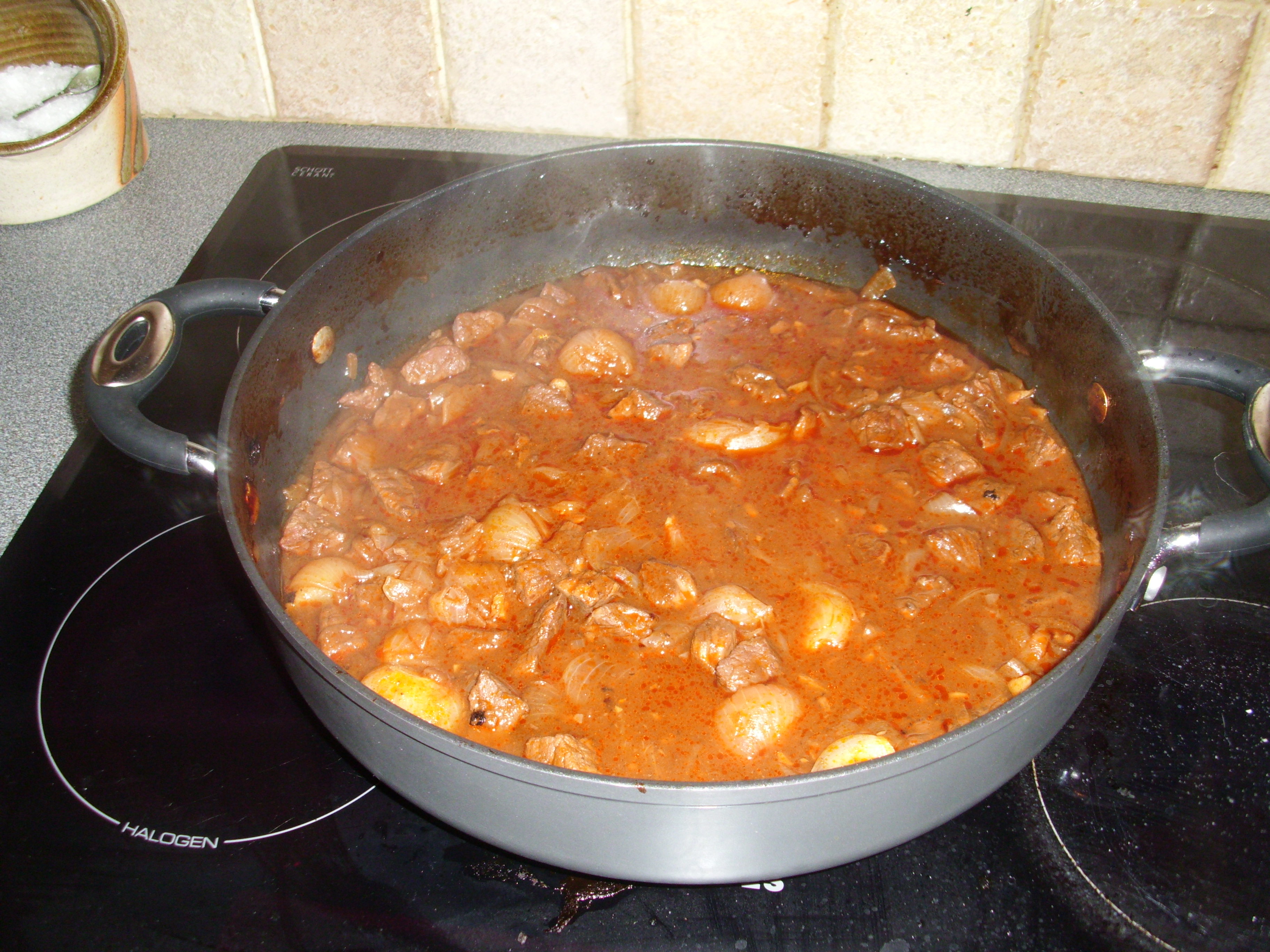
  3. Heat the remaining oil and fry the onions over a medium heat, stirring, until lightly browned.  Add the garlic and fry for a couple of minutes then add the tomato puree, vinegar, red wine and sugar.  Return the meat to the pan and mix well.  Put the cloves and cumin seeds either in a muslim cloth or a closed tea strainer.  Add to the dish with the cinnamon stick and bay leaves.  Season, cover and cook in oven for 1.5 hours.
  4. Blanch the shallots in boiling salted water for 1 minute.  Add to the casserole and continue to cook for 1 hour.  Check every now and again to ensure it is not going dry, if so, add a little water.
  5. When meat is tender, remove from oven.  Remove spices and bay leaves.  Stir in the lemon juice and sprinkle with the chopped parsley before serving.

    This slideshow requires JavaScript.

This can be made in a slow cooker. Add to slow cooker after steps 1 & 2. Cook on low for 6 hrs or high for 3 hours. Add the blanched shallots and continue cooking for 2 hrs on low or 1 on high. Check the shallots are tender then complete Step 5 before serving. Kali Orexi.