Archive | Pork RSS feed for this section

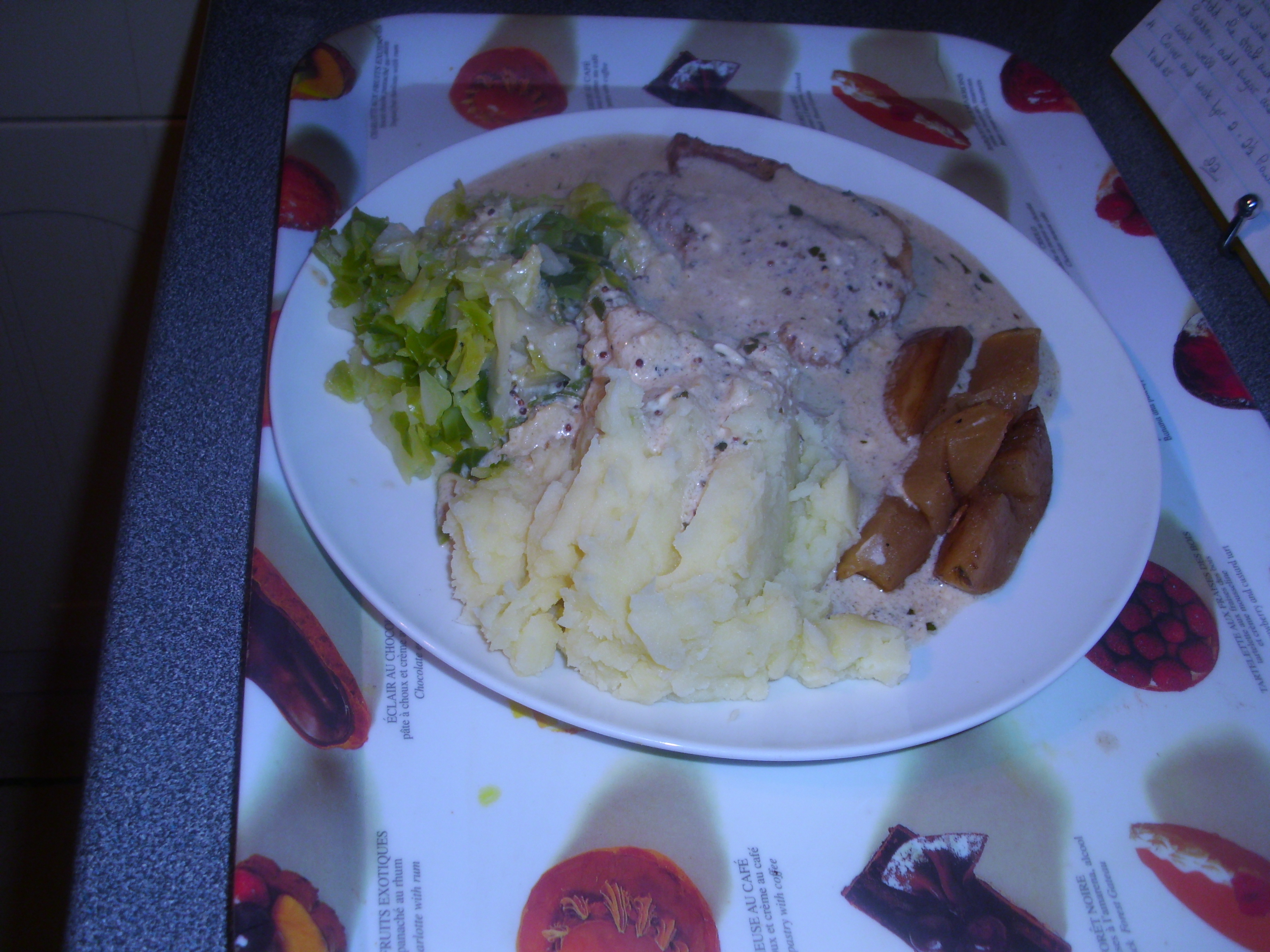
Pork chops with apples and sage – divine!

1 Apr

This recipe uses cider as the cooking liquor and I was a bit concerned it would be too sweet.  I shouldn’t have worried, it was absolutely gorgeous.  I served it with mashed potato and cabbage.  I think cabbage is a really underutilised vegetable and I have no idea why.  I often serve it with mashed potatoes and make sure I make more than I need so I can use up the leftovers in Bubble and Squeak for breakfast the following day.  Mmmmmm!!

Jason Atherton has recently presented in the BBC series, The Great British Food Revival.  His commentary stated that the cabbage, in particular the Hispi or pointed cabbage, is in crisis.  Sales of this type of cabbage have fallen by 71% and of cabbages in general by over 30% since the 1990’s.  The belief is that this wonderful vegetable is unpopular due to memories of school dinners, soggy cabbage, stinking cooking vapours and last, but not least, that it causes flatulence.  Mrs Beeton, no doubt the founder of the soggy, smelly cabbage, has stated in her cookery book that cabbage should be cooked for 45 minutes.Cabbage is also thought of as a winter vegetable, hence the decline in the sale of the summer growing Hispi.  The truth is, however, that today cabbages are grown all year round, so at any time you can select a cabbage that is seasonal and buy it from local producers.

Not only does the cabbage taste wonderful but it is also good for you.  Lincoln University have been doing studies on the health benefits of cabbage.  They have found that there is as much Vitamin C in 1 cabbage as there is in 1 orange.  They also contain Vitamin A which is good for eyesight and the greener the cabbage leaf, the more Vitamin A it will contain. Other studies have shown evidence that cabbages reduce cholesterol and protects against some types of cancer, whilst cabbage juice has anti-inflammatory properties.  The most recent studies show that red cabbage is good for memory loss and there are some suggestions that it may prevent the onset of Alzheimer’s.  All good reasons, I think, to eat more cabbage and follow the lead from Eastern European countries where it is part of their staple diet!

Jason did some fantastic cabbage recipes on the programme.  If you missed it you can watch it on the BBC iplayer.  Here is the link:

http://www.bbc.co.uk/iplayer/episode/b0178cf0/Great_British_Food_Revival_Series_Two_Herbs_and_Cabbage/

OK, here is the recipe.  I hope you love it as much as we do!

Pork chops with apples and cider                                Serves 4

  • 4 pork chops
  • 2 tbsp plain flour, seasoned with salt and black pepper
  • 1 tbsp olive oil
  • 1 tsp unsalted butter
  • 2 eating apples (Braeburn are good for this)
  • 250ml/9 fl oz dry cider
  • 1 tbsp chopped sage
  • 100ml/3 fl oz low fat creme fraiche
  • 1 tsp wholegrain mustard
  1. Heat the oven to 160C/150C fan/gas 3.  Lightly coat the chops in the flour.  Heat the oil and butter in a frying pan.  When the butter is dissolved fry the chops on both sides for a couple of minutes until golden brown.  Transfer to a shallow, ovenproof dish.
  2. Quarter and core the apples then cut into half to make 16 wedges.  Lower the heat in the pan then fry the apples until golden on both sides.  Arrange around the chops.
  3. Deglaze the pan with the cider then pour over the chops.  Cover the dish with foil and cook in the oven for 45 minutes to 1 hour, dependant on the thickness of the chops, or until the pork is tender and the apples are cooked.
  4. Transfer the pork and apples to a serving plate and keep warm.  Return the cooking liquor to the pan and add the sage.  Bring to the boil and reduce by half.  Take the sauce off the heat and stir in the creme fraiche and mustard.  Simmer for a few minutes then pour over the chops and serve. 

    This slideshow requires JavaScript.

Pork ribs – meltingly tender!

9 Jul

My husband said these were the best spare ribs he has ever tasted.  You may not know it, but that is a huge compliment as he has had some fantastic spare ribs in his time.  The ones we had in America when we lived there were incredible and the ones swerved in Fado Rock, Fuerteventura were almost as good, but the best we have eaten out have to be at Roulas Restaurant in Lardos, Rhodes.  I think I agree with him though, these were better than any of those.  The meat just fell off the bone and the flavour was incredible.

The recipe was adapted from one of John Torode’s and it introduced me, for the first time, to Chipotle Tabasco.  I thank him for that as it is a wonderful discovery, a really smoky chilli flavour.  Fantastic!

Chipotles impart a relatively mild but earthy spiciness to many dishes in Mexican cuisine. The chiles are used to make various salsa. Chipotle can be ground and combined with other spices to make a meat marinade called adobo.

Most chipotle chiles are produced in the northern Mexican state of Chihuahua. This variety of chipotle is known as a morita (Spanish for small [mulberry]). In central and southern Mexico, chipotle chiles are known as chile meco, chile ahumado, or típico. Whereas moritas from Chihuahua are purple in color, chile meco is tan/grey in color and has the general appearance of a cigar butt. Most chipotle chiles found in the United States are of the morita variety. Almost all of the chipotle meco is consumed in Mexico.

Chipotles are purchased in various forms, including chipotle powder, chipotle pods, chipotles en adobo in a can, concentrated chipotle base and wet chipotle meat marinade.

Chipotles have heat, but also a distinctive smoky flavor. The flesh is thick and so the chile is best if used in a slow-cooked dish rather than raw. Add whole chipotles to a soup, stew or in the braising liquid for meats. Chipotles are an accompaniment to beans or lentils.

Well, here is the recipe.  It is easy and delicious.  I hope you give it a go.  I could not find the original recipe on the internet so here is how I made them.

Pork ribs                                                      Serves 4

  • 2 lbs of spare ribs, either in a rack or separate
  • 1 tbsp mustard powder
  • 1 tbsp mild chilli powder
  • 1 tbsp tomato ketchup with chilli
  • 1 tbsp soft brown sugar
  • 3 tbsp chipotle tabasco
  • 1 tbsp cider vinegar
  • 4 tbsp clear honey
  • 2 tbsp tomato ketchup
  1. Preheat the oven to 190C/170C fan/gas 5.
  2. Mix together the mustard, chilli powder, tomato and chilli ketchup and the sugar.  Rub the paste into the meaty parts of the ribs then lay the ribs in a singles layer in a shallow baking tray.  Pour 125ml water into the bottom of the baking tray then cover the whole thing with foil.  Bake in the oven for 1 hour 30 minutes or until the meat is really tender.  Remove from the oven and pour off any liquid.
  3. Turn up the oven to 110C/200C fan/Gas 7.  Combine the chipotle tabasco, cider vinegar, honey and tomato ketchup in a bowl.  Brush all over the meat and return to the oven for a further 10 minutes.  Remove and serve immediately.

    This slideshow requires JavaScript.

Paella for a friend.

12 Feb

A friend has asked me to make a Paella dish that does not contain seafood.  I love Paella and often choose it when we are eating out on holiday in Spain.  It can be hit or miss though and, when watching cooking demonstrations in Fuerteventura, I can see why!  It seems adding the ingredients is an exact science.  I am quite nervous that this is going to turn out like a sticky mass.  Still, always up for a challenge!! The first time I had Paella was in 1991, cooked on a wooden fire, on the beach in Nerja.  The cook, Chiringuito Ayo, has been making massive dishes of paella in this way for over 40 years.  Chiringuito is quite famous in Nerja.  When he was a boy, in 1959, he was playing with some friends from his village, Maro, when they climbed through a small hole and discovered the famous Caves of Nerja.  Imagine their surprise when they were confronted with this! The dish originated in the Valentia Region of Spain and is typically made in a large, shallow pan called a paellera.  Making paella is often a man’s activity in Spain.  I suppose this equates to barbecues in the UK, as they make it outdoors on an open fire made of orange and pine wood.  The one thing that appears to come through from my research, is that the recipe is adapted to suit personal taste, with the exception of a few key ingredients.  The Spanish make it look so easy!  I remember this chef doing a cooking demonstration in our hotel once.  The paella was delicious! Well, I’ve dusted off my paella pan that I bought in 1991 and have never used, and here goes.  I have chosen a variety of meats for this recipe.  If you choose to make it, you can add or omit, according to your own taste.  You can also add raw prawns and fresh mussels to make a mixed paella, but leave these until the last 5 minutes of cooking or they will be overcooked.  You will need special rice for this and it must be short grain.  I could not find Paella Rice so I used Carnaroli.  I made mine on the barbecue.  You will need a kettle barbecue and we let the coals burn for 15 minutes before we started cooking (you don’t have to let the coals go grey). The recipe below is for those who do not have a barbecue, just keep the same cooking times if you do! Meat Paella   Serves 4 (hungry people)

  • 12 oz (350g) rice
  • 2 tbsp olive oil
  • 4 chicken thighs, bone in, cut in half
  • 8 oz (225g) sirloin steak, fat removed, cut into 1 inch cubes
  • 8 oz (225g) tenderloin pork, fat removed, cut into 1 inch cubes
  • 4 oz (110g) raw chorizo sausage, cut into 1/2 inch dice
  • 1 large onion, peeled and roughly chopped
  • 1 red pepper, deseeded and cut into 1/2 inch pieces
  • 2 cloves garlic, peeled and crushed
  • 1 heaped tsp paprika
  • 1/4 level tsp cayenne pepper
  • 1/2 level tsp saffron strands
  • 8 oz (225g) ripe tomatoes, skinned and roughly diced
  • 20z (50g) frozen peas
  • Salt and pepper
  • 1 lemon, cut into wedges to garnish
  1. Prepare everything as per ingredient list before you start making the paella, you will not have time to mess about between each step!
  2. Heat the oil in the pan over a fairly high heat.  Season the chicken and add to pan, saute on all sides until golden brown.  Remove and set aside.  Do the same with the beef and lastly the pork.
  3. Next, add the onion, pepper and chorizo and fry these over a medium heat for 6-8 minutes, or until they are browning at the edges.  Add the garlic, paprika, cayenne and saffron and cook for another minute, making sure the garlic does not burn.  Return the meat to the pan, followed by the tomatoes, plenty of seasoning and 2 pints (1.2 litres) of boiling water.  Bring everything to a gentle simmer, turn down the heat and cook, uncovered, for 10 minutes.
  4. Push the meat to the edges of the pan and pour the rice into the centre.  Bring everything back to the boil, give it a stir so all the rice is covered by liquid, and simmer, uncovered for about 10 minutes. Shake the pan occasionally to distribute the rice and make sure it is evenly cooked
  5. Add the peas and continue to simmer for 10 minutes until the moisture has been absorbed.  Remove from the heat and cover with a clean tea towel for 5 minutes to absorb the steam.
  6. Serve with lemon wedges.

    This slideshow requires JavaScript.